Ownership and Management

EKONOMIKA SYARIAH • JOURNAL GOVERNANCE

Ownership and Management

Publishing institution, editorial governance, financial separation, and public accountability.

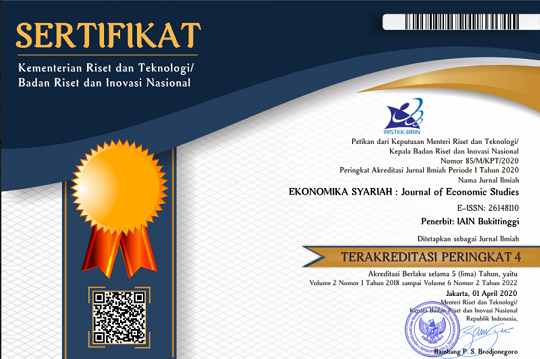
Publisher: Universitas Islam Negeri Sjech M. Djamil Djambek Bukittinggi, Indonesia  •  Current accreditation: SINTA 3.

1Journal Identity

Element Current Information
Journal EKONOMIKA SYARIAH: Journal of Economic Studies
Publisher Universitas Islam Negeri Sjech M. Djamil Djambek Bukittinggi
p-ISSN / e-ISSN 2614-7890 / 2614-8110
DOI Prefix 10.30983/es
Publication Frequency Two issues annually: June and December
National Accreditation SINTA Rank 3 (current status, 2026)

2Publishing Institution and Organizational Responsibility

Universitas Islam Negeri Sjech M. Djamil Djambek Bukittinggi is the publishing institution responsible for the journal’s organizational framework, publishing infrastructure, and institutional accountability. Journal publishing services are supported within the university’s scholarly-publishing ecosystem, including Rumah Jurnal, while scientific assessment and manuscript decisions remain under the authority of the appointed editorial team.

Institutional affiliations of editors and reviewers identify their professional affiliations and do not imply ownership of the journal or institutional influence over individual editorial decisions.

3Editorial Governance

The journal is managed through defined editorial roles consisting of the Editor-in-Chief, Managing Editor, Associate Editors, Editorial Board, and independent peer reviewers. The Editor-in-Chief is responsible for overall scientific quality and final editorial decisions. Managing and associate editors coordinate screening, peer review, communication, production, and publication workflows according to delegated responsibilities.

Editors must recuse themselves from manuscripts where a conflict of interest could reasonably affect, or appear to affect, impartiality.

4Editorial Independence

Editorial decisions are based on scholarly merit, methodological quality, originality, relevance to the journal’s scope, ethical compliance, and peer-review evidence. Decisions must not be influenced by institutional position, nationality, personal relationships, commercial interests, citation expectations, or payment of publication charges.

5Financial and Administrative Separation

The journal may charge the published Article Processing Charge stated on its official APC page. Payment administration must be separated from manuscript assessment. Authors are never guaranteed acceptance in exchange for payment, and editors or reviewers must not request personal payments, gifts, citations, or other benefits in return for favorable decisions.

All legitimate payment instructions must be communicated through an official invoice or designated institutional channel.

6Accountability and Public Information

The publisher and editorial leadership are responsible for keeping the journal’s public information accurate and current, including editorial appointments, reviewer information, APCs, publication frequency, contact details, accreditation, indexing, licensing, and ethical policies. Material changes should be updated promptly across the OJS website, institutional journal portal, and relevant indexing metadata.

Governance wording is aligned with transparency principles in scholarly publishing and the Indonesian 2026 accreditation environment; reference to external principles does not imply organizational membership.