About the Journal

EKONOMIKA SYARIAH • JOURNAL INFORMATION

About the Journal

Advancing scholarship in Islamic economics, finance, and business

Journal Overview

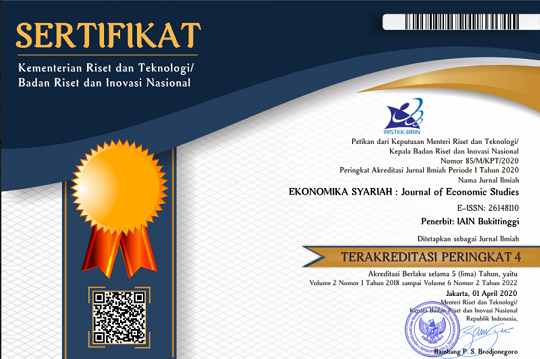
EKONOMIKA SYARIAH: Journal of Economic Studies is a peer-reviewed, open-access scholarly journal published by Universitas Islam Negeri Sjech M. Djamil Djambek Bukittinggi, Indonesia. It provides a platform for original research and critical academic discussion in Islamic economics, finance, and business, bringing together theoretical perspectives, empirical evidence, and policy-relevant scholarship.

The journal examines economic institutions, financial systems, markets, enterprise, and socioeconomic development through the analytical and ethical foundations of Islamic economics. It welcomes scholarship that advances understanding of contemporary economic challenges while making a clear and substantive contribution to the field.

Mission and Scholarly Contribution

The journal aims to strengthen Islamic economic knowledge by promoting rigorous inquiry into economic behaviour, institutional performance, governance, and public policy. Its editorial orientation connects Islamic economic thought with contemporary research methods, critical analysis, and evidence-based recommendations.

Through national and international scholarly exchange, EKONOMIKA SYARIAH seeks to inform academic debate and professional practice in ways that support economic justice, institutional accountability, financial inclusion, community welfare, and sustainable development. Interdisciplinary research is welcome when its relevance to Islamic economic theory, institutions, policy, or practice is explicit and central to the study.

Research Coverage

The journal’s principal areas of scholarship include the following interconnected fields. A more detailed description of topical boundaries and eligibility criteria is available in the Focus and Scope section.

01Islamic Economic Thought and Policy

Islamic economic principles, maqasid al-Shariah, distributive justice, governance, welfare, and policy evaluation.

02Islamic Banking, Finance, and Capital Markets

Banking performance and resilience, Sharia governance, financial regulation, sukuk, Islamic equities, and investment risk.

03Zakat, Waqf, and Islamic Social Finance

Islamic philanthropy, social finance institutions, poverty alleviation, resource mobilisation, and programme effectiveness.

04Halal Business and Community Empowerment

The halal economy, Islamic entrepreneurship, ethical business, Islamic microfinance, MSME financing, and economic inclusion.

05Digital and Sustainable Islamic Economy

Islamic fintech, digital financial services, financial literacy, responsible finance, ESG-related practices, and sustainable development.

Editorial Quality and Research Integrity

Manuscripts are initially assessed for relevance, originality, scholarly contribution, and compliance with the journal’s submission requirements. Eligible research articles proceed through independent, double-anonymous peer review, in which reviewers evaluate the appropriateness of the methods, quality of evidence, clarity of argument, and contribution to Islamic economic scholarship. Editorial decisions take reviewers’ assessments into account and remain the responsibility of the journal’s editors.

The journal is committed to responsible scholarly publishing and expects authors, editors, and reviewers to uphold research integrity, accurate attribution, transparent reporting, and appropriate disclosure of relevant interests. Detailed requirements are provided in the journal’s Author Guidelines and other published editorial policies.

Open Access and Scholarly Dissemination

EKONOMIKA SYARIAH provides immediate open access to its published articles to support the broad dissemination, reading, and use of scholarly research. The journal identifies the Creative Commons Attribution–ShareAlike 4.0 International (CC BY-SA 4.0) licence as its licensing framework. Readers and authors should consult the journal’s Licensing Terms for the applicable conditions.

Publication Profile

Publisher: Universitas Islam Negeri Sjech M. Djamil Djambek Bukittinggi, Indonesia

Publication schedule: Two issues per year, designated June and December

Languages: English and Bahasa Indonesia

Peer review: Editorial screening followed by double-anonymous peer review for eligible research articles

Access model: Immediate open access

DOI prefix: 10.30983/es (Crossref)

Intended Readership

The journal serves researchers, university academics, postgraduate students, policymakers, regulators, Islamic banking and finance professionals, managers of zakat and waqf institutions, halal-industry stakeholders, entrepreneurs, and practitioners seeking research-informed perspectives on Islamic economic development.

Further Journal Information

For detailed editorial policies and publication requirements, please consult the following official pages:

• Focus and Scope

• Author Guidelines

• Editorial Team

• Submissions

• Article Processing Charges

• Journal Contact