ADDITIONAL MENU
About the Journal
About the Journal
Islam Realitas: Journal of Islamic and Social Studies is a peer-reviewed, open-access scholarly journal published by Universitas Islam Negeri Sjech M. Djamil Djambek Bukittinggi, West Sumatra, Indonesia, and managed by Rumah Jurnal (Scholarly Publishing Center).
The journal is devoted to the interdisciplinary study of Islam as a lived social reality and of Muslim societies in processes of social transformation. It provides a scholarly platform for examining how Islamic beliefs, practices, values, institutions, authorities, identities, and discourses are produced, experienced, negotiated, contested, and transformed within everyday life and the public sphere.
Islam Realitas particularly encourages theoretically informed and empirically grounded research that connects local Muslim experiences with broader scholarly debates in Islamic studies, the social sciences, and the humanities.
While welcoming scholarship from diverse geographical contexts, the journal has a particular interest in Muslim societies in Southeast Asia and the Global South, while also encouraging comparative, cross-regional, transnational, and diaspora studies that contribute to broader scholarly debates on Islam and contemporary society.
Scholarly Coverage
The journal publishes original research addressing the intersections between Islam, Muslim societies, and social transformation, including research on:
- Lived religion, everyday Islam, religious practices, and Muslim social life;
- Religious authority, Islamic institutions, organizations, movements, and networks;
- Islam, politics, citizenship, governance, democracy, and the public sphere;
- Islam, law, and socio-legal transformation;
- Muslim identities, gender, family, youth, minorities, migration, and diaspora;
- Interreligious relations, religious diversity, pluralism, conflict, reconciliation, and peacebuilding;
- Islam, media, digital culture, technology, and popular culture;
- Islamic economic practices, philanthropy, work, entrepreneurship, and socioeconomic change;
- Muslim communities, education, knowledge production, and transformations of religious authority;
- Islam, local cultures, arts, heritage, literature, and changing forms of religious expression;
- Islam, environment, development, and emerging social challenges affecting Muslim societies;
- Historical studies that illuminate the formation and transformation of Muslim societies and institutions; and
- Comparative and transnational studies of Islam and Muslim societies across different social, cultural, and political contexts.
The journal welcomes qualitative, quantitative, historical, comparative, ethnographic, and interdisciplinary research. Priority is given to manuscripts that critically engage with relevant scholarly debates and demonstrate a clear theoretical, empirical, or methodological contribution to the understanding of Islam and Muslim societies.
Studies primarily concerned with theological, doctrinal, textual, educational, legal, economic, or literary issues are considered when they establish a substantive connection between their subject matter and the broader social realities, institutions, practices, or transformations of Muslim societies.
Journal Information
| Journal Title | Islam Realitas: Journal of Islamic and Social Studies |
| Journal Abbreviation | J. Islam. Soc. Stud. |
| e-ISSN | 2477-1201 |
| p-ISSN | 2477-1309 |
| Publisher | Universitas Islam Negeri Sjech M. Djamil Djambek Bukittinggi |
| Journal Management | Rumah Jurnal (Scholarly Publishing Center), Universitas Islam Negeri Sjech M. Djamil Djambek Bukittinggi |
| Editor-in-Chief | Prof. Dr. Syafwan Rozi, M.Ag. |
| Managing Editor | Firdaus Annas, S.Pd., M.Kom. |
| Publication Frequency | Biannual — two issues per year |
| Publication Schedule | June and December |
| Publication Language | English |
| Peer Review | Double-anonymous peer review |
| Access Model | Open Access |
| License | Creative Commons Attribution-ShareAlike 4.0 International (CC BY-SA 4.0) |
| DOI Prefix | 10.30983 |
| Journal Website | https://ejournal.uinbukittinggi.ac.id/Islam_realitas |
Accreditation and Indexing
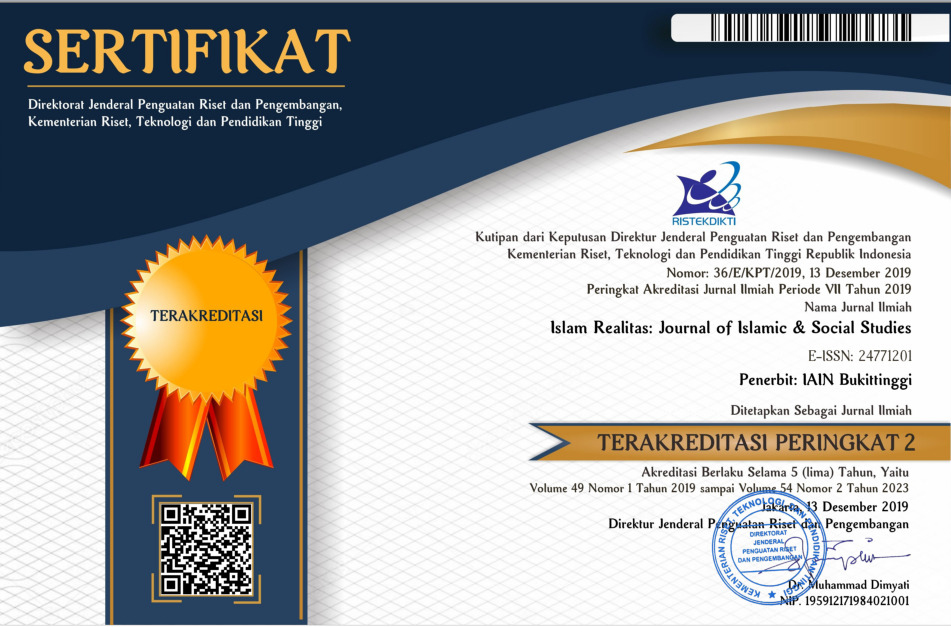
Islam Realitas: Journal of Islamic and Social Studies is nationally accredited SINTA 2 and is covered by scholarly indexing, abstracting, and discovery services including:
DOAJ (Directory of Open Access Journals), EBSCO, GARUDA, MORAREF, Google Scholar, Dimensions, and ROAD.
Digital Object Identifiers (DOIs) for published articles are registered through Crossref.
Publication and Open Access
Islam Realitas is published twice a year, in June and December. All published articles are made immediately and permanently available to readers under an open-access model.
The journal applies the Creative Commons Attribution-ShareAlike 4.0 International (CC BY-SA 4.0) license, allowing published works to be read, shared, and reused in accordance with the terms of the license.
Peer Review
All manuscripts submitted to Islam Realitas undergo an editorial screening process to assess their relevance to the journal's focus and scope, scholarly quality, originality, and compliance with the journal's author guidelines.
Manuscripts that pass the initial editorial assessment are evaluated through a double-anonymous peer-review process by reviewers with relevant expertise. The final decision regarding publication is made by the editorial team based on the manuscript's scholarly contribution, reviewers' recommendations, and conformity with the journal's editorial standards.
Journal History
The current publication series of Islam Realitas: Journal of Islamic and Social Studies began in 2015, continuing the scholarly publication previously known as Islam dan Realitas Sosial. Since then, the journal has developed as a scholarly venue for research examining Islam and Muslim societies through interdisciplinary perspectives.
Through its current editorial direction, Islam Realitas seeks to strengthen its distinctive scholarly identity around the study of Islam as a lived social reality, Muslim societies, and processes of social transformation , while fostering dialogue between locally grounded research and wider scholarly debates.