Peer Review Process

PEER REVIEW

Peer Review Process

Double-anonymous, independent, substantive peer review
Peer review exists to test the scholarly reliability and contribution of a manuscript. It must remain independent, confidential, documented, and free from AI-assisted manuscript assessment by reviewers.

Review model

Islam Realitas uses double-anonymous peer review: reviewers are not informed of author identities through the review manuscript, and authors are not informed of reviewer identities. The editorial office takes reasonable steps to remove identifying information, although anonymity cannot be guaranteed when authors reveal themselves through citations, repositories, preprints, or other public materials.

Process

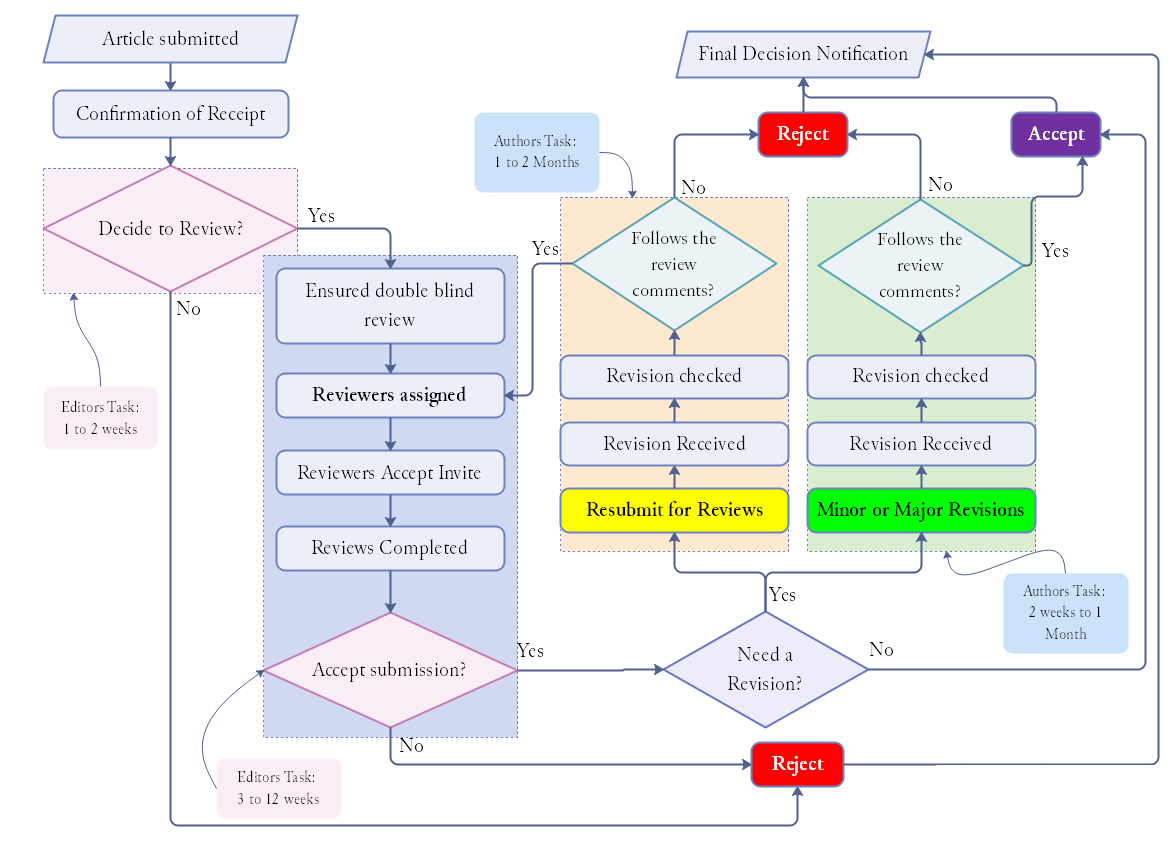
  1. Technical and editorial screening. The editorial office checks completeness, anonymization, ethics, declarations, scope, originality, and minimum scholarly quality. Manuscripts may be declined without external review when they clearly fail these requirements.
  2. Reviewer selection. The handling editor appoints at least two independent reviewers with relevant expertise, a suitable recent publication record, and no material conflict of interest. Reviewer identities and affiliations must be valid and used with consent.
  3. Independent review. Reviewers assess the manuscript's scholarly problem, originality, literature engagement, conceptual framing, methods/analytical approach, evidence, interpretation, ethical integrity, and contribution. Review must be substantive and constructive, not limited to grammar or layout.
  4. Additional review. A third reviewer or additional expert may be appointed when reports materially conflict, specialized expertise is needed, or integrity concerns require further assessment.
  5. Decision. The Editor-in-Chief or authorized handling editor decides reject, major revision, minor revision, or accept. Reviewer recommendations inform but do not mechanically determine the editorial decision.
  6. Revision. Authors must respond point-by-point and explain changes. A revised manuscript may be returned to reviewers when necessary.
  7. Final assessment. Acceptance is granted only when scholarly and ethical requirements are satisfied. Payment, sponsorship, nationality, institutional origin, and non-academic pressure must not influence the decision.

Expected review standards

Number of reviews
Normally at least two independent substantive reviews per manuscript.
Turnaround
Review deadlines are stated in the invitation. A standard target of 21 calendar days is recommended for adoption if operationally sustainable; extensions require editor approval.
Confidentiality
Manuscripts, supplementary files, reviewer reports, and editorial correspondence are confidential.
AI prohibition
Reviewers are strictly prohibited from using AI to analyze, evaluate, summarize, score, or draft comments on a manuscript, and from uploading any manuscript content to AI systems.

Reviewer independence and conflicts

A reviewer must decline or disclose any relationship that could reasonably affect impartiality, including close collaboration, recent co-authorship, supervisory relationships, personal disputes, direct competition, financial interests, or other relevant ties. Editors must document reviewer assignment and review evidence in OJS.

Blind-review safeguard
The journal may publish a general reviewer roster, but should not publicly identify the reviewer of a specific article or issue when doing so would compromise anonymity. Reviewer evidence remains available internally for audit and accreditation purposes.
Governance basis: Permendiktisaintek No. 9 of 2026; Directorate General of Science and Technology Decision No. 374/DST/D.D1/HM.01.01/2026; COPE Core Practices; and the Principles of Transparency and Best Practice in Scholarly Publishing (Version 5, 2026).