High School Teachers’ Performance in Term of Transformational Leadership and Principle Supervision Competencies
DOI:
https://doi.org/10.30983/educative.v6i2.4791Keywords:
Transformational Leadership, Supervision Competence, PerformanceAbstract
References
Aprison, Wedra, ‘Pengaruh Persepsi Motivasi, Iklim Kerja, Dan Kepemimpinan Terhadap Produktivitas Dosen Di Sekolah Tinggi Agama Islam Negeri Bukittinggi’, Pusaka Media Design, 2018, 78
Depdiknas, ‘Undang-Undang Republik Indonesia Nomor 20 Tahun 2003 Tentang Sistim Pendidikan Nasional Pasal 39 Ayat 1 Dan 2’, Citra Umbara, 2003
Firmanti, Pipit dan Fauzi Yuberta, ‘Changes in The Matematics Learning Process During The Covid-19 Pandemic at Junior High School in Bukittinggi’, Jurnal Educative: Journal of Education Studies, 6 (2021), 60
Junaidi, ‘Pengaruh Gaya Kepemimpinan Transformasional Kepala Sekolah Terhadap Keberhasilan Pelaksanaan MBS Pada Pesantren-Pesantren Di Kabupaten Agam’, Jurnal Educative: Journal of Education StudiesEducative, 2 (2017), 6
Junaidi, Dr., ‘Pengaruh Kepemimpinan Transformasional Kepala Sekolah Dan Profesionalisme Guru Terhadap Implementasi MBS Pada Pesantren Di Kabupaten Agam’, ISLAM TRANSFORMATIF : Journal of Islamic Studies, 2018 <https://doi.org/10.30983/it.v2i1.437>
Kharis, Indra, ‘Pengaruh Gaya Kepemimpinan Tranformasional Terhadap Kinerja Karyawan Dengan Motivasi Kerja Sebagai Variabel Intervening’, Jurnal Administrasi Bisnis, 3 (2015), 2
M., Berry L. and Gouston J. P., Psychology at Work: An Introduction and Industrial and Organisational Psychology (New York: MC. Grew Hill International, 1993)
Mangkunegara, A. A. Anwar Prabu, Evaluasi Kinerja SDM (Bandung: Refika Aditama, 2007)
Mulyasa, Enco, Menjadi Kepala Sekolah Yang Profesional, Bandung: Remaja Rosdakarya (Bandung: Remaja Rosda Karya, 2014)
Nugroho, Febry Adi, and Marzuki Marzuki, ‘Pengaruh Motivasi Kerja Dan Kepemimpinan Kepala Sekolah Terhadap Kinerja Guru IPS Bersertifikat Pendidik’, Harmoni Sosial, 6 (2019), 113
Pemerintah RI, ‘Peraturan Pemerintah Republik Indonesia Nomor 19 Tahun 2005 Tentang Standar Nasional Pendidikan’, Standar Nasional Pendidikan, 2005
Pidarta, Made, Supervisi Pendidikan Kontekstual (Jakarta: Rineka Cipta, 2009)
Rivai, Veithzal dan Sylviana Murni, Education Management: Analisis Teori Dan Praktek (Jakarta: Rajawali, 2009)
Satori, Djam’an, Supervisi Akademik: Teori Dan Praktek (Jakarta: Dekdikbud Dithjen Disdasmen, 1996)
Siagian, Sondang P., Kiat Meningkatkan Produktivitas Kerja (Jakarta: Rineka Cipta, 2009)
Susanto, ‘The Impact of Covid-19 Pandemic on Mental Condition And The Need For Psychological Support of Student in Jakarta’, Jurnal Educative: Journal of Education Studies, 6 (2021)
Syahrudin, Asep, ‘Pengeruh Kepemimpinan Transformasional Dan Iklim Kerja Sekolah Terhadap Kinerja Mengajar Guru Di SMPN Kota Bandung’, Repository, 2 (2009)
Tinggi, Direktorat Jenderal Pendidikan, Manajemen Mutu Total Di PergruanTingi, (Jakarta, 1995)
Wahab, Abdul dkk, Kepemimpinan Pendidikan Dan Kecerdasan Spritual (Jogjakarta: Ar Ruzz Media, 2011)
Wayne, Hoy K., Educational Administration: Theory, Research, and Practice (USE: The Ohio University, 2001)
Werang, Basilius Redan, ‘Pengaruh Kepemimpinan Transformasional Kepala Sekolah, Moral Kerja Guru Dan Kepuasan Kerja Guru SDN Di Kota Merouke’, Jurnal Cakrawala Pendidikan, 2014 <https://doi.org/10.21831/cp.v1i1.1869>
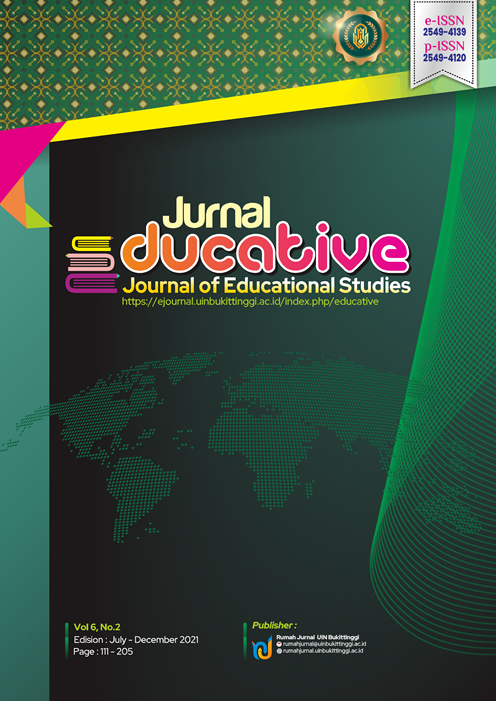
Downloads
Published
How to Cite
Issue
Section
Citation Check
License
Authors who publish with this journal agree to the following terms:
1. Authors retain copyright and grant the journal right of first publication with the work simultaneously licensed under a Creative Commons Attribution License that allows others to share the work with an acknowledgment of the work's authorship and initial publication in this journal.
2. Authors are able to enter into separate, additional contractual arrangements for the non-exclusive distribution of the journal's published version of the work (e.g., post it to an institutional repository or publish it in a book), with an acknowledgment of its initial publication in this journal.
3. Authors are permitted and encouraged to post their work online (e.g., in institutional repositories or on their website) prior to and during the submission process, as it can lead to productive exchanges, as well as earlier and greater citation of published work (See The Effect of Open Access).