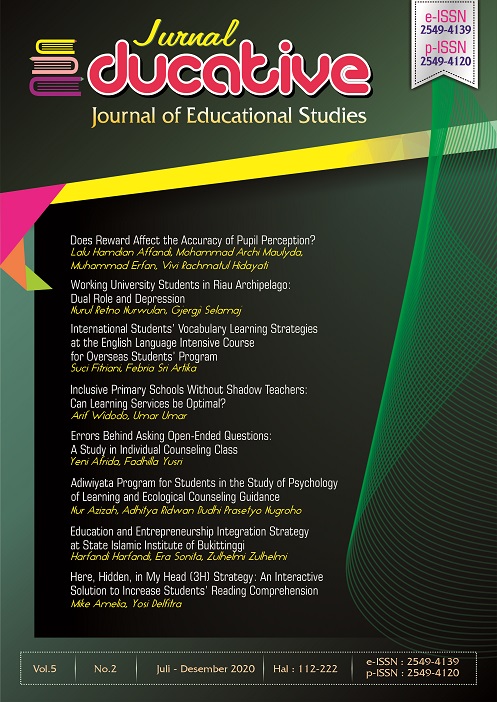
Adiwiyata Program for Students in the Study of Psychology of Learning and Ecological Counseling Guidance
DOI:
https://doi.org/10.30983/educative.v5i2.3689Keywords:
adiwiyata program, psychology of learning, ecological counseling guidanceAbstract
References
Book
Fahyuni, Eni Fariyatul, and Istikomah Istikomah. Psikologi Belajar & Mengajar (Kunci Sukses Guru Dalam Interaksi Edukatif). Sidoarjo: Nizamia Learning Center, 2016.
Kosmiyah, Indah. Belajar Dan Pembelajaran. Yogyakarta: Teras, 2012.
Nurjan, Syarifan. Psikologi Belajar. Edited by Wahyudi Setiawan. Ponorogo: Wade Group, 2016.
Journal
Adams, Sabirah, and Shazly Savahl. “Children’s Discourses of Natural Spaces: Considerations for Children’s Subjective Well-Being.†Child Indicators Research 10 (2017): p.423–446. https://doi.org/10.1007/s12187-016-9374-2.
Amsari, Dina, and Mudjiran. “Implikasi Teori Belajar E-Thorndike (Behavioristik) Dalam Pembelajaran Matematika.†Jurnal Basicedu 2, no. 2 (2018): p.52–60. https://doi.org/10.31004/basicedu.v2i2.168.
Annamma, Subini, and Deb Morrison. “DisCrit Classroom Ecology: Using Praxis To Dismantle Dysfunctional Education Ecologies.†Teaching and Teacher Education 73 (2018): p.70–80. https://doi.org/10.1016/j.tate.2018.03.008.
Anwar, Moh Khoerul, and Ruly Ningsih. “Faith-Base Communities (FBCs) in Ecological Counseling (EC) to Promote Well-Being (WB) in Millenial Era.†Counsellia: Jurnal Bimbingan Dan Konseling 9, no. 1 (2019). https://doi.org/10.25273/counsellia.v9i1.3209.
Bølling, Mads, Janni Niclasen, Peter Bentsen, and Glen Nielsen. “Association of Education Outside the Classroom and Pupils’ Psychosocial Well-Being: Results From a School Year Implementation.†Journal Of School Health 89, no. 3 (2019): p.210–18. https://doi.org/10.1111/josh.12730.
Bower, Isabella, Richard Tucker, and Peter G. Enticott. “Impact of Built Environment Design on Emotion Measured via Neurophysiological Correlates and Subjective Indicators: A Systematic Review.†Journal of Environmental Psychology p.66 (2019). https://doi.org/10.1016/j.jenvp.2019.101344.
Capaldi, Colin A., Holli-Anne Passmore, Elizabeth K. Nisbet, John M. Zelenski, and Raelyne L. Dopko. “Flourishing in Nature: A Review of the Benefits of Connecting with Nature and Its Application as a Wellbeing Intervention.†International Journal of Wellbeing 5, no. 4 (2015). https://doi.org/10.5502/ijw.v5i4.449.
Duchi, Lorenzo, Doug Lombardi, Fred Paas, Sofie M M, and Loyens. “How a Growth Mindset Can Change the Climate: The Power of Implicit Beliefs in Influencing People’s View and Action.†Journal of Environmental Psychology 70 (2020). https://doi.org/10.1016/j.jenvp.2020.101461.
Harvey, Deborah J, Louise N. Montgomery, Hannah Harvey, Felix Hall, Alan C. Gange, and Dawn Watling. “Psychological Benefits of a Biodiversity-Focussed Outdoor Learning Program for Primary School Children.†Journal of Environmental Psychology 67 (2020). https://doi.org/10.1016/j.jenvp.2019.101381.
Heft, Harry. “Perceptual Information of ‘An Entirely Different Order’: The ‘Cultural Environment’ in The Senses Considered as Perceptual Systems.†Ecological Psychology 29, no. 2 (2017): p.122–45. https://doi.org/10.1080/10407413.2017.1297187.
Hughes, Joelene, Miles Richardson, and Ryan Lumber. “Evaluating Connection to Nature and the Relationship with Conservation Behaviour in Children.†Journal for Nature Conservation 45 (2018): p.11–19. https://doi.org/10.1016/j.jnc.2018.07.004.
Indonesia, Menteri Lingkungan Hidup dan Kehutanan Republik. Peraturan Menteri Lingkungan Hidup dan Kehutanan Republik Indonesia (2019).
Peraturan Menteri Lingkungan Hidup dan Kehutanan Republik Indonesia No. P.52/MENLHK/SETJEN/KUM.1/9/2019 Tentang Gerakan Peduli dan Berbudaya Lingkungan Hidup di Sekolah.
Iswari, Rizky Dewi, and Suyud W. Utomo. “Evaluasi Penerapan Program Adiwiyata Untuk Membentuk Perilaku Peduli Lingkungan Di Kalangan Siswa (Kasus: SMA Negeri 9 Tangerang Selatan Dan MA Negeri 1 Serpong).†Jurnal Ilmu Lingkungan 15, no. 1 (2017): p.35–41. https://doi.org/10.14710/jil.15.1.35-41.
Kelz, Christina, Gary William Evans, and Kathrin Röderer. “The Restorative Effects of Redesigning the Schoolyard: A Multi-Methodological, Quasi-Experimental Study in Rural Austrian Middle Schools.†Environment and Behavior 47, no. 2 (2015). https://doi.org/10.1177/0013916513510528.
Limawati, Limawati. “Implementasi Program Sekolah Adiwiyata Di Sekolah Dasar.†Wiyata Dharma: Jurnal Penelitian Dan Evaluasi Pendidikan 6, no. 1 (2018): p.20–24. https://doi.org/10.30738/wd.v6i1.3355.
Lina, Marsiana, Masluyah Suib, and Usman Radiana. “Pengelolaan Sekolah Adiwiyata Oleh Kepala Sekolah Di Sekolah Menengah Pertama Negeri 02 Ngabang, Jurnal Pendidikan Dan Pembelajaran Khatulistiwa.†Jurnal Pendidikan Dan Pembelajaran Khatulistiwa 5, no. 10 (2016): p.1–17. https://jurnal.untan.ac.id/index.php/jpdpb/article/view/17009.
Maharani, Laila. “Dukungan Ekologi Berbasis Perkembangan Sosial Untuk Meningkatkan Kemampuan Keterampilan Sosial Anak.†KONSELI : Jurnal Bimbingan Dan Konseling 4, no. 2 (2017).
http://www.ejournal.radenintan.ac.id/index.php/konseli/article/view/2402.
Marchant, Emily, Charlotte Todd, Roxanne Cooksey, Samuel Dredge, Hope Jones, David Reynolds, Gareth Stratton, Russell Dwyer, Ronan Lyons, and Sinead Brophy. “Curriculum-Based Outdoor Learning for Children Aged 9-11: A Qualitative Analysis of Pupils’ and Teachers’ Views.†PLoS ONE 14, no. 5 (2019). https://doi.org/10.1371/journal.pone.0212242.
Nahar, Novi Irwan. “Penerapan Teori Belajar Behavioristik Dalam Proses Pembelajaran.†Nusantara (Jurnal Ilmu Pengetahuan Sosial) 1, no. 1 (2016). http://jurnal.um-tapsel.ac.id/index.php/nusantara/article/view/94.
Permana, Bayu Indra, and Nurul Ulfatin. “Budaya Sekolah Berwawasan Lingkungan Pada Sekolah Adiwiyata Mandiri.†Ilmu Pendidikan: Jurnal Kajian Teori Dan Praktik Kependidikan 3, no. 1 (2018): p.11–21. https://doi.org/10.17977/um027v3i12018p011.
Pradini, Indah Kusuma, Bedjo Sudjanto, and Nurjannah Nurjannah. “Implementasi Program Sekolah Adiwiyata Dalam Peningkatan Mutu Pendidikan Di SDN Tanah Tinggi 3 Kota Tangerang.†JGG-Jurnal Green Growth Dan Manajemen Lingkungan 7, no. 2 (2018): p.112–32. https://doi.org/10.21009/jgg.072.03.
Richardson, George B., Blair S. Hanson-Cook, and Aurelio José Figueredo. “Bioecological Counseling.†Evolutionary Psychological Science 5, no. 4 (2019): p.472–86. https://doi.org/10.1007/s40806-019-00201-4.
Siswanto, Siswanto, Karimullah Karimullah, Reni Prasetyawati, and Nurhayati Nurhayati. “Environmental Cultured Education and Its Implication on the Student’s Competencies in an Adiwiyata School.†Cakrawala Pendidikan: Jurnal Ilmiah Pendidikan 38, no. 3 (2019): p.552–64. https://doi.org/10.21831/cp.v38i3.23154.
Supriyadi, Supriyadi. “Community of Practitioners: Solusi Alternatif Berbagi Pengetahuan Antar Pustakawan.†Lentera Pustaka: Jurnal Kajian Ilmu Perpustakaan, Informasi Dan Kearsipan 2, no. 2 (2016): p.83–93. https://doi.org/10.14710/lenpust.v2i2.13476.
Szokolszky, Agnes, and Catherine Read. “Developmental Ecological Psychology and a Coalition of Ecological–Relational Developmental Approaches.†Ecological Psychology 30, no. 1 (2018): p.6–38. https://doi.org/10.1080/10407413.2018.1410409.
Verplanken, Bas, and Deborah Roy. “Empowering Interventions to Promote Sustainable Lifestyles: Testing the Habit Discontinuity Hypothesis in a Field Experiment.†Journal of Environmental Psychology 45 (2016): p.127–34. https://doi.org/10.1016/j.jenvp.2015.11.008.
Yasin, Muhammad Khairul. “Character Education for Environmental Awareness through the Adiwiyata Program.†Islamic Studies Journal for Social Transformation 3, no. 2 (2019): p.127–45. https://doi.org/10.28918/isjoust.v3i2.2265.
Downloads
Published
How to Cite
Issue
Section
Citation Check
License
Authors who publish with this journal agree to the following terms:
1. Authors retain copyright and grant the journal right of first publication with the work simultaneously licensed under a Creative Commons Attribution License that allows others to share the work with an acknowledgment of the work's authorship and initial publication in this journal.
2. Authors are able to enter into separate, additional contractual arrangements for the non-exclusive distribution of the journal's published version of the work (e.g., post it to an institutional repository or publish it in a book), with an acknowledgment of its initial publication in this journal.
3. Authors are permitted and encouraged to post their work online (e.g., in institutional repositories or on their website) prior to and during the submission process, as it can lead to productive exchanges, as well as earlier and greater citation of published work (See The Effect of Open Access).