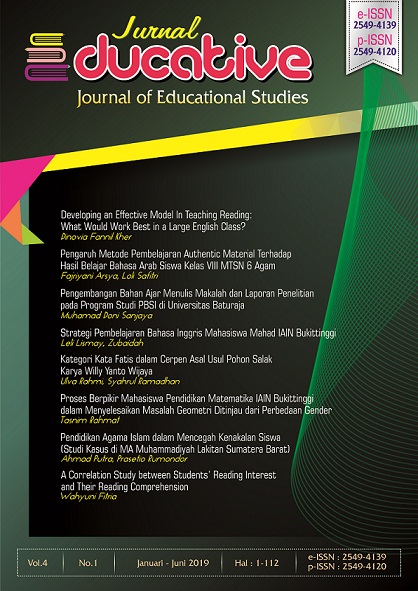
Proses Berpikir Mahasiswa Program Studi Matematika IAIN Bukittinggi dalam Memecahkan Masalah Geometri Ditinjau dari Perbedaan Gender
DOI:
https://doi.org/10.30983/educative.v4i1.1286Keywords:
Thinking Process, Mathematics Problem, Geometry, GenderAbstract
References
Budhi, Wono Setya dan Bana G. Kartasasmita, Berpikir Matematis, Matematika Untuk Semua (Jakarta: Erlangga, 2015)
Gagne, R. M, The Conditions of Learning (New York: Holt, Rinehart and Winston Inc, 1970)
Hightower, M. W, ‘The Boy-Turn in Research on Gender and Education’, American Educational Research Association, Vol. 73 No (2003), 471-498.
Huberman, Miles and, Data Analysis (America: Sage Publications, 1994)
Marpaung, Y, Struktur Kognitif Dalam Pembentukan Konsep Algoritma Matematis (Yogyakarta: Mrican, 1987)
NCTM, ‘Principles and Standards for School Mathematics’, National Council of Teachers of Mathematics, Reston VA (2000)
Polya, G, How Tio Solve It (Princeton, New Jersey: Princeton University Press, 1973)
Santrock, J. W, Child Development (McGraw Hill Companies, 2007)
Saragih, S, ‘Pengambangan Keterampilan Berpikir Matematika’, Makalah Seminar Nasional Matematika Dan Pendidikan Matematika FMIPA UNY, 2008
Schoenfeld, A. H, Learning to Think Matematically: Problem Solving, Metacognition, and Sense Making in Mathematics (Newyork: MacMillan, 1992)
Slavin, Robert, Psikologi Pendidikan Teori Dan Praktik Jilid 1, Indeks (Jakarta)
Solso, R. L, Cognitive Psychology (Boston: Allyn and Bacon, 1995)
Suherman, Erman, Strategi Pembelajaran Matematika (Bandung: JICA, 2003)
Suherman, Erman dkk., Strategi Pembelajaran Matematika Kontemporer (Bandung: JICA, 2003)
Tasnim Rahmat, Pipit Firmanti, ‘Proses Berpikir Mahasiswa Pmtk Iain Bukittinggi Dalam Menyelesaikan Masalah Matematika’, Jurnal Tarbiyah, 24 (2017), 330–50
Zhu, Zheng, ‘Gender Differences in Mathematical Problem Solving Patterns: A Review of Literature’, International Education Journal, Vol. 8(2) (2007), 187–203
Downloads
Published
How to Cite
Issue
Section
Citation Check
License
Authors who publish with this journal agree to the following terms:
1. Authors retain copyright and grant the journal right of first publication with the work simultaneously licensed under a Creative Commons Attribution License that allows others to share the work with an acknowledgment of the work's authorship and initial publication in this journal.
2. Authors are able to enter into separate, additional contractual arrangements for the non-exclusive distribution of the journal's published version of the work (e.g., post it to an institutional repository or publish it in a book), with an acknowledgment of its initial publication in this journal.
3. Authors are permitted and encouraged to post their work online (e.g., in institutional repositories or on their website) prior to and during the submission process, as it can lead to productive exchanges, as well as earlier and greater citation of published work (See The Effect of Open Access).