| Journal Title | : USRATY : Journal of Islamic Family Law |
| Abbreviation | : USRATY |
| Editor-in-Chief | : Prof. Ismail,   Universitas Islam Negeri Sjech M. Djamil Djambek Bukittinggi Universitas Islam Negeri Sjech M. Djamil Djambek Bukittinggi |
| Publishing System | : Open Journal System (OJS 3.3) |
| DOI Prefix | : Prefix 10.30983/usraty - Crossref Linked |
| ISSN | : ISSN 3026-7404 (online) |
| Frequency | : 2 editions per year (January-June and July-December) |
| : [email protected] | |
| Language | : Indonesia and English |
| Licensing | : Creative Commons Attribution-ShareAlike 4.0 International License |
| Manag. Style | : Open Access (OA) |
| Publisher | : Universitas Islam Negeri Sjech M. Djamil Djambek Bukittinggi |
| Acceptance Rate |
: 32% Total Submission |
| Citation Analysis | : DOAJ | Dimensions | Google Scholar |
USRATY: Journal of Islamic Family Law
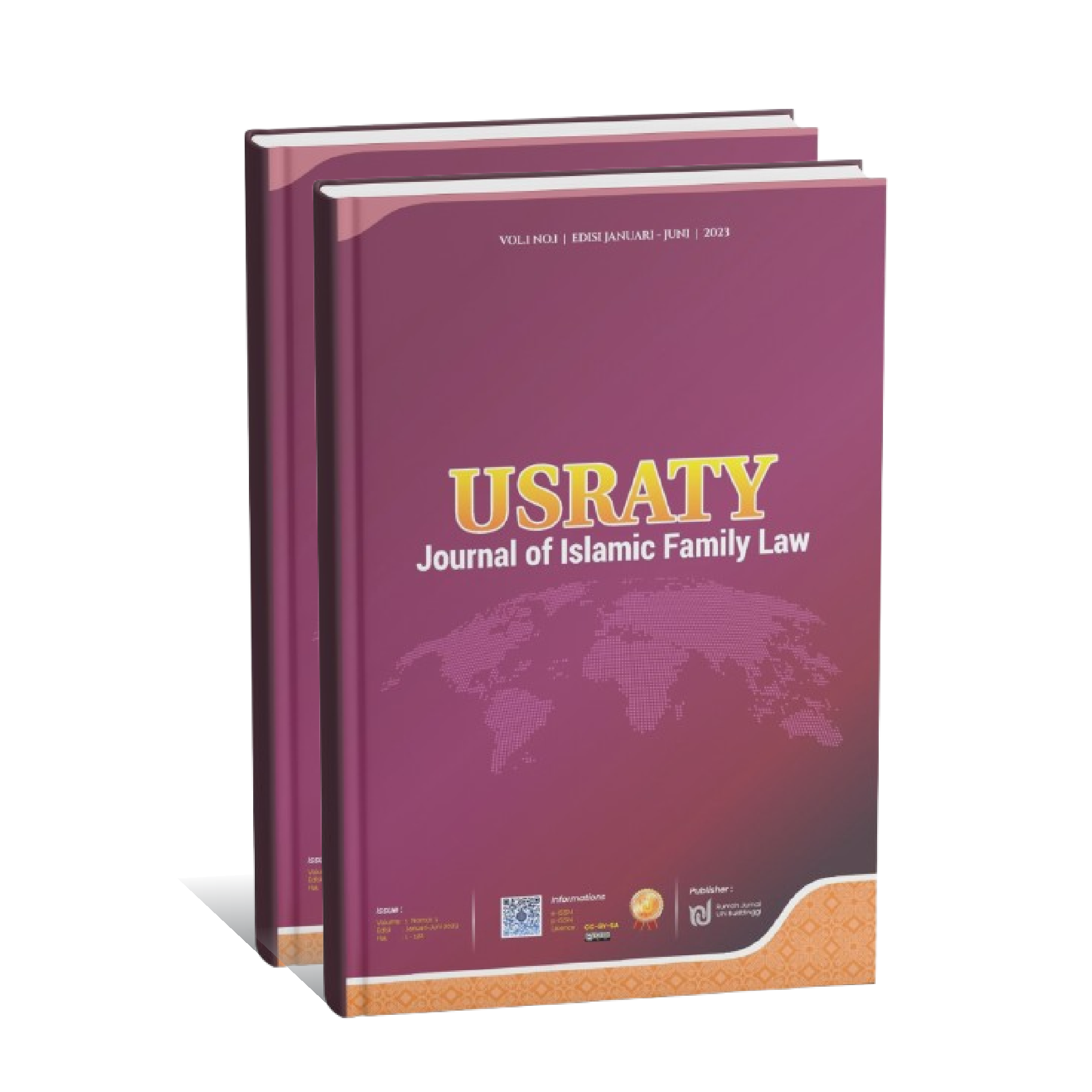
USRATY : Journal of Islamic Family Law is a peer-reviewed academic journal dedicated to advancing critical, comparative, and interdisciplinary scholarship on contemporary Islamic family law. The journal welcomes original research that examines the transformation of Muslim family norms, institutions, and practices in relation to legal reform, social change, gender justice, child protection, digital innovation, and the interaction between Islamic law, state law, customary law, and international human rights norms. The journal gives particular attention to Islamic family law in Muslim-majority countries, Muslim minority contexts, and transnational Muslim communities and encourages studies that combine normative Islamic legal analysis with socio-legal, anthropological, historical, comparative, political, and technological approaches. USRATY : Journal of Islamic Family Law covers a broad range of topics within Islamic Family Law, including but not limited to contemporary Islamic marriage and divorce law, including marriage registration, guardianship, polygamy, mut’ah, maintenance, marital property, post-divorce rights, and family dispute resolution; maqasid al-shariah and reform of Islamic family law, including reinterpretation of classical doctrines, comparative madhhab studies, maslahah-based reasoning, and ethical approaches to family justice; gender justice, women’s rights, and child protection in Islamic family law, religious courts, family policies, humanitarian crises, and post-divorce arrangements; digital transformation of Islamic family law, including AI-based family counseling, online marriage services, legal technology, digital religious authority, and platform-based family administration; legal pluralism in Muslim family life, including the interaction between Islamic law, state law, customary law, local traditions, and international legal norms; comparative and transnational Muslim family law, including legal reform in Muslim countries, Muslim minority family practices, diaspora communities, and cross-border family issues; socio-legal studies of Islamic family law in practice, including religious court decisions, judicial reasoning, lived experiences of families, community mediation, and institutional practices; and family law, human rights, and vulnerable groups, including women, children, refugees, minorities, and families affected by conflict, displacement, or political instability. See More
Current Issue
Vol. 4 No. 1 (2026): Editions January-June 2026
In Progress


Published:
2026-05-05
Articles
Indexed by :