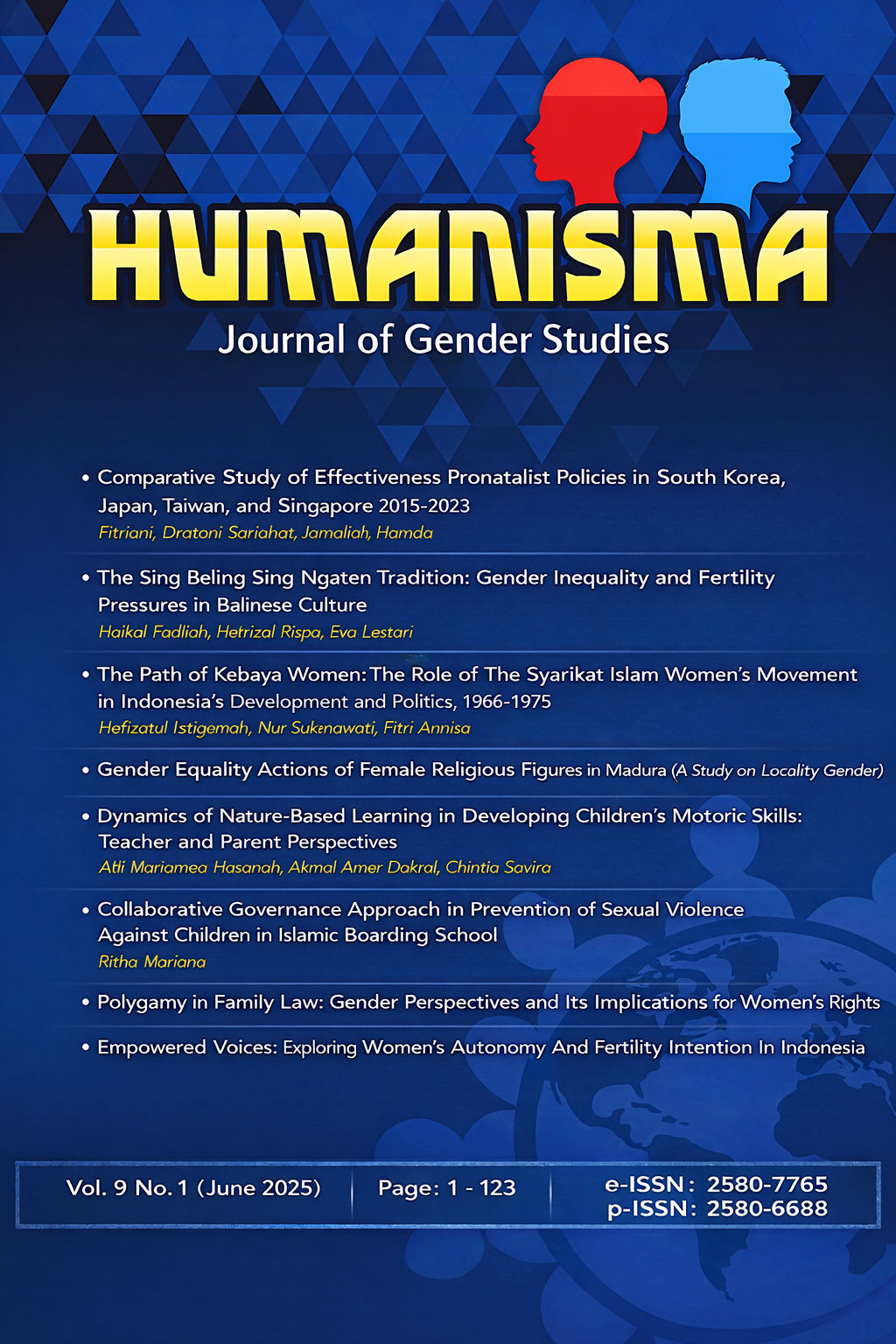
Empowered Voices: Exploring Women's Autonomy And Fertility Intention In Indonesia
DOI:
https://doi.org/10.30983/humanisma.v9i1.9315Keywords:
Women’s autonomy, couple, fertility intention, instrumental variableAbstract
References
Ajzen, Icek and Jane Klobas, ‘Fertility Intentions’, Demographic Research, 29 (2013), 203–32 <https://doi.org/10.4054/DemRes.2013.29.8>
Amraeni, Yunita, Sudijanto Kamso, Sabarinah B Prasetyo and Muhammad Nirwan, A Matriarchal and Patriarchal Perception on Women’s Autonomy in Decision Making on Contraception: Qualitative Analysis in Indonesia, Malaysian Journal of Medicine and Health Sciences, 2021, XVII
Angrist, Joshua, Victor Lavy and Analia Schlosser, ‘Multiple Experiments for the Causal Link between the Quantity and Quality of Children’, Journal of Labor Economics, 28 (2010), 773–824 <https://doi.org/10.1086/653830>
Arsyad, Syahmida Syahbuddin and Septi Nurhayati, ‘DETERMINAN FERTILITAS DI INDONESIA’, Jurnal Kependudukan Indonesia, 11 (2017), 1 <https://doi.org/10.14203/jki.v11i1.65>
Atake, Esso-Hanam and Pitaloumani Gnakou Ali, ‘Women’s Empowerment and Fertility Preferences in High Fertility Countries in Sub-Saharan Africa’, BMC Women’s Health, 19 (2019), 54 <https://doi.org/10.1186/s12905-019-0747-9>
Bollen, Kenneth A, ‘Instrumental Variables in Sociology and the Social Sciences’, Annual Review of Sociology, 38 (2012), 37–72 <https://doi.org/10.1146/annurev-soc-081309-150141>
Debnath, Sisir, ‘The Impact of Household Structure on Female Autonomy in Developing Countries’, The Journal of Development Studies, 51 (2015), 485–502 <https://doi.org/10.1080/00220388.2014.983909>
Doepke, Matthias and Fabian Kindermann, ‘Intrahousehold Decision Making and Fertility’, IZA Discussion Paper No 8726, 2017 <https://doi.org/https://ssrn.com/abstract=2543921>
Doss, C, ‘Intrahousehold Bargaining and Resource Allocation in Developing Countries’, The World Bank Research Observer, 28 (2013), 52–78 <https://doi.org/10.1093/wbro/lkt001>
Dyson, Tim and Mick Moore, ‘On Kinship Structure, Female Autonomy, and Demographic Behavior in India’, Population and Development Review, 9 (1983), 35 <https://doi.org/10.2307/1972894>
Forty, James, Kannan Navaneetham and Gobopamang Letamo, ‘Determinants of Fertility in Malawi: Does Women Autonomy Dimension Matter?’, BMC Women’s Health, 22 (2022) <https://doi.org/10.1186/s12905-022-01926-4>
Goldscheider, Frances, Eva Bernhardt and Trude Lappegård, ‘The Gender Revolution: A Framework for Understanding Changing Family and Demographic Behavior’, Population and Development Review, 41 (2015), 207–39 <https://doi.org/10.1111/j.1728-4457.2015.00045.x>
Haider, Mohammad Rifat, Zaina P Qureshi and M Mahmud Khan, ‘Effects of Women’s Autonomy on Maternal Healthcare Utilization in Bangladesh: Evidence from a National Survey’, Sexual & Reproductive Healthcare, 14 (2017), 40–47 <https://doi.org/10.1016/j.srhc.2017.09.002>
Haque, Rezwanul, Khorshed Alam, Syed Mahbubur Rahman, Syed Afroz Keramat and Mohammed Khaled Al-Hanawi, ‘Women’s Empowerment and Fertility Decision-Making in 53 Low and Middle Resource Countries: A Pooled Analysis of Demographic and Health Surveys’, BMJ Open, 11 (2021), e045952 <https://doi.org/10.1136/bmjopen-2020-045952>
Herawati, Kirani and Windhu Purnomo, ‘Hubungan Budaya Patriarki Dan Pemahaman Informasi KB Dengan Kepesertaan Kontrasepsi’, Jurnal Biometrika Dan Kependudukan, 4 (2015), 162–71
Hindin, Michelle J, ‘Women’s Autonomy, Women’s Status and Fertility-Related Behavior in Zimbabwe’, Population Research and Policy Review, 19 (2000), 255–82
Jejeebhoy, Shireen J, ‘Women’s Autonomy in Rural India: Its Dimensions, Determinants, and the Influence of Context’, in Women’s Empowerment and Demographic Processes (Oxford University PressOxford, 2000), pp. 204–38 <https://doi.org/10.1093/oso/9780198297314.003.0009>
Mason, Karen Oppenheim, ‘The Impact of Women’s Social Position on Fertility in Developing Countries’, Sociological Forum, 2 (1987), 718–45 <http://www.jstor.org/stable/684300>
Nadeem, Muhammad, Muhammad Irfan Malik, Mumtaz Anwar and Sobia Khurram, ‘Women Decision Making Autonomy as a Facilitating Factor for Contraceptive Use for Family Planning in Pakistan’, Social Indicators Research, 156 (2021), 71–89 <https://doi.org/10.1007/s11205-021-02633-7>
Putra, I Gusti Ngurah Edi, Tashi Dendup and Pande Putu Januraga, ‘The Roles of Women Empowerment on Attitude for Safer Sex Negotiation among Indonesian Married Women’, Women and Health, 61 (2021), 95–108 <https://doi.org/10.1080/03630242.2020.1831685>
Qian, Yue and Yongai Jin, ‘Women’s Fertility Autonomy in Urban China: The Role of Couple Dynamics Under the Universal Two-Child Policy’, Chinese Sociological Review, 50 (2018), 275–309 <https://doi.org/10.1080/21620555.2018.1428895>
Rammohan, A and M Johar, ‘The Determinants of Married Women’ s Autonomy in Indonesia’, Feminist Economics, 15 (2009), 31–55 <https://doi.org/10.1080/13545700903153989>
Sougou, NM, O Bassoum, A Faye and MMM Leye, ‘Women’s Autonomy in Health Decision-Making and Its Effect on Access to Family Planning Services in Senegal in 2017: A Propensity Score Analysis’, BMC Public Health, 20 (2020) <https://doi.org/10.1186/s12889-020-09003-x>
Stein, Petra, Sebastian Willen and Monika Pavetic, ‘Couples’ Fertility Decision-Making’, Demographic Research, 30 (2014), 1697–1732 <https://doi.org/10.4054/DemRes.2014.30.63>
Upadhyay, Ushma D, Jessica D Gipson, Mellissa Withers, Shayna Lewis, Erica J Ciaraldi, Ashley Fraser, and others, ‘Women’s Empowerment and Fertility: A Review of the Literature’, Social Science & Medicine, 115 (2014), 111–20 <https://doi.org/10.1016/j.socscimed.2014.06.014>
Wieinga, SE, ‘Women Resisting Creeping Islamic Fundamentalism in Indonesia’, Asian Journal of Women’s Studies, 15 (2009), 30–56 <https://doi.org/10.1080/12259276.2009.11666077>
Downloads
Published
How to Cite
Issue
Section
Citation Check
License
Copyright (c) 2025 Azka Muthia, Diahhadi Setyonaluri

This work is licensed under a Creative Commons Attribution-ShareAlike 4.0 International License.
Authors who publish with this journal agree to the following terms:
- Authors retain copyright and grant the journal right of first publication with the work simultaneously licensed under a Creative Commons Attribution-ShareAlike 4.0. that allows others to share the work with an acknowledgment of the work's authorship and initial publication in this journal.
- Authors are able to enter into separate, additional contractual arrangements for the non-exclusive distribution of the journal's published version of the work (e.g., post it to an institutional repository or publish it in a book), with an acknowledgment of its initial publication in this journal.
- Authors are permitted and encouraged to post their work online (e.g., in institutional repositories or on their website) prior to and during the submission process, as it can lead to productive exchanges, as well as earlier and greater citation of published work (See The Effect of Open Access).