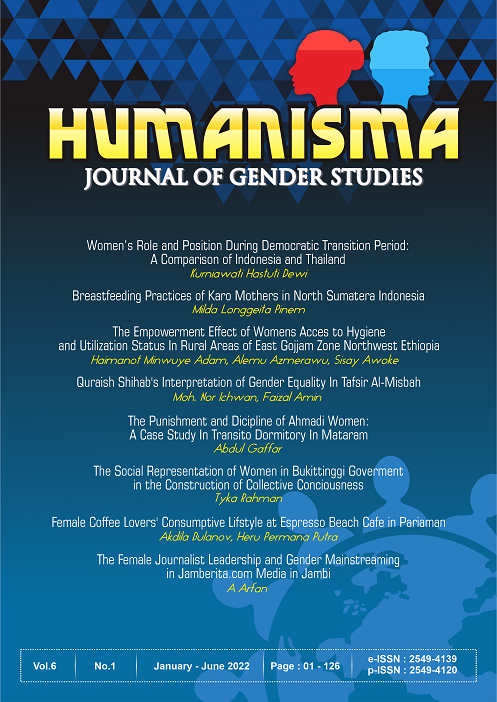
The Punishment and Dicipline of Ahmadi Women: A Case Study In Transito Dormitory In Mataram
DOI:
https://doi.org/10.30983/humanisme.v6i1.5307Keywords:
Ahmadiyya, Punishment, Discipline, Women,Abstract
References
Journal
Asrita, Stara. “Identitas Perempuan Ahmadiyah Di Ruang Publik.†Jurnal Riset Komunikasi 2, no. 1 (2019): 51–62.
Baihaqi, Mohamad. 2020. Relasi Elit Lokal Dalam Konflik Keagamaan di Lombok Barat. Jurnal Sosiologi Agama Vol. 14, No. 2.
Burhani, Ahmad Najib. “Fundamentalism and Religious Dissent: The LPPI’s Mission to Eradicate the Ahmadiyya in Indonesia.†Indonesia and the Malay World 44, no. 129 (2016): 145–164.
Chusniyah, Tutu, dkk. 2020. Pebedaan Intoleransi Politik Jamaah Nahdlatul Wathan Terhadap Jamaah Ahmadiyah Ditinjau dari Gender. Ulumuddin: Jurnal Ilmu-Ilmu Keislaman Vol. 10, No. 2.
Halimatusa’diah, Halimatusa’diah. “Dari Prasangka Hingga Diskriminasi: Menyoal Stigma Sesat Dan Kekerasan Terhadap Ahmadiyah Dalam Perspektif Komunikasi.†Avant Garde 5, no. 1 (2017): 15.
Irawan, Andi Muhammad. “‘They Are Not Muslims’: A Critical Discourse Analysis of the Ahmadiyya Sect Issue in Indonesia.†Discourse and Society 28, no. 2 (2017): 162–181.
Ismail, Zaky. “Ahmadiyah Di Lombok: Respon Pemerintah Daerah Terhadap Pemenuhan Hak-Hak Sipil Jemaat Ahmadiyah Di Mataram Pasca SKB 2008.†Jurnal Review Politik 4, no. 2 (2014): 293–317.
Koerner, C, and W D Putro. “The Socio-Legal Construction of Ahmadiyah as a Religious Minority by Local and National Government Policy: Restrictions before the Law, a Challenge for ….†International Journal of Indonesian Studies 4, no. 1 (2017): 14–30. https://arts.monash.edu/__data/assets/pdf_file/0005/1679414/ahmadiyah-final-version.pdf.
Marshall, Paul. “Patterns and Contexts of Religious Freedom and Persecution.†The Brandywine Review of Faith & International Affairs 2, no. 3 (2004): 27–34.
Mu'ti, Abdul dan Burhani, Najib, “The limits of religious freedom in Indonesia:with reference to the first pillar Ketuhanan yang Maha Esa of Pancasila,†Indonesian Journal of Islam and Muslim Societies 9, no. 1 (2019).
Nurhikmah. “Satu Dekade Jadi Rumpun Terasing: Narasi Identitas Dan Kekerasan Jemaat Ahmadiyah Di Lombok.†Retorik 5, no. 1 (2017).
Putrawan, Ainul Azrin, 2019. Stigma Jemaah Ahmadiyah (Studi Fenomenologi pada Pengungsi Jemaah Ahmadiyah Wisma Transito Mataram). Tesis tidak diterbitkan
Soedirgo, Jessica. “Informal Networks and Religious Intolerance: How Clientelism Incentivizes the Discrimination of the Ahmadiyah in Indonesia.†Citizenship Studies 22, no. 2 (2018): 191–207. https://doi.org/10.1080/13621025.2018.1445490.
Surahman, Buyung. “Peran Ibu Terhadap Masa Depan Anak.†Jurnal Hawa : Studi Pengarus Utamaan Gender dan Anak 1, no. 2 (2019).
Suryana, Aan. “State Officials’ Entanglement with Vigilante Groups in Violence against Ahmadiyah and Shi’a Communities in Indonesia.†Asian Studies Review 43, no. 3 (2019): 475–492. https://doi.org/10.1080/10357823.2019.1633273.
Wahab, Abdul Jamil, and Fakhruddin Fakhruddin. “Menakar Efektivitas Skb Tentang Ahmadiyah: Sudi Kasus Konflik Ahmadiyah Di Desa Gereneng Lombok Timur.†Harmoni 18, no. 1 (2019): 443–459.
Book
Bungin, Burhan. 2011. Penelitian Kualitatif: Komunikasi, Ekonomi, Kebijakan Publik, dan Ilmu Sosial Lainnya. Jakarta: Prenada Group.
Denzin, Norman K. 2009. Handbook Of Qualitative Research. Terj. Dariyatno (dkk). Yogyakarta: Pustaka Pelajar.
J.S Furnival, 1956. Colonial Policy and Praktice: A Comparative Study of Burma and Netherlands (New York: New York Press.
Ritzer, George. 2010. Teori Sosial Posmodern. Yogyakarta: Kreasi Wacana.
Sarup, Madan. 2011. Panduan Pengantar untuk Memahami Postrukturalisme dan Posmodernisme. Yogyakarta: Jalasutra
Downloads
Published
How to Cite
Issue
Section
Citation Check
License
Authors who publish with this journal agree to the following terms:
- Authors retain copyright and grant the journal right of first publication with the work simultaneously licensed under a Creative Commons Attribution-ShareAlike 4.0. that allows others to share the work with an acknowledgment of the work's authorship and initial publication in this journal.
- Authors are able to enter into separate, additional contractual arrangements for the non-exclusive distribution of the journal's published version of the work (e.g., post it to an institutional repository or publish it in a book), with an acknowledgment of its initial publication in this journal.
- Authors are permitted and encouraged to post their work online (e.g., in institutional repositories or on their website) prior to and during the submission process, as it can lead to productive exchanges, as well as earlier and greater citation of published work (See The Effect of Open Access).