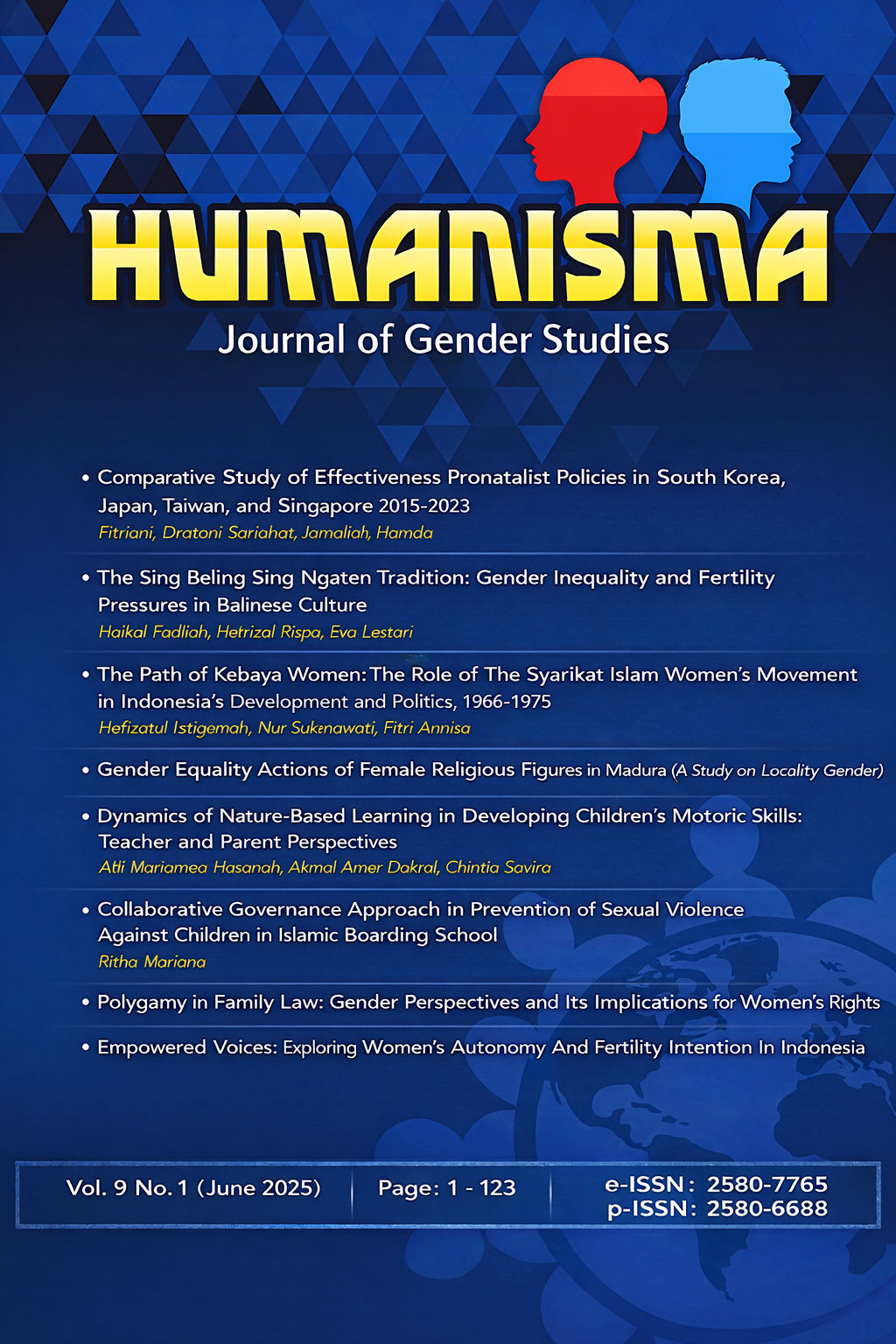
Comparative Study of Effectiveness Pronatalist Policies in South Korea, Japan, Taiwan, and Singapore 2015-2023
DOI:
https://doi.org/10.30983/humanisma.v9i1.9235Keywords:
Asia-Pacific, Comparative Study, Declining, Fertility, Pronatalist PolicyAbstract
References
Article
Aarssen, Lonnie W. 2005. “Why Is Fertility Lower in Wealthier Countries? The Role of Relaxed Fertility-Selection,” Population and Development Review, 31.1: 113–26 <https://doi.org/10.1111/j.1728-4457.2005.00054.x>
Buttner, Thomas, and Wolfgang Lutz. 1990. “Estimating Fertility Responses to Policy Measures in the German Democratic Republic,” Population and Development Review, 16.3: 539 <https://doi.org/10.2307/1972835>
Castles, Francis G. 2003. “The World Turned Upside Down: Below Replacement Fertility, Changing Preferences and Family-Friendly Public Policy in 21 OECD Countries,” Journal of European Social Policy, 13.3: 209–27 <https://doi.org/10.1177/09589287030133001>
Choo, Dahae, and Hugo Jales. 2021. “Childbearing and the Distribution of the Reservation Price of Fertility: The Case of the Korean Baby Bonus Program,” Journal of Asian Economics, 77: 101395 <https://doi.org/10.1016/j.asieco.2021.101395>
Demeny, P. (1986). Pronatalist policies in low-fertility countries: Patterns, performance, and prospects. Population and Development Review, 12, 335. https://doi.org/10.2307/2807916
Furstenberg, Frank F. 2010. “On a New Schedule: Transitions to Adulthood and Family Change,” The Future of Children, 20.1: 67–87 <https://doi.org/10.1353/foc.0.0038>
Gauthier, A. H. (2007). The impact of family policies on fertility in industrialized countries: A review of the literature. Population Research and Policy Review.
Huang, Jr-Tsung. 2007. “PERSONAL TAX EXEMPTION: THE EFFECT ON FERTILITY IN TAIWAN,” The Developing Economies, 13.1: 32–48
Hugo, Graeme. 2000. “Declining Fertility and Policy Intervention in Europe: Some Lessons for Australia?,” Journal of Population Research, 17.2: 175–98 <https://doi.org/10.1007/bf03029464>
Kim, Taewook. 2023. “The Impact of Working Hours on Pregnancy Intention in Childbearing-Age Women in Korea, the Country with the World’s Lowest Fertility Rate,” PLOS ONE, 18.7: e0288697 <https://doi.org/10.1371/journal.pone.0288697>
Knize, Veronika J. 2021. “What Gender-Neutral Activation? Understanding the Gender Sanction Gap in Germany’s Welfare System,” Social Politics: International Studies in Gender, State & Society, 29.4: 1286–1313<https://doi.org/10.1093/sp/jxab037>
Koo, Eunjung. 2019. “Women’s Subordination in Confucian Culture: Shifting Breadwinner Practices,” Asian Journal of Women’s Studies, 25.3: 417–36 <https://doi.org/10.1080/12259276.2019.1648065>
Lee, Youngcho. 2022. “Norms about Childcare, Working Hours, and Fathers’ Uptake of Parental Leave in South Korea,” Community, Work & Family, 26.4: 466–91 <https://doi.org/10.1080/13668803.2022.2031889>
Malak, Natalie, and Terry Yip. 2016. “Baby Bonus, Anyone? Examining Heterogeneous Responses to a Pro-Natalist Policy,” SSRN Electronic Journal <https://doi.org/10.2139/ssrn.2846802>
Miyajima, Takeru, and Hiroyuki Yamaguchi. 2017. “I Want to but I Won’t: Pluralistic Ignorance Inhibits Intentions to Take Paternity Leave in Japan,” Frontiers in Psychology, 8 <https://doi.org/10.3389/fpsyg.2017.01508>
Oláh, L. S., Kotowska, I. E., & Richter, R. (2021). The new roles of men and women and implications for families and societies. Families and Societies Working Paper Series.
Pendleton, Brian F. 1978. “An Historical Description and Analysis of Pronatalist Policies in Italy, Germany and Sweden,” Policy Sciences, 9.1: 45–70 <https://doi.org/10.1007/bf00137978>
Raymo, J. M., & Park, H. (2020). Childbearing and changing gender roles in East Asia. Demographic Research, 42, 1349–1372.
Rindfuss, Ronald R., David K. Guilkey, S. Philip Morgan, and ØYstein Kravdal. 2010. “Child‐Care Availability and Fertility in Norway,” Population and Development Review, 36.4: 725–48 <https://doi.org/10.1111/j.1728-4457.2010.00355.x>
Sleebos, Joelle. 2003. Low Fertility Rates in OECD Countries: Facts and Policy Responses, pp. 1–62
Son, Keonhi, and Tobias Böger. 2021. “The Inclusiveness of Maternity Leave Rights over 120 Years and across Five Continents,” Social Inclusion, 9.2: 275–87 <https://doi.org/10.17645/si.v9i2.3785>
Tan, Jolene. 2023. “Perceptions towards Pronatalist Policies in Singapore,” Journal of Population Research, 40.3 <https://doi.org/10.1007/s12546-023-09309-8>
Online Reference
Bloomenthal, Andrew. 2011. “Four Asian Tigers: What They Are, Economic Strengths Explained,” Investopedia <https://www.investopedia.com/terms/f/four-asian-tigers.asp> [accessed 19 February 2025]
Cheng, Mira. 2024. “Global Fertility Rates to Plunge in Decades Ahead, New Report Says,” CNN <https://edition.cnn.com/2024/03/20/health/global-fertility-rates-lancet-study/index.html> [accessed 19 February 2025]
Dalton, Emma. 2022. “Japan’s Stubborn Gender Inequality Problem,” East Asia Forum <https://eastasiaforum.org/2022/06/28/japans-stubborn-gender-inequality-problem/> [accessed 19 February 2025]
Inland Revenue Authority of Singapore. 2024. “Tax Savings for Married Couples and Families,” IRAS <https://www.iras.gov.sg/taxes/individual-income-tax/basics-of-individual-income-tax/tax-reliefs-rebates-and-deductions/tax-savings-for-married-couples-and-families/> [accessed 19 February 2025]
Jeong, Jin-Ho, and Ji-Eun Seo. 2023. “In Korea, More Women Are Becoming Breadwinners,” Korea JoongAng Daily <https://koreajoongangdaily.joins.com/2023/01/09/business/economy/Korea-singleincome-mother/20230109173901073.html> [accessed 19 February 2025]
Mamchii, Oleksandra. 2024. “Richest Countries in Asia,” Best Diplomats <https://bestdiplomats.org/richest-countries-in-asia/> [accessed 19 February 2025]
Ministry of Manpower Singapore. 2021. “A Gender-Inclusive Workforce,” Ministry of Manpower <https://stats.mom.gov.sg/Pages/a-gender-inclusive-workforce.aspx >
NIPPON. 2022. “Japan Sees 90% Drop in Daycare Waiting Lists over the Last Five Years,” Nippon.Com <https://www.nippon.com/en/japan-data/h01428/> [accessed 19 February 2025]
OECD (2023). Family Database – SF2.1: Parental leave systems. https://www.oecd.org/social/family/database.htm
Report
Del Boca, Daniela. 2002. Low Fertility and Labour Force Participation of Italian Women: Evidence and Interpretations <http://ideas.repec.org/p/oec/elsaaa/61-en.html>
Duclos, Edith, Pierre Lefebvre, and Phillip Merrigan. 2001. “A ‘Natural Experiment’ on the Economics of Storks: Evidence on the Impact of Differential Family Policy on Fertility Rates in Canada,” CREFE Working Papers
Gender Equality Committee Taiwan. 2024. Telephone Poll on Gender Equality Perceptions
Kohara, Miki, and Bipasha Maity. 2020. Review of Economics of the Household The Impact of Work-Life Balance Policies on the Time Allocation and Fertility The Impact of Work-Life Balance Policies on the Time Allocation and Fertility Preference of Japanese Women
Legatum Institute. 2023. Source and Indicators
Ministry of Economy and Finance. (2022). KOREAN TAXATION.
Taiwan Government. (2024). Exemption and Deduction.
UNDESA. 2021. World Population Policies In International Affairs <https://doi.org/10.2307/2615426>
Downloads
Published
How to Cite
Issue
Section
Citation Check
License
Copyright (c) 2025 Mahira Sandria Rahmatiana, Adhi Cahya Fahadayna

This work is licensed under a Creative Commons Attribution-ShareAlike 4.0 International License.
Authors who publish with this journal agree to the following terms:
- Authors retain copyright and grant the journal right of first publication with the work simultaneously licensed under a Creative Commons Attribution-ShareAlike 4.0. that allows others to share the work with an acknowledgment of the work's authorship and initial publication in this journal.
- Authors are able to enter into separate, additional contractual arrangements for the non-exclusive distribution of the journal's published version of the work (e.g., post it to an institutional repository or publish it in a book), with an acknowledgment of its initial publication in this journal.
- Authors are permitted and encouraged to post their work online (e.g., in institutional repositories or on their website) prior to and during the submission process, as it can lead to productive exchanges, as well as earlier and greater citation of published work (See The Effect of Open Access).