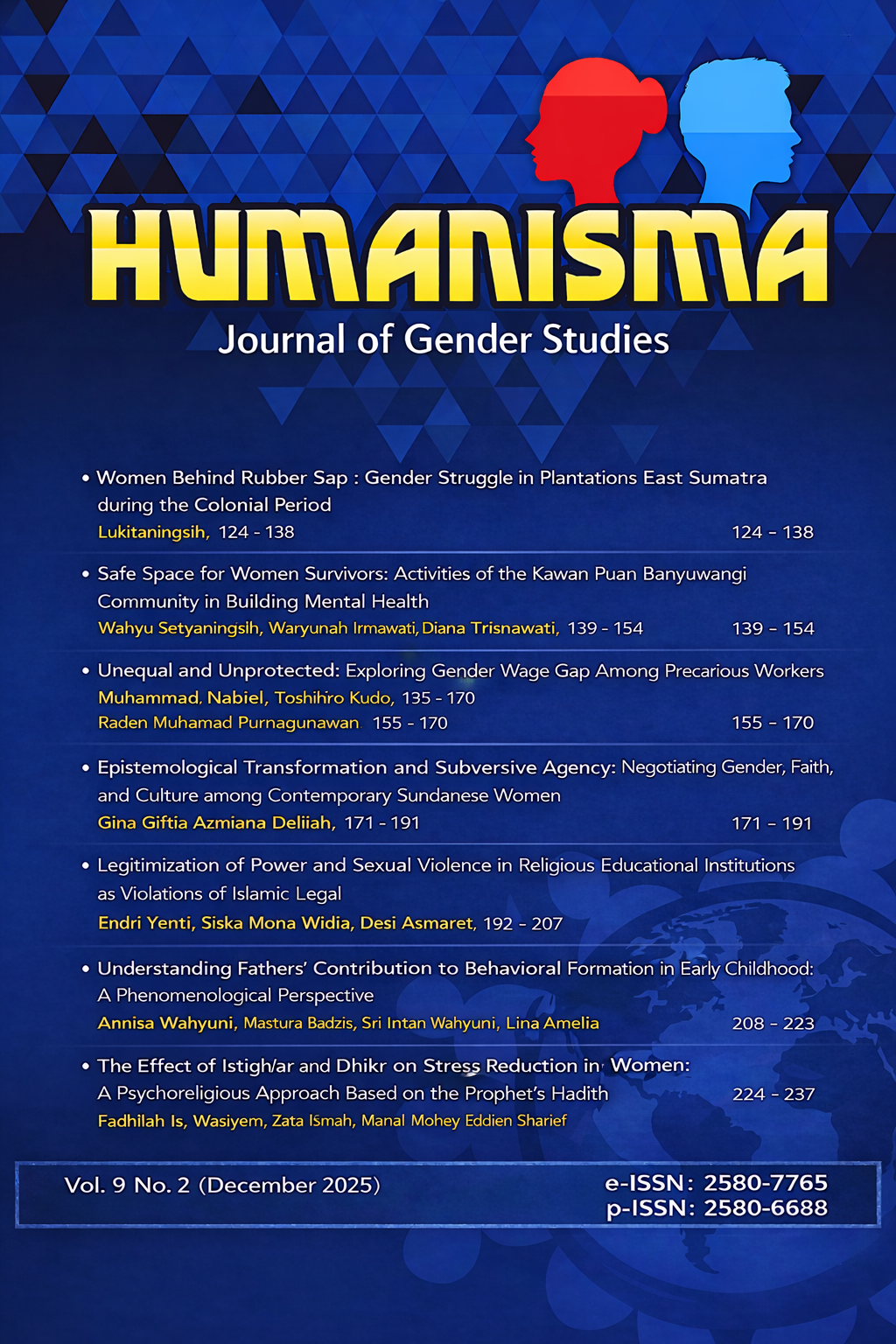
Safe Space for Women Survivors: Activities of the Kawan Puan Banyuwangi Community in Building Mental Health
DOI:
https://doi.org/10.30983/humanisma.v9i2.9918Keywords:
history, safe space, mental health, Kawan Puan Banyuwangi Community, women, survivorsAbstract
References
Adi Ahdiat, ‘Perempuan Lebih Rentan Depresi Dibanding Laki-Laki’, Https://Databoks.Katadata.Co.Id/Layanan-Konsumen-Kesehatan/Statistik/33043f2e6d4b621/Perempuan-Lebih-Rentan-Depresi-Dibanding-Laki-Laki, 2024, 14/06/2024 edn
Aditya Mega P., ‘Kawan Puan, Ruang Aman Untuk Perempuan’, Https://Mepnews.Id/2022/03/17/Kawan-Puan-Ruang-Aman-Untuk-Perempuan/, 17 March 2022
Ariadi, Ryan, ‘Pengaruh Kekerasan Terhadap Kesehatan Mental Dampak Jangka Panjang’, circle-archive, 4.1 (2024) <https://circle-archive.com/index.php/carc/article/view/72/70>
Arifah, Dhea Nur, and Pipit Feriani Wiyoko, ‘Hubungan Kekerasan Psikis dengan Kesehatan Mental pada Remaja Sekolah Menengah Pertama Selama Pandemi Covid-19 di Kecamatan Sungai Kunjang Samarinda’, Borneo Student Research, 3.2 (2022) <https://journals.umkt.ac.id/index.php/bsr/article/view/2683/1182>
Arwan, ‘Budaya Patriarki Bahasa Dan Gender Terhadap Perempuam Bima’, Jurnal Ilmu Sosial Dan Pendidikan, 4.4 (2020), pp. 401–07
Astuti, Andarweni, and Loina Christine, ‘The Concept Of The Needs Of Society According To Abraham Maslow’s perspective’, JBKI Jurnal Bimbingan dan Konseling Indonesia, 7.2 (2022), pp. 1–8
BB. Wawancara Pribadi, 23 April 2022.
Boy Achmad Sofyan, ‘Masihkah Ada Ruang Aman Bagi Perempuan Di Indonesia?’, Https://Www.Jalastoria.Id/Masihkah-Ada-Ruang-Aman-Bagi-Perempuan-Di-Indonesia/, 24 January 2022
BPS Kabupaten Banyuwangi, ‘Banyuwangi Dalam Angka’, Https://Banyuwangikab.Go.Id/Profil-Daerah/Geografi, 2021
Cohen, Sheldon, and Thomas Ashby Wills, ‘Stress, Social Support, and the Buffering Hypothesis’, Psychological Bulletin, 98.2 (1985), pp. 310–57
Dewi Ratnawati, Sulistyorini, and Ahmad Zainal Abidin, ‘Kesetaraan Gender Tentang Pendidikan Laki-Laki Dan Perempuan’, Jurnal Harkat, Media Komunikasi Gender, 15.1 (2019), pp. 10–23, doi:10.15408/harkat.v15i1.13436
Fawziah Zahrawati B, ‘Resiliensi Pendidik Perempuan Pasca Perceraian Di Kota Parepare’, Kafa’ah Journal, 10.2 (2020)
FY. Wawancara Pribadi, 11 December 2022.
Ghebreyesus, Dr Tedros Adhanom, ‘Universal Health Coverage for Mental Health’, Https://Iris.Who.Int/Bitstream/Handle/10665/310981/WHO-MSD-19.1-Eng.Pdf?sequence=1&isAllowed=y, 2019
IR. Wawancara Pribadi, 10 December 2022.
Israpil, ‘Budaya Patriarki Dan Kekerasan Terhadap Perempuan (Sejarah Dan Perkembangannya)”, Jurnal Pusaka, Vol. 5, No.2, 2017.’, Jurnal Pusaka, 5.2 (2017)
Kementerian Kesehatan Republik Indonesia, ‘Pengertian Kesehatan Mental’, Https://Ayosehat.Kemkes.Go.Id/Pengertian-Kesehatan-Mental, 2018, 08 Juni 2018 Edition
Kementrian Pemberdayaan Perempuan dan Perlindungan Anak RI. (2021, Desember Pukul 19.19 WIB). Glosary Ketidakadilan Gender. Https://Www.Kemenpppa.Go.Id/Index.Php/Page/View/23.
LI. Wawancara Pribadi, 14 December 2022.
Lyn Parker & Helen Creese. (2016). The Stigmatisation of Widows And Divorcees (Janda) in Indonesian Society. Indonesia and the Malay World. https://doi.org/10.1080/13639811.2015.1111647.
MA. Wawancara Pribadi, 10 December 2022.
Muhammad Jauhari Sofi dan Nasim Basiri, ‘Reclaiming Identity: Women, Social Exclusion, and Resistance in Bumi Manusia.’, SAWWA: Jurnal Studi Gender, 15.2 (2020), pp. 155–72, doi:https://doi.org/10.21580/sa.v15i2.6646
Mustofa, A. Z. (2022). Hierarchy of Human Needs: A Humanistic Psychology Approach of Abraham Maslow. Kawanua International Journal of Multicultural Studies, 3(2), 30–35. https://doi.org/10.30984/kijms.v3i2.282
MY. Wawancara Pribadi, 23 April 2022.
Niman, Susanti, and others, ‘Dukungan Kesehatan Jiwa dan Psikososial pada Anak Penyintas Gempa Bumi’, Jurnal Ilmu Keperawatan Jiwa, 6.3 (2023)
Putri, Triyana Harlia, and others, ‘Dukungan Kesehatan Jiwa Bersama Teman Sebaya melalui Program Duta Kesehatan Jiwa Sekolah’, Jurnal Kreativitas Pengabdian Kepada Masyarakat (PKM), 7.11 (2024), pp. 4737–46, doi:10.33024/jkpm.v7i11.17522
Rina Ayu Panca Rini, ‘4 Kriteria Orang Sehat Secara Mental Versi WHO’, Https://Www.Tribunnews.Com/Seleb/2022/02/18/4-Kriteria-Orang-Sehat-Secara-Mental-Versi-Who?Page=2, 2022, Jumat, 18 Februari 2022 17:16 WIB Edition
Saloni Dattani, and others, ‘Mental Health’, Https://Ourworldindata.Org/Mental-Health, 2024
SIMFONI PPA. (2024). Https://Kekerasan.Kemenpppa.Go.Id/Ringkasan
Susanto, Nanang Hasan, ‘Tantangan Mewujudkan Kesetaraan Gender Dalam Budaya Patriarki’, Muwazah, 7.2 (2016), doi:10.28918/muwazah.v7i2.517
Taylor, Shelley E., ‘Social Support: A Review’, in The Oxford Handbook of Health Psychology, ed. by Howard S. Friedman, 1st edn (Oxford University Press, 2012), pp. 190–214, doi:10.1093/oxfordhb/9780195342819.013.0009
Undang-Undang Dasar Negara Kesatuan Republik Indonesia Tahun 1945 Khususnya Dalam Pasal 28 G Ayat 1. (1945).
Vika Azkiya Dihni. (2023). Mengapa Perempuan Lebih Banyak Menderita Gangguan Mental? Https://Katadata.Co.Id/Analisisdata/649e2c12b7ca0/Mengapa-Perempuan-Lebih-Banyak-Menderita-Gangguan-Mental
Wandi, Gusri, ‘Rekonstruksi Maskulinitas: Menguak Peran Laki-Laki Dalam Perjuangan Kesetaraan Gender’, Kafa`ah: Journal of Gender Studies, 5.2 (2015), p. 239, doi:10.15548/jk.v5i2.110
Wiyatmi. (2013). Menjadi Perempuan Terdidik: Novel Indonesia Dan Feminisme. UNY Press.
You, Yanuarious, ‘Relasi Gender Patriarki Dan Dampaknya Terhadap Perempuan Hubula Suku Dani, Kabupaten Jayawijaya, Papua’, Sosiohumaniora, 21.1 (2019), p. 65, doi:10.24198/sosiohumaniora.v21i1.19335
Zalifa Nuri dan Susi Machdalena. (2020). Pembentukan Identitas Sosial Perempuan Pada Zaman Orde Baru Dalam Novel Saman Karya Ayu Utami. HUMANISMA: Journal of Gender Studies, 4(2). http://dx.doi.org/10.30983/humanisme.v4i2
Zuhriyah, Lailatuzz, ‘Perempuan, Pendidikan Dan Arsitek Peradaban Bangsa’, Martabat: Jurnal Perempuan dan Anak, 2.2 (2018), pp. 249–68, doi:10.21274/martabat.2018.2.2.249-268
Downloads
Published
How to Cite
Issue
Section
Citation Check
License
Copyright (c) 2025 Wahyu Setyaningsih, Waryunah Irmawati, Diana Trisnawati

This work is licensed under a Creative Commons Attribution-ShareAlike 4.0 International License.
Authors who publish with this journal agree to the following terms:
- Authors retain copyright and grant the journal right of first publication with the work simultaneously licensed under a Creative Commons Attribution-ShareAlike 4.0. that allows others to share the work with an acknowledgment of the work's authorship and initial publication in this journal.
- Authors are able to enter into separate, additional contractual arrangements for the non-exclusive distribution of the journal's published version of the work (e.g., post it to an institutional repository or publish it in a book), with an acknowledgment of its initial publication in this journal.
- Authors are permitted and encouraged to post their work online (e.g., in institutional repositories or on their website) prior to and during the submission process, as it can lead to productive exchanges, as well as earlier and greater citation of published work (See The Effect of Open Access).