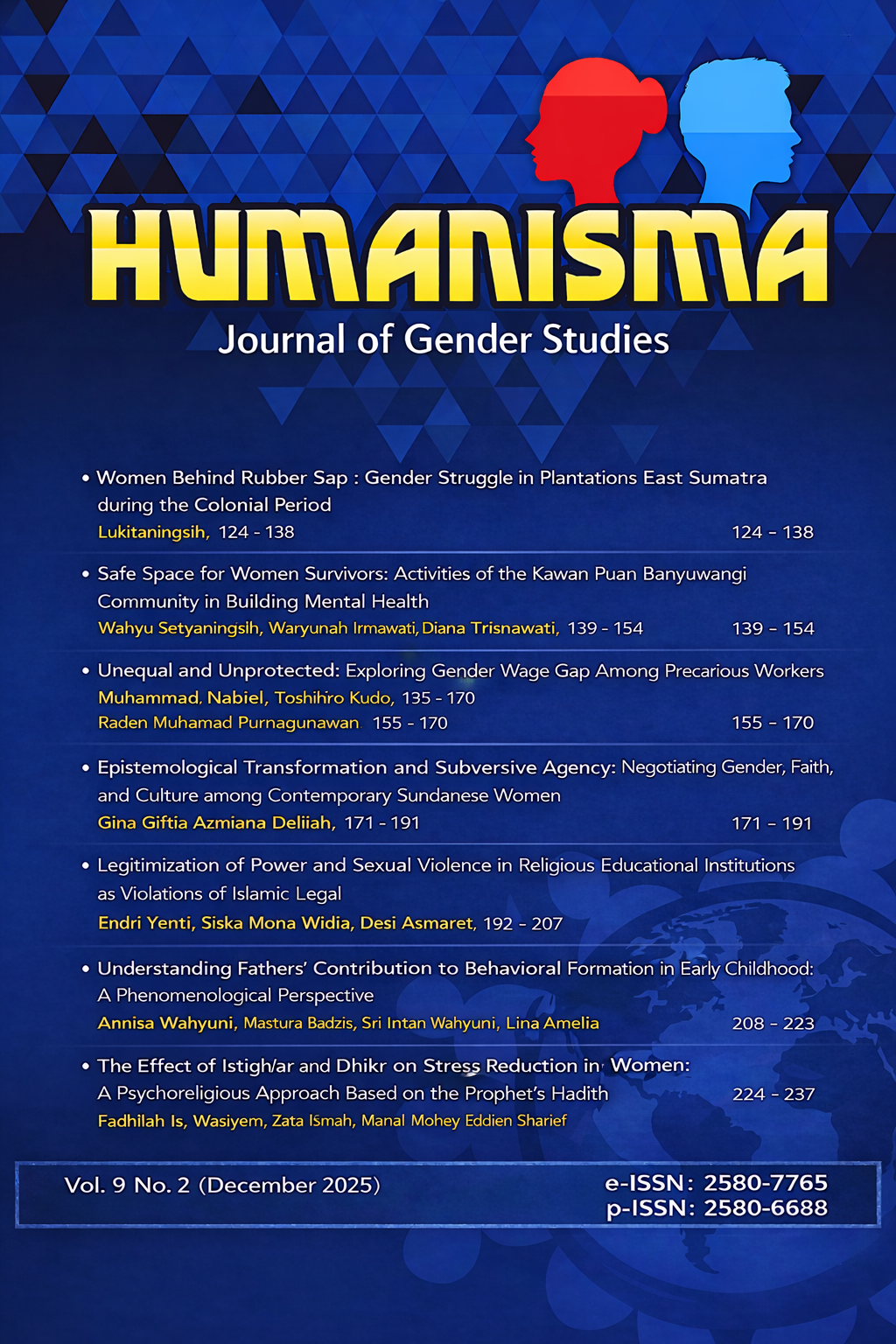
Understanding Fathers’ Contribution to Behavioral Formation in Early Childhood: A Phenomenological Perspective
DOI:
https://doi.org/10.30983/humanisma.v9i2.10032Keywords:
Father Involvement, Complementary Parenting, Emotional Literacy, Early ChildhoodAbstract
References
Airin Mutiarasari,Aan Listiana, Yeni Rachmawati. “Strategi Dan Tantangan Keterlibatan Ayah Dalam Pengasuhan Anak Usia Dini Di Era Digital.” Jurnal Obsesi: Jurnal Pendidikan Anak Usia Dini 8, no. 6 (2024): 5779–92. Akses URL.
Alhazmi, A, and A Kaufmann. “Phenomenological Qualitative Methods Applied to the Analysis of Cross-Cultural Experience in Novel Educational Social Contexts.” Frontiers in Psychology, 2022. https://doi.org/10.3389/fpsyg.2022.785134.
Alifia Nabila Sausan , Esya Anesty Mashudi, Pepi Nuroniah. “Keterlibatan Ayah Dalam Perkembangan Kognitif Anak Usia Dini: Sebuah Studi Korelasional,” n.d.
Amanullah, Akhmad Syah Roni, Endang Sri Wulaningsih, and Indrayani Nurdiana Sari. “Implementasi Teknik Scaffolding Untuk Mengembangkan Kecerdasan Kognitif Anak Usia Dini.” Awwaliyah: Jurnal Pendidikan Guru Madrasah Ibtidaiyah 5, no. 1 (2022): 94–106.
Brantasari, M. “Peran Pengasuhan Ayah Terhadap Perilaku Empati Anak Usia Dini.” Pendas Mahakam: Jurnal Pendidikan Dan Pembelajaran Sekolah Dasar, 2022. https://doi.org/10.24903/pm.v6i2.861.
Braun, V, and V Clarke. “Using Thematic Analysis in Psychology.” Qualitative Research in Psychology 3, no. 2 (2006): 77–101. https://doi.org/10.1191/1478088706qp063oa.
Craig, A G, J M D Thompson, R F Slykerman, C R Wall, R Murphy, E A Mitchell, and K E Waldie. “The Long-Term Effects of Early Paternal Presence on Children’s Behavior.” Journal of Child and Family Studies, 2018. https://doi.org/10.1007/S10826-018-1206-1.
Creswell, J W, and C N Poth. Qualitative Inquiry and Research Design: Choosing Among Five Approaches. 4th ed. Thousand Oaks, CA: SAGE Publications, 2018.
Davies, E. “Family, Men’s Involvement In.” In The Blackwell Encyclopedia of Sociology, 2022. https://doi.org/10.1002/9781405165518.wbeosf014.pub2.
Debi Irama, Sutarto, Syamsul Risal. “IMPLEMENTASI TEORI BELAJAR SOSIAL MENURUT ALBERT BANDURA DALAM” 12 (n.d.): 129–39.
Diniz, E, T Brandão, and M Veríssimo. “Father Involvement during Early Childhood: A Systematic Review of Qualitative Studies.” Family Relations, 2023. https://doi.org/10.1111/fare.12858.
Dri, E, V Bressan, L Cadorin, S Stevanin, G Bulfone, A Rizzuto, and G Luca. “Providing Care to a Family Member Affected by Head and Neck Cancer: A Phenomenological Study.” Supportive Care in Cancer, 2020. https://doi.org/10.1007/S00520-019-05026-2.
F Febrianni, RF Haristawati, R Annisa, Z Humaero. “Strategi Scaffolding Dalam Evaluasi Pembelajaran Pendidikan Jasmani Di TK Murni Asih.” Jurnal Untirta, 2024. Akses URL.
Fernandes, C, M Fernandes, A J Santos, M Antunes, L Monteiro, B E Vaughn, and M Veríssimo. “Early Attachment to Mothers and Fathers: Contributions to Preschoolers’ Emotional Regulation.” Frontiers in Psychology, 2021. https://doi.org/10.3389/FPSYG.2021.660866.
Flourishing, Jurnal. “Dampak Ketiadaan Figur Ayah Pada Gender Role Development Seorang Anak.” Jurnal Flourishing, 2023. Akses URL.
Garcia, D, R Castillo, and C Alvarez. “Father’s Emotional Responsiveness and the Development of Preschoolers’ Social Competence.” Journal of Child and Family Studies 31, no. 9 (2022): 2305–18. https://doi.org/10.1007/s10826-022-02311-5.
Giannotti, M, M Gemignani, P Rigo, P Venuti, and S de Falco. “The Role of Paternal Involvement on Behavioral Sensitive Responses and Neurobiological Activations in Fathers: A Systematic Review.” Frontiers in Behavioral Neuroscience, 2022. https://doi.org/10.3389/fnbeh.2022.820884.
Go, L, and M F Pang. “Phenomenography in the ‘Lived’ Context of Parental Learning.” International Journal of Qualitative Methods, 2021. https://doi.org/10.1177/16094069211016160.
Gonzalez, J C, C C Klein, M L Barnett, and N K Schatz. “Intervention and Implementation Characteristics to Enhance Father Engagement: A Systematic Review of Parenting Interventions.” Clinical Child and Family Psychology Review, 2023. https://doi.org/10.1007/s10567-023-00430-x.
Gultom, R, R Sihombing, D N Sinaga, and S Sijabat. “PERAN AYAH DALAM MEMBANGUN KARAKTER ANAK.” Jurnal Pendidikan Sosial Dan Humaniora 4, no. 1 (2024): 587–96. https://publisherqu.com/index.php/pediaqu/article/view/1638.
H Yuliah, RA Aprianty, DL Quarta. “Pengaruh Father Involvement Terhadap Kontrol Diri Pada Generasi Z Di Kota Banjarmasin.” Innovative: Journal Of Social Science Research 5, no. 4 (2025): 8703–18. Akses URL.
Hadfield, K, M Al-Soleiti, R Dajani, and I Mareschal. “Father Involvement and Child Development: A Prospective Study of Syrian Refugee Families.” Journal of Child and Family Studies, 2024. https://doi.org/10.1007/s10826-024-02809-y.
Halodoc. “Kata Psikolog: Pentingnya Peranan Ayah Pada Karakter Anak.” Halodoc, 2022. https://www.halodoc.com/artikel/kata-psikolog-pentingnya-peranan-ayah-pada-karakter-anak.
Han, Y, K Liu, and Y Xie. “Factors Affecting Father Involvement in Parenting and Solutions.” Journal of Education, Humanities and Social Sciences, 2023. https://doi.org/10.54097/ehss.v8i.4624.
Herawati, H, and R Yulia. “Pemberdayaan Ibu Rumah Tangga Sebagai Upaya Mengembangkan Kemandirian Dan Budaya Kreatif Pendidikan Anak Usia Dini Almukmin Di Kelurahan Way Kandis Bandar Lampung.” Jurnal Pengabdian Kepada Masyarakat Indonesia, 2023. https://doi.org/10.55606/jpkmi.v3i1.1054.
Ihsan, A L, Jurnal Pendidikan, Islam Anak, Usia Dini, and Online Issn. “No Title” 2 (2021).
Ika Anggraheni, Devi Wahyu Ertanti. “Pengaruh Keterlibatan Ayah Dalam Pendidikan Anak Usia Dini Terhadap Perkembangan Karakter Moral” 10 (2024): 96–101.
Ingriani, Diva, Ulfa Dwina, Muhammad Fajar Yuwanda, and Kania Jeanrita. “Dampak Father Involvement Dalam Pengasuhan Remaja,” 2025.
Isnaini, Ayu, Nawang Warsi Wulandari, and Deasy Christia Sera. “Pengaruh Keterlibatan Ayah Dalam Pengasuhan (Father Involvement) Terhadap Konsep Diri Remaja.” Jurnal Psikologi Tabularasa 16, no. 2 (2021): 77–82.
Kamila Syafa Zahira, Wiwien Dinar Pratisti. “KETERLIBATAN PENGASUHAN AYAH DALAM MENDUKUNG KEMANDIRIAN ANAK USIA DINI,” n.d.
Kelas, Bandura Di, and Keanu Pramudiantoro. “Upaya Guru Dalam Mengimplementasi Teori Belajar Sosial Albert” 9439, no. May (2025): 17–24.
Kotelchuck, M. “The Impact of Fatherhood on Men’s Health and Development,” 2022. https://doi.org/10.1007/978-3-030-75645-1_4.
Lestari, R H, and S K Alam. “Mother’s Perception of Father’s Involvement in Developing Social–Emotional Development of Early Childhood.” In Proceedings of the 3rd International Conference on Learning Innovation and Quality Education (ICLIQE 2019), 2020. https://doi.org/10.2991/ASSEHR.K.200129.011.
Manik, S, M Sembiring, I Padang, and L W Manurung. “Theory of Bandura’s Social Learning in The Process Of Teaching at SMA Methodist Berastagi Kabupaten Karo.” Jurnal Visi Pengabdian Kepada Masyarakat, 2022. https://doi.org/10.51622/pengabdian.v3i2.729.
Marzuki, M, K S Dewi, and D P Paramita. “Father Involvement Pada Ayah Bekerja Di Jabodetabek.” INTUISI: Jurnal Psikologi Ilmiah 11, no. 1 (2019). https://journal.unnes.ac.id/nju/index.php/INTUISI/article/view/20115.
Masyhuri, M, Robi’atul Adawiyah. “Analisis Peran Orang Tua Dalam Pembentukan Karakter Moral Pada Anak Usia Dini” 12, no. 4 (n.d.): 304–19.
Mil, Silvie, Farah Qothrunnada, Pendidikan Guru, Pendidikan Anak, Usia Dini, Universitas Muhammadiyah, and Prof Hamka. “Pengaruh Pengasuhan Ayah Terhadap Perilaku Insecure Anak Usia Dini” 7, no. 4 (2023): 4752–63. https://doi.org/10.31004/obsesi.v7i4.4877.
Moleong, L J. Metodologi Penelitian Kualitatif. Edisi revi. Bandung: PT Remaja Rosdakarya, 2019.
Munifah Bahfen, Sriyanti Rahmatunnisa, Anggita Zahra Ratusila. “Keterlibatan Ayah Dalam Pengasuhan Anak Usia Dini Di Wilayah Kelurahan Ciater.” Jurnal UMJ 7, no. 1 (2023): 93–102. Akses URL.
Nageswaran, S, and S L Golden. “Establishing Relationships and Navigating Boundaries When Caring for Children With Medical Complexity at Home.” Home Healthcare Now, 2018. https://doi.org/10.1097/NHH.0000000000000636.
News, Antara. “20,9 Persen Anak Indonesia Tumbuh Tanpa Peran Ayah.” 2024. https://www.antaranews.com/berita/4956325/209-persen-anak-indonesia-tumbuh-tanpa-peran-ayah.
Novianti, R, and N Islami. “Parenting in Cultural Perspective: A Systematic Review of Paternal Role Across Cultures.” Journal of Ethnic and Cultural Studies, 2023. https://doi.org/10.29333/ejecs/1287.
Nurjanah, Novita Eka, Fasli Jalal, and Asep Supena. “Studi Kasus Fatherless: Peran Ayah Dalam Pengasuhan Anak Usia Dini.” Kumara Cendekia 11, no. 3 (2023): 261–70.
Pajares, Frank, Dale H Schunk, and Self- Concept. “( Perspektif Teori Kognitif Sosial Dan Implikasinya Terhadap Pendidikan ) Abd . Mukhid,” 1994.
“Pelatihan Parenting Skill Bagi Orang Tua Untuk Meningkatkan Keterampilan Dalam Mengasuh Anak.” Jurnal Unsia, 2024. Akses URL.
“Peran Attachment Dalam Kehidupan Sosial Di Masyarakat.” Orasi Ilmiah Universitas Kristen Maranatha, 2024. Akses URL.
PrimaKu. “Peran Penting Ayah Dalam Membangun Rasa Percaya Diri Anak,” 2024. http://https//...
Puglisi, N, V Rattaz, N Favez, and H Tissot. “Father Involvement and Emotion Regulation during Early Childhood: A Systematic Review.” BMC Psychology, 2024. https://doi.org/10.1186/s40359-024-02182-x.
Putri, M, Puspitawati, Subandi, M G Adiyanti, E O S Hiariej, and S Bulut. “Factors Inhibiting the Psychological Recovery Process of Children in Conflict with the Law.” Unpublished Manuscript, 2023.
Rasdi, R, M Ismail, and S Wook. “How Do Malaysian Adolescent Children Perceive Their Fathers’ Involvement in Their Parenting?” Journal of Social Sciences 11, no. 2 (2015). https://www.researchgate.net/publication/282851733_How_do_Malaysian_Adolescent_Children_Perceive_their_Fathers%27_Involvement_in_their_Parenting.
Ratna Ganda Ningrum, Heny Wulandari. “Keterlibatan Ayah Dalam Pengasuhan Emosional Anak Usia Dini.” Murhum: Jurnal Pendidikan Anak Usia Dini 6, no. 2 (2025): 544–54. Akses URL.
Ruli, Efrianus. “Tugas Dan Peran Orang Tua Dalam Mendidk Anak.” Jurnal Edukasi Nonformal 1, no. 1 (2020): 143–46.
Septianingsih, Yuli Kurniawati Sugiyo Pranoto. “Kelekatan Aman (Secure Attachment) Ayah Terhadap Kecerdasan Sosial Anak Usia 4–6 Tahun.” Jurnal Studi Guru Dan Pembelajaran 8, no. 2 (2025): 1038–49. Akses URL.
Sinta Krisnawati, Rohita. “PERAN AYAH DALAM MENANAMKAN NILAI IBADAH PADA” 2, no. 2 (2020).
Sofyan, Muhammad Robbi, and Vania Pramudita Hanjani. “RINEKA :,” no. 1 (2025).
Statistik, Badan Pusat. “Profil Anak Indonesia: Persentase Anak Tinggal Bersama Kedua Orang Tua.” Badan Pusat Statistik, 2023. https://www.bps.go.id.
Strugarek, P, and J Wendland. “Paternal Cognitions and Strategies Related to Sleep Problems of Toddlers: A Qualitative Study from the Father’s Point of View.” Early Child Development and Care, 2022. https://doi.org/10.1080/03004430.2021.2022657.
Sugiyono. Metode Penelitian Kualitatif, Kuantitatif, Dan R&D. Edisi terb. Bandung: Alfabeta, 2022.
Sulung, U, and M Muspawi. “Memahami Sumber Data Penelitian: Primer, Sekunder, Dan Tersier.” Edu Research 5, no. 3 (2024): 110–16.
Syamsuddin, A, Y Pratama, and S Handayani. “Father Involvement and Socio-Emotional Development of Early Childhood in Indonesia.” Early Childhood Research Journal 8, no. 3 (2020): 210–20. https://doi.org/10.31004/ecrj.v8i3.567.
“Teori Pemodelan Bandura.” Jurnal Multidisiplin Madani, 2022. https://doi.org/10.55927/mudima.v2i7.692.
UNESA, S3 PAUD F I P. “Pentingnya Peran Ayah Dalam Pengasuhan Anak Usia Dini.” S3 PAUD FIP UNESA, 2025. Akses URL.
Wahyuni, Annisa, Syamsiah Depalina Siregar, and Riris Wahyuningsih. “Peran Ayah (Fathering) Dalam Pengasuhan Anak Usia Dini.” AL IHSAN: Jurnal Pendidikan Islam Anak Usia Dini 2, no. 2 (2021): 55–66.
Wijaya, Yeny Duriana, Fakultas Psikologi, and Universitas Esa. “Hubungan Keterlibatan Pengasuhan Ayah Dengan Maskulinitas Mahasiswa Pria Universitas ‘ X ’ DI JAKARTA,” 2004.
Downloads
Published
How to Cite
Issue
Section
Citation Check
License
Copyright (c) 2025 Annisa Wahyuni, Mastura Badzis ,Sri Intan Wahyuni,Lina Amelia

This work is licensed under a Creative Commons Attribution-ShareAlike 4.0 International License.
Authors who publish with this journal agree to the following terms:
- Authors retain copyright and grant the journal right of first publication with the work simultaneously licensed under a Creative Commons Attribution-ShareAlike 4.0. that allows others to share the work with an acknowledgment of the work's authorship and initial publication in this journal.
- Authors are able to enter into separate, additional contractual arrangements for the non-exclusive distribution of the journal's published version of the work (e.g., post it to an institutional repository or publish it in a book), with an acknowledgment of its initial publication in this journal.
- Authors are permitted and encouraged to post their work online (e.g., in institutional repositories or on their website) prior to and during the submission process, as it can lead to productive exchanges, as well as earlier and greater citation of published work (See The Effect of Open Access).