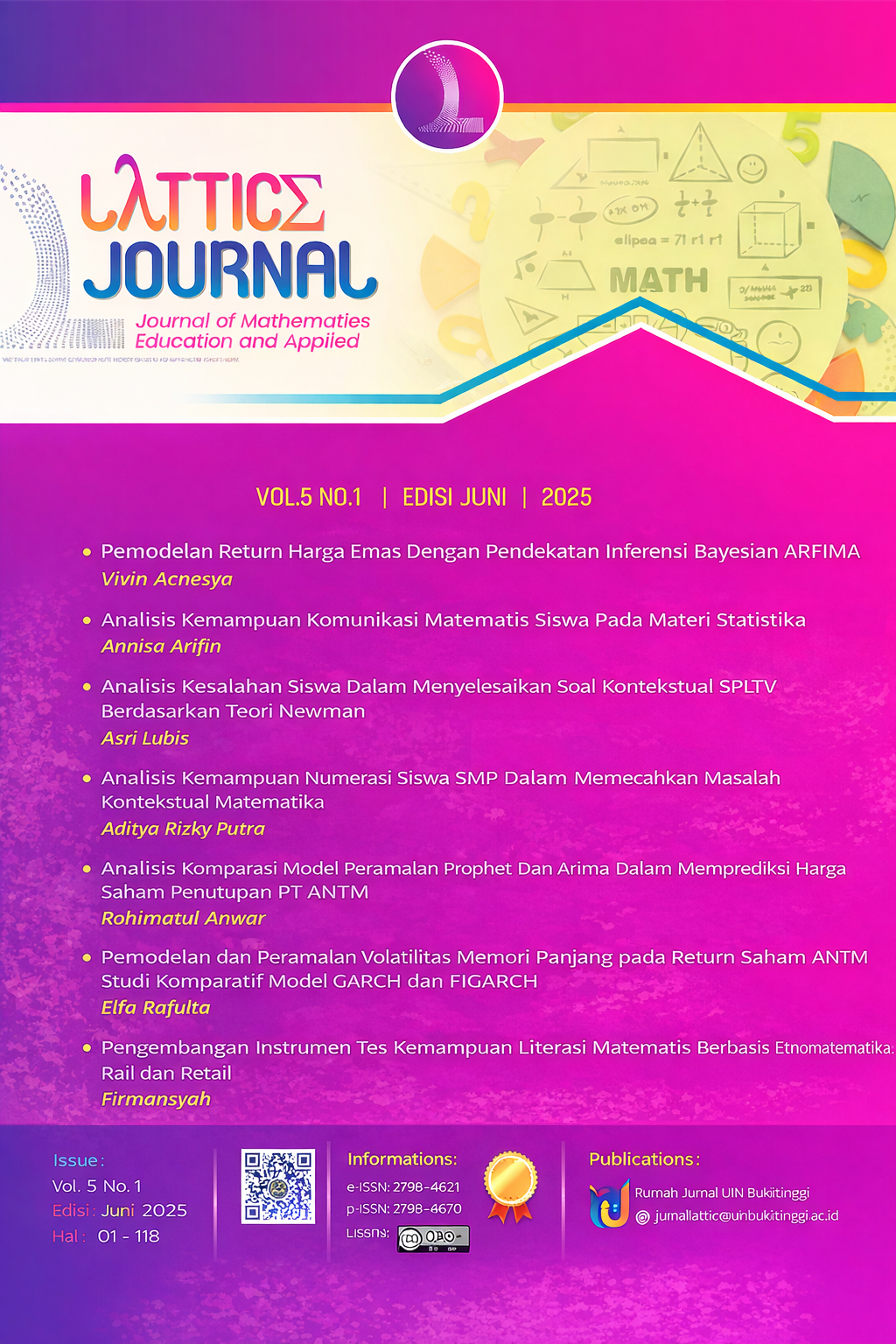
Pemodelan Return Harga Emas Dengan Pendekatan Inferensi Bayesian ARFIMA
DOI:
https://doi.org/10.30983/lattice.v5i1.9403Keywords:
Volatilitas, ARFIMA, Bayesian, EmasAbstract
References
Arif, E., Devianto, D., & Yollanda, M. (2022). Analysis of precious metal price movements using long memory model and fuzzy time series Markov chain. International Journal of Energy Economics and Policy, 12(6), 202–214. https://doi.org/10.32479/ijeep.13531.
Ermanely, E., Devianto, D., & Yanuar, F. (2023). Model volatilitas saham LQ45 dengan pendekatan Markov-Switching GARCH. Jurnal Lebesgue: Jurnal Ilmiah Pendidikan Matematika, Matematika dan Statistika, 4(2). https://doi.org/10.46306/lb.v4i2.402.
Firdaus, R. G. (2020). Pengaruh risiko, return, dan perekonomian Indonesia terhadap keputusan berinvestasi saat COVID-19. Jurnal Pasar Modal dan Bisnis, 2(2), 118.
Mayhisya, E. R. (2023). Bahan ajar manajemen keuangan lanjutan (hlm. 104). Malang: CV Literasi Nusantara Abadi.
Nurfitri Imro’ah, E. D. K. (2020). Peramalan volatilitas saham menggunakan model Threshold Generalized Autoregressive Conditional Heteroscedasticity. Bimaster: Buletin Ilmiah Matematika, Statistika dan Terapannya, 9(1). https://doi.org/10.26418/bbimst.v9i1.38588.
Hachicha, N., Ghorbel, A., Feki, M. C., Tahi, S., & Dammak, F. A. (2022). Hedging Dow Jones Islamic and conventional emerging market indices with CDS, oil, gold and the VSTOXX: A comparison between DCC, ADCC and GO-GARCH models. Borsa Istanbul Review, 22(2). https://doi.org/10.1016/j.bir. 2021.04.002.
L. Liu, Q. Geng, Y. Zhang, and Y. Wang, “Investors’ perspective on forecasting crude oil return volatility: Where do we stand today?,” Journal of Management Science and Engineering, vol. 7, no. 3. 2022. doi: 10.1016/j.jmse.2021.11.001.
Arif, E., Herlinawati, E., Devianto, D., Yollanda, M., & Permana, D. (2024). Hybridization of long short-term memory neural network in fractional time series modeling of inflation. Frontiers in Big Data, 6, 1282541. https://doi.org/10.3389/fdata.2024.1282541.
Kartikasari, P., Yasin, H., & Maruddani, D. A. I. (2021). Autoregressive fractional integrated moving average (ARFIMA) model to predict COVID-19 pandemic cases in Indonesia. Media Statistika, 14(1), 44–55. https://doi.org/10.14710/medstat.14.1.44-55.
Devianto, D., Ramadani, K., Maiyastri, Asdi, Y., & Yollanda, M. (2022). The hybrid model of autoregressive integrated moving average and fuzzy time series Markov chain on long-memory data. Frontiers in Applied Mathematics and Statistics, 8, 1045241. https://doi.org/10.3389/fams.2022. 1045241.
Devianto, D., Wahyuni, E., Maiyastri, M., & Yollanda, M. (2024). The seasonal model of chili price movement with the effect of long memory and exogenous variables for improving time series model accuracy. Frontiers in Applied Mathematics and Statistics, 10, 1408381. https://doi.org/10.3389/fams. 2024. 1408381.
Devianto, D., Ramadani, K., Juwita, D., Almuhayar, M., & Bahari, A. (2025). The long short-term memory model as the neural networks approach in modeling water supply structural production. Communications in Mathematical Biology and Neuroscience, 2025, Article-ID.
Devianto, D., Yollanda, M., Maryati, S., Maiyastri, Asdi, Y., & Wahyuni, E. (2023). The Bayesian vector autoregressive model as an analysis of the government expenditure shocks while the COVID-19 pandemic to macroeconomic factors. Journal of Open Innovation: Technology, Market, and Complexity, 9(4). https://doi.org/10.1016/j.joitmc.2023.100156.
Devianto, D., Afifah, A. N., & Febrianti, I. K. (2021). The Bayesian model of COVID-19 case fatality rate proportion on provinces in Indonesia. IOP Conference Series: Earth and Environmental Science, 708(1), 012057. https://doi.org/10.1088/1755-1315/708/1/012057.
Ghouli, D., & Ourbih-Tari, M. (2023). Bayesian autoregressive adaptive refined descriptive sampling algorithm in the Monte Carlo simulation. Statistical Theory and Related Fields, 7(3), 177–187. https://doi.org/10.1080/24754269.2023.2180225.
Albassam, M., Soliman, E. E. A., & Ali, S. S. (2022). Bayesian estimation of multivariate pure moving average processes. IEEE Access, 10, 14225–14235. https://doi.org/10.1109/ACCESS.2022.3146724.
Miyandoab, M. F., Nasiri, P., & Mosammam, A. M. (2023). Bayesian estimation of fractional difference parameter in ARFIMA models and its application.
Aslam, F., Mohti, W., & Ferreira, P. (2020). Predicting precious metals returns using Bayesian time series models. Resources Policy, 68, 101751. https://doi.org/10.1016/j.resourpol.2020.101751.
Qian, Y., & Su, L. (2021). Bayesian long memory modeling in commodity prices: Evidence from gold and silver. Journal of Commodity Markets, 24, 100165. https://doi.org/10.1016/j.jcomm.2021.100165.
Ardia, D., Bluteau, K., & Boudt, K. (2022). Forecasting long-memory volatility using Bayesian ARFIMA-GARCH models. Econometrics and Statistics, 24, 109–124. https://doi.org/10.1016/j.ecosta. 2021.10.001.
Downloads
Published
How to Cite
Issue
Section
Citation Check
License
Copyright (c) 2025 Vivin Acnesya, Dodi Devianto, Maiyastri

This work is licensed under a Creative Commons Attribution-ShareAlike 4.0 International License.
Authors who publish with Lattice Journal : Journal of Mathematics Education and Applied agree to the following terms: Authors retain copyright and grant the Lattice Journal : Journal of Mathematics Education and Applied right of first publication with the work simultaneously licensed under a Creative Commons Attribution License (CC BY-SA 4.0) that allows others to share (copy and redistribute the material in any medium or format) and adapt (remix, transform, and build upon the material) the work for any purpose, even commercially with an acknowledgement of the work's authorship and initial publication in Lattice Journal : Journal of Mathematics Education and Applied. Authors are able to enter into separate, additional contractual arrangements for the non-exclusive distribution of the journal's published version of the work (e.g., post it to an institutional repository or publish it in a book), with an acknowledgement of its initial publication in Lattice Journal : Journal of Mathematics Education and Applied. Authors are permitted and encouraged to post their work online (e.g., in institutional repositories or on their website) prior to and during the submission process, as it can lead to productive exchanges, as well as earlier and greater citation of published work (See The Effect of Open Access).