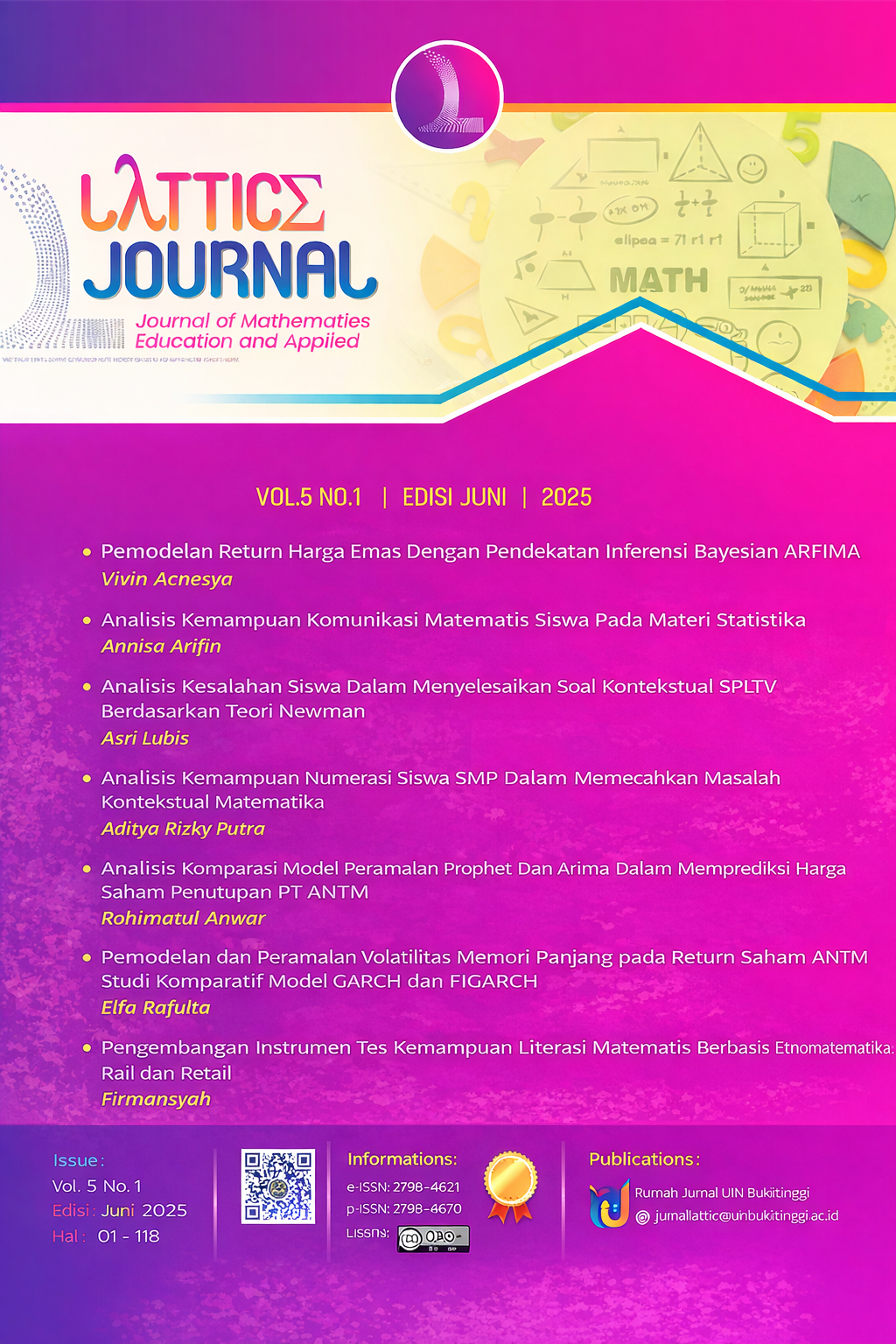
Analisis Kesalahan Siswa Dalam Menyelesaikan Soal Kontekstual SPLTV Berdasarkan Teori Newman
DOI:
https://doi.org/10.30983/lattice.v5i1.9399Keywords:
Kesalahan Siswa, SPLTV, Teori Newman, Masalah KontekstualAbstract
References
L. Laelasari, “Analisis Kemampuan Pemecahan Masalah Matematis Pada Materi Sistem Persamaan Linear Tiga Variabel ( SPLTV ) Di SMA PGRI 4 Jakarta,” J. Ilm. Mat. , Kebumian dan Angkasa, vol. 3, no. 1, pp. 16–25, 2025.
O. H. Delvia and L. Z. Cut, “Analisis Kesalahan Siswa Berdasarkan Newman’s Error Analysis Dalam Menyelesaikan Soal Cerita Dan Minat Belajar Siswa Menggunakan Model Contextual Teaching Learning,” J. MathEducation Nusant., vol. 6, no. 2, pp. 143–154, 2018.
H. Faradilla, E. Yanty, and P. Nasution, “Analisis Kesalahan Siswa Menurut Teori Newman dalam Menyelesaikan Masalah Persamaan Garis Lurus Berdasarkan Tipe Kepribadian Judging dan Perceiving,” J. Pendidik. Mat., vol. 4(3), no. November 2024, pp. 571–590, 2024.
H. MUSTIKA, P. ASTUTI, S. Y. NINGSIH, G. H. MEDIKA, H. T. ARJELIA, and R. FITRI, “ANALISIS KEMAMPUAN BERPIKIR KRITIS MATEMATIS SISWA PADA MATERI ARITMATIKA SOSIAL BERDASARKAN PERBEDAAN GENDER,” Ensiklopedia J., vol. 2, no. 2, pp. 155–164, 2020.
J. Jefriza, Z. Aima, and L. Lovia, “Analisis Kesalahan Siswa dalam Menyelesaikan Soal Cerita Siswa Kelas X IPS,” Lattice J. J. Math. Educ. Appl., vol. 1, no. 2, p. 101, 2022, doi: 10.30983/lattice.v1i2.5017.
M. I. Nuralam, E. Senjayawati, I. Siliwangi, J. Terusan, and J. Sudirman, “Jurnal Pembelajaran Matematika Inovatif ANALISIS KESALAHAN SISWA SMA KELAS X DALAM MENYELESAIKAN SOAL KONEKSI MATEMATIS MATERI SISTEM PERSAMAAN LINEAR TIGA VARIABEL”, doi: 10.22460/jpmi.v6i3.17096.
M. Aziza and E. Eratika, “Newman’s Error Analysis: The Errors of 4th Grade Students in Solving TIMSS Problems,” J. Pendidik. Mat., vol. 5, no. 2, p. 123, Dec. 2022, doi: 10.21043/jpmk.v5i2.16618.
I. Darmawan et al., “Analisis Kesalahan Siswa SMP Berdasarkan Newman dalam Menyelesaikan Soal Kemampuan Berpikir Kritis Matematis pada Materi Bangun Ruang Sisi datar,” 2018.
R. Nopiana and N. Ratnaningsih, “Analisis Kesalahan Siswa Dalam Menyelesaikan Soal Cerita SPLTV Ditinjau Dari Motivasi Belajar,” SJME (Supremum J. Math. Educ., vol. 7, no. 2, pp. 233–242, Jul. 2023, doi: 10.35706/sjme.v7i2.7952.
J. Aulia, “Analisis Kesalahan Siswa dalam Menyelesaikan Soal Matematika Pada Materi Himpunan Kelas VII SMP/MTs,” vol. 05, no. 01, pp. 484–500, 2021.
U. I. Anisa, E. Suanto, P. Yuanita, and M. Maimunah, “Analisis Kesalahan Siswa pada Pembelajaran Matematika Berdasarkan Teori Newman dalam Menyelesaikan Soal SPLDV,” J. Paedagogy, vol. 10, no. 1, p. 250, 2023, doi: 10.33394/jp.v10i1.6496.
A. A. Tias and I. Ismail, “Analisis Kesalahan Siswa SMA dalam Menyelesaikan Soal Cerita Matematika SPLTV Berdasarkan Prosedur Newman Ditinjau dari Gaya Belajar,” MATHEdunesa, vol. 12, no. 2, pp. 359–371, Jul. 2023, doi: 10.26740/mathedunesa.v12n2.p359-371.
I Made Parma, “Matematika Berbasis Pemecahan Masalah,” J. Pendidik. dan Pengajaran, vol. 42(1), no. April 2009, pp. 51–58, 2006.
K. Putrieny and R. Setiani, “Newman Error Analysis (Nea) Dalam Pemecahan Masalah Berdasarkan Teori Polya Soal Cerita Bertipe Hots Materi Volume Balok Siswa Kelas V Sdn 2 Tanggulwelahan,” J. Pendidik. DEWANTARA Media Komunikasi, Kreasi dan Inov. Ilm. Pendidik., vol. 9, no. 2, pp. 63–71, 2023, doi: 10.55933/jpd.v9i2.512.
A. Augina et al., “Teknik Pemeriksaan Keabsahan Data pada Penelitian Kualitatif di Bidang Kesehatan Masyarakat,” 2020.
S. P. Dewi and K. Kartini, “Analisis Kesalahan Siswa Dalam Menyelesaikan Soal Sistem Persamaan Linear Tiga Variabel Berdasarkan Prosedur Kesalahan Newman,” vol. 05, pp. 632–642.
Buyung and Dwijanto, “Analisis Kemampuan Literasi Matematis Melalui Pembelajaran Inkuiri Dengan Strategi Scaffolding,” UJMER Unnes J. Math. Educ. Res., vol. 6, no. 1, pp. 112–119, 2017.
A. Fuady, “BERFIKIR REFLEKTIF DALAM PEMBELAJARAN MATEMATIKA,” J. Ilm. Pendidik. Mat., vol. 1(2), pp. 104–112.
M. S. Lubis, N. A. Lubis, J. P. Matematika, I. Tarbiyah, and D. Keguruan, “ANALISIS KESALAHAN SISWA DALAM MENYELESAIKAN SOAL MATEMATIKA TIPE HOTS MENGGUNAKAN TEORI NEWMAN DI KELAS X SMA NEGERI 1 SIBOLGA 1,” J. Mat. dan Pendidik. Mat., vol. 8(1), no. April 2024, p. 2024, 2024.
Downloads
Published
How to Cite
Issue
Section
Citation Check
License
Copyright (c) 2025 Asri Rahmayani Lubis, Putri Yuanita, Nahor Murani Hutapea

This work is licensed under a Creative Commons Attribution-ShareAlike 4.0 International License.
Authors who publish with Lattice Journal : Journal of Mathematics Education and Applied agree to the following terms: Authors retain copyright and grant the Lattice Journal : Journal of Mathematics Education and Applied right of first publication with the work simultaneously licensed under a Creative Commons Attribution License (CC BY-SA 4.0) that allows others to share (copy and redistribute the material in any medium or format) and adapt (remix, transform, and build upon the material) the work for any purpose, even commercially with an acknowledgement of the work's authorship and initial publication in Lattice Journal : Journal of Mathematics Education and Applied. Authors are able to enter into separate, additional contractual arrangements for the non-exclusive distribution of the journal's published version of the work (e.g., post it to an institutional repository or publish it in a book), with an acknowledgement of its initial publication in Lattice Journal : Journal of Mathematics Education and Applied. Authors are permitted and encouraged to post their work online (e.g., in institutional repositories or on their website) prior to and during the submission process, as it can lead to productive exchanges, as well as earlier and greater citation of published work (See The Effect of Open Access).