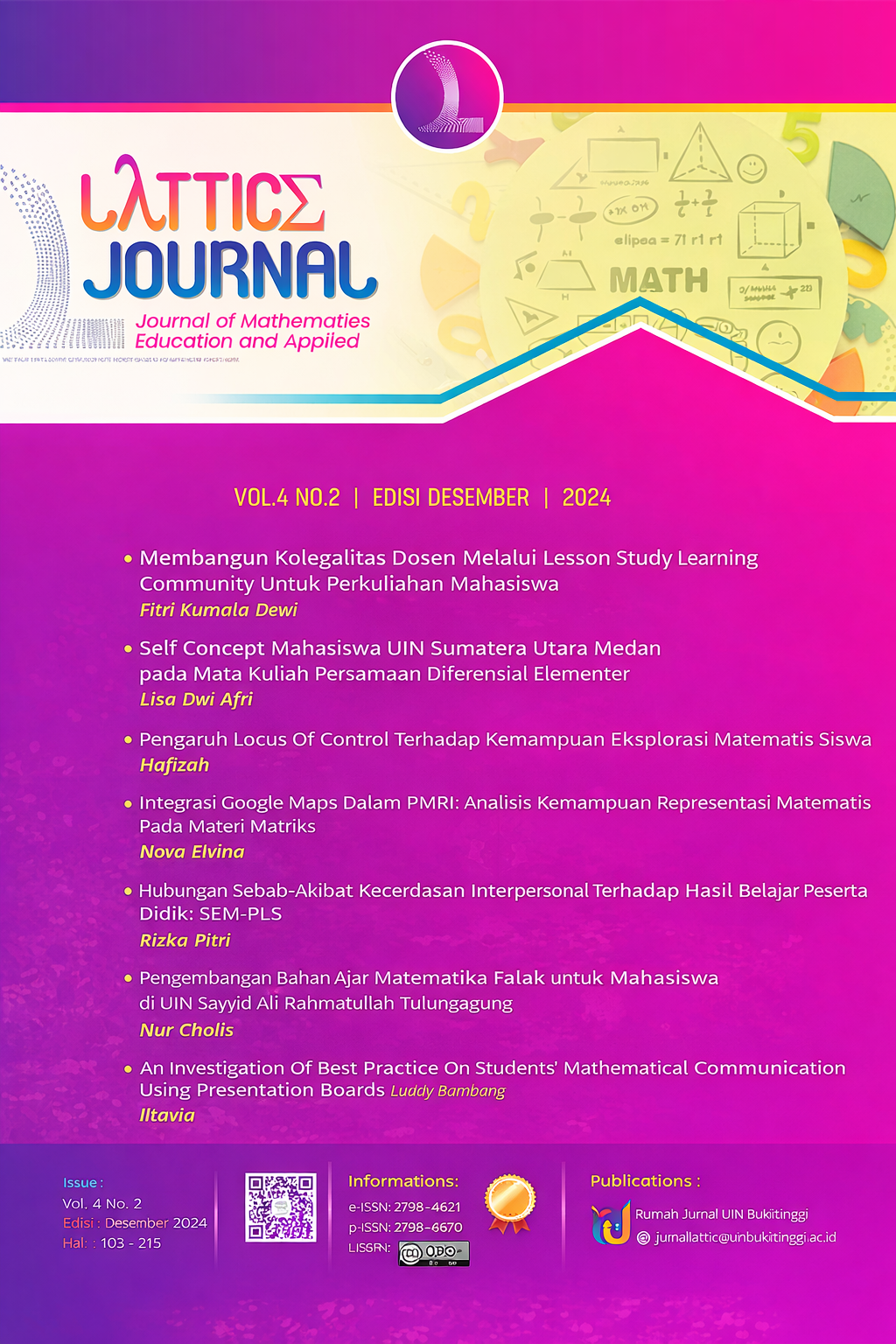
An Investigation Of Best Practice On Students' Mathematical Communication Using Presentation Boards
DOI:
https://doi.org/10.30983/lattice.v4i2.8673Keywords:
Best practice, Mathematical communication, Presentation boardsAbstract
References
B. s. Miller, “The 6Cs Squared Version of Education in the 21st Century.”
M. Anugerahwati, “Integrating the 6Cs of the 21st Century Education into the English Lesson and the School Literacy Movement in Secondary Schools,” KnE Soc. Sci., vol. 3, no. 10, p. 165, 2019, doi: 10.18502/kss.v3i10.3898.
OECD, PISA 2022 MATHEMATICS FRAMEWORK (DRAFT). 2018.
B. Chen, Yuelan., He, Xiaoyan., Xu, “The Development of Communication in Chinese Mathematics Curricula,” in Beyond Shanghai and PISA Cognitive and Non-cognitive Competencies of Chinese Students in Mathematics, X. Xu, Biyan., Zhu, Yan., Lu, Ed., Switzerland: Springer Nature Switzerland AG, 2021, pp. 235–253. doi: https://doi.org/10.1007/978-3-030-68157-9.
B. Wilson, “Mathematical Communication through Written and Oral Expression,” J. Math. Educ., vol. 23, no. 3, pp. 122–134, 2009.
D. T. Utari, D. P. Utomo, and Z. Zukhrufurrohmah, “Effectiveness of the application of Quantum Learning Model in terms of students’ written mathematical communication skills,” Math. Educ. J., vol. 4, no. 2, pp. 177–186, 2020, doi: 10.22219/mej.v4i2.12228.
D. P. Utomo and D. L. Syarifah, “Examining mathematical representation to solve problems in trends in mathematics and science study: Voices from Indonesian secondary school students,” Int. J. Educ. Math. Sci. Technol., vol. 9, no. 3, pp. 540–556, 2021, doi: 10.46328/IJEMST.1685.
D. Tiwow, V. Wongkar, N. O. Mangelep, and E. A. Lomban, “Pengaruh Media Pembelajaran Animasi Powtoon Terhadap Hasil Belajar Ditinjau dari Minat Belajar Peserta Didik,” J. Focus Action Res. Math. (Factor M), vol. 4, no. 2, pp. 107–122, 2022, doi: 10.30762/factor_m.v4i2.4219.
N. O. Mangelep, “Pengembangan Website Pembelajaran Matematika Realistik Untuk Siswa Sekolah Menengah Pertama,” Mosharafa J. Pendidik. Mat., vol. 6, no. 3, pp. 431–440, 2018, doi: 10.31980/mosharafa.v6i3.331.
I. Magdalena, A. Fatakhatus Shodikoh, A. R. Pebrianti, A. W. Jannah, I. Susilawati, and U. M. Tangerang, “Pentingnya Media Pembelajaran Untuk Meningkatkan Minat Belajar Siswa Sdn Meruya Selatan 06 Pagi,” Ed. J. Edukasi dan Sains, vol. 3, no. 2, pp. 312–325, 2021.
D. H. Tong, B. P. Uyen, and N. V. A. Quoc, “The improvement of 10th students’ mathematical communication skills through learning ellipse topics,” Heliyon, vol. 7, no. 11, p. e08282, 2021, doi: 10.1016/j.heliyon.2021.e08282.
A. Sfard, Thiking As Communicating Human Development, the Growth of Discourses, and Mathematizing. CAMBRIDGE UNIVERSITY PRESS, 2008.
Abraham Arcavi, “the Role of Visual Representations in the Learning of Mathematics,” Educ. Stud. Math., vol. 103, no. 3, pp. 239–248, 2003.
M. M. David and V. S. Tomaz, “The role of visual representations for structuring classroom mathematical activity,” Educ. Stud. Math., vol. 80, no. 3, pp. 413–431, 2012, doi: 10.1007/s10649-011-9358-6.
I. Lavie, A. Steiner, and A. Sfard, “Routines we live by: from ritual to exploration,” Educ. Stud. Math., vol. 101, no. 2, pp. 153–176, 2019, doi: 10.1007/s10649-018-9817-4.
Downloads
Published
How to Cite
Issue
Section
Citation Check
License
Copyright (c) 2024 Luddy Bambang Sasongko, Rita Lefrida

This work is licensed under a Creative Commons Attribution-ShareAlike 4.0 International License.
Authors who publish with Lattice Journal : Journal of Mathematics Education and Applied agree to the following terms: Authors retain copyright and grant the Lattice Journal : Journal of Mathematics Education and Applied right of first publication with the work simultaneously licensed under a Creative Commons Attribution License (CC BY-SA 4.0) that allows others to share (copy and redistribute the material in any medium or format) and adapt (remix, transform, and build upon the material) the work for any purpose, even commercially with an acknowledgement of the work's authorship and initial publication in Lattice Journal : Journal of Mathematics Education and Applied. Authors are able to enter into separate, additional contractual arrangements for the non-exclusive distribution of the journal's published version of the work (e.g., post it to an institutional repository or publish it in a book), with an acknowledgement of its initial publication in Lattice Journal : Journal of Mathematics Education and Applied. Authors are permitted and encouraged to post their work online (e.g., in institutional repositories or on their website) prior to and during the submission process, as it can lead to productive exchanges, as well as earlier and greater citation of published work (See The Effect of Open Access).