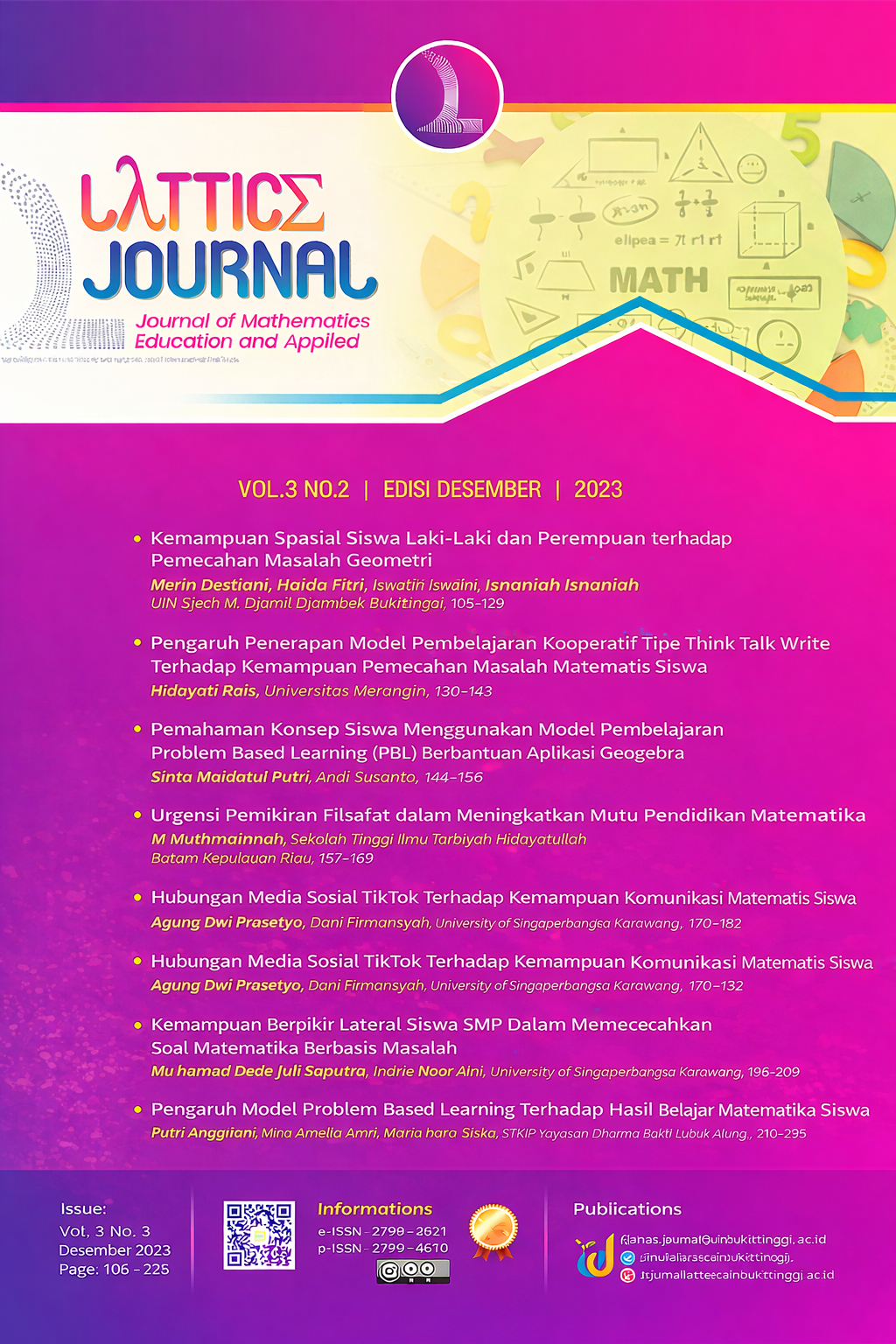
Kemampuan Berpikir Lateral Siswa SMP Dalam Memecahkan Soal Matematika Berbasis Masalah
DOI:
https://doi.org/10.30983/lattice.v3i2.7627Keywords:
Lateral Thinking Ability, Problem SolvingAbstract
References
Puspitaningtyas, “Proses berpikir lateral siswa sd dalam menyelesaikan masalah matematika open-ended ditinjau dari perbedaan gaya belajar,†MAJAMATH J. Pendidik. dan Mat., vol. 1, no. 1, pp. 24–30, 2019.
Wardhani, “Proses berpikir siswa berdasarkan kerangka kerja Manson.,",†JARME (Journal Authentic Res. Math. Educ., pp. 112–123, 2019.
Nurjanah, “Proses berpikir siswa berkecerdasan matematis logis dalam menyelesaikan masalah matematis,†J. Pendidik. Teor. Penelitian, dan Pengemb., vol. 4, no. 11, 2019.
Muliawati, “Proses Berpikir Lateral Siswa dalam Memecahkan Masalah Berdasarkan Gaya Kognitif dan Gender,†JP2M (Jurnal Pendidik. dan Pembelajaran Mat., vol. 2, no. 1, pp. 55–68, 2016.
Pradhini, “Meningkatkan Kemampuan Komunikasi dan Pemecahan Masalah serta Disposisi Matematis Siswa SMA melalui Strategi REACT,†STKIP Siliwangi Bandung, 2016.
M. Wati, G. H. Medika, and J. Junaidi, “Pengaruh Kemampuan Koneksi Matematis Terhadap Kemampuan Pemecahan Masalah Matematis Siswa,†Math Educ. J., vol. 5, no. 1, pp. 54–61, 2021, [Online]. Available: https://ejournal.uinib.ac.id/jurnal/index.php/matheduca/article/view/1823
H. K, “The effects of Polya’s heuristic and diary writing on children’s problem solving,†Math. Eduacation Res. J., vol. 7, no. 1, pp. 59–85, 2012.
“ANALISIS KEMAMPUAN PEMECAHAN MASALAH DITINJAU DARI MOTIVASI BELAJAR SISWA MTS,†Math. Learn. Educ., vol. 4, no. 4, 2019.
E. D. Bono, Think! Before it’s too late. London: Vermilion, 2009.
Puspitaningtyas, “Berpikir lateral siswa SD dalam pembelajaran matematika,†Mathema J. Pendidik. Mat., vol. 1, no. 2, pp. 24–30, 2019.
E. D. Bono, Berpikir Lateral Buku Teks Kreativitas. Jakarta: Erlangga, 1991.
Hildayanti, “Penerapan model pembelajaran poget menggunakan media audiovisual dalam membangun kemampuan berpikir lateral siswa,†SNP2M, pp. 325–330, 2019.
E. D. Bono, Lateral Thinking Step By Step. Malta: Kindle Edition, 1970.
P.A, “KEMAMPUAN BERPIKIR LATERAL SISWA SMP DALAM MEMECAHKAN MASALAH MATEMATIKA OPEN-ENDED DITINJAU DARI GAYA BELAJAR SENSING DAN INTUITION,†MATHEdunesa, vol. 11, no. 2, pp. 513–524, 2022.
Wantika, “Kemampuan berpikir lateral siswa smp pada pemecahan masalah geometri,†PRIMA, Pros. Semin. Nas. Mat., pp. 932–937, 2019.
“Purposeful Sampling for Qualitative Data Collection and Analysis in Mixed Method Implementation Research,†Adm. Plicy Ment. Heal. Res., vol. 42, no. 4, pp. 533–544, 2015.
Downloads
Additional Files
Published
How to Cite
Issue
Section
Citation Check
License
Copyright (c) 2023 Muhamad Dede Juli Saputra, Indrie Noor Aini

This work is licensed under a Creative Commons Attribution-ShareAlike 4.0 International License.
Authors who publish with Lattice Journal : Journal of Mathematics Education and Applied agree to the following terms: Authors retain copyright and grant the Lattice Journal : Journal of Mathematics Education and Applied right of first publication with the work simultaneously licensed under a Creative Commons Attribution License (CC BY-SA 4.0) that allows others to share (copy and redistribute the material in any medium or format) and adapt (remix, transform, and build upon the material) the work for any purpose, even commercially with an acknowledgement of the work's authorship and initial publication in Lattice Journal : Journal of Mathematics Education and Applied. Authors are able to enter into separate, additional contractual arrangements for the non-exclusive distribution of the journal's published version of the work (e.g., post it to an institutional repository or publish it in a book), with an acknowledgement of its initial publication in Lattice Journal : Journal of Mathematics Education and Applied. Authors are permitted and encouraged to post their work online (e.g., in institutional repositories or on their website) prior to and during the submission process, as it can lead to productive exchanges, as well as earlier and greater citation of published work (See The Effect of Open Access).