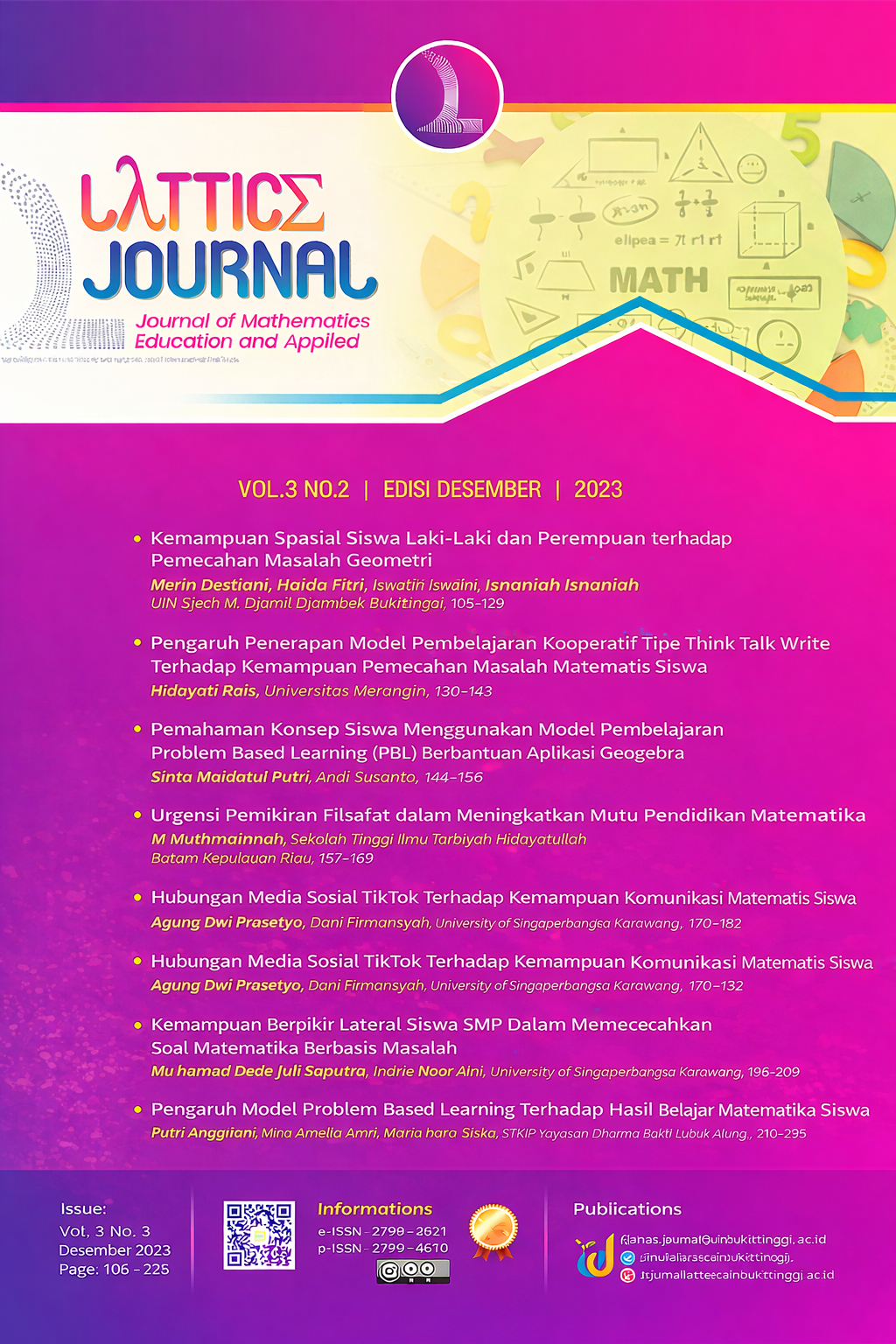
Urgensi Pemikiran Filsafat dalam Meningkatkan Mutu Pendidikan Matematika
DOI:
https://doi.org/10.30983/lattice.v3i2.7553Keywords:
Pemikiran, Filsafat, Mutu, Pendidikan MatematikaAbstract
References
D. Novita Sari and D. Armanto, “Matematika Dalam Filsafat Pendidikan,†AXIOM J. Pendidik. dan Mat., vol. 10, no. 2, p. 202, 2022, doi: 10.30821/axiom.v10i2.10302.
H. H. Ismail, I. Dewi, and E. Simamora, “Keterkaitan antara Filsafat Matematika dengan Model Pembelajaran Berbasis Budaya,†Parad. J. Pendidik. Mat., vol. 15, no. 2, pp. 39–46, 2022.
N. Catur and W. Asih, “Pengaruh Filsafat Dalam Pembelajaran Matematika SD,†Pros. Semin. dan Disk. Nas. Pendidik. Dasar, pp. 337–342, 2018.
Y. D. Sadewo, P. D. Purnasari, and S. Muslim, “Filsafat Matematika: Kedudukan, Peran, Dan Persepektif Permasalahan Dalam Pembelajaran Matematika,†Inov. Pembang. J. Kelitbangan, vol. 10, no. 01, pp. 15–28, 2022, doi: 10.35450/jip.v10i01.269.
M. F. Siswopranoto, “Standar Mutu Pendidikan,†Al-Idaroh J. Stud. Manaj. Pendidik. Islam, vol. 6, no. 1, pp. 17–29, 2022, doi: 10.54437/alidaroh.v6i1.372.
L. O. Kattsoff, Pengantar Filsafat. Yogyakarta: Tiara Wacana Yogya, 2004.
R. Natawidjaja, Teori dan Praksis Ilmu Pendidikan. Bandung: Universitas Pendidikan Indonesia Press, 2007.
A. Tafsir, Filsafat Ilmu, Bandung. Bandung: PT. Remaja Rosdakarya, 2012.
F. J. Miharja, “KUALITAS MANUSIA INDONESIA DI ERA GLOBALISASI,†no. 246, 2015.
F. Rahmi, I. Iltavia, and R. H. Zarista, “Mathematical Literacy of Junior High School Students in Solving Problems PISA in Minang Context,†JTAM (Jurnal Teor. dan Apl. Mat., vol. 6, no. 4, p. 1112, Oct. 2022, doi: 10.31764/jtam.v6i4.10221.
Y. Anggraena, Guru Pembelajar: Modul Matematika SMP. Yogyakarta: Direktorat Jenderal Guru dan Tenaga Kependidikan, 2016.
P. Ernest, The philosophy of mathematics education. 2013. doi: 10.4324/9780203058923.
A. Mullis, I.V.S., Martin, M.O., Foy, P., & Arora, Timss 2011 International Results in Mathematics Executive Summary. 2011.
A. Dariyo, Dasar-dasar Pedagogi Modern. Jakarta: PT Indeks, 2013.
M. Muthma’Innah, J. A. Dahlan, and S. Suhendra, “Ability of mathematical critical thinking - What about Learning Cycle 7E model?,†J. Phys. Conf. Ser., vol. 1157, no. 3, 2019, doi: 10.1088/1742-6596/1157/3/032129.
Putri Kesuma Darma, “Penerapan Model Problem Based Learning dalam Upaya Meningkatkan Pemahaman Konsep Matematis Siswa,†Parad. J. Pendidik. Mat., vol. Vol. 15, p. No 2, 2022.
F. Fairus, I. Dewi, and E. Simamora, “Keterkaitan Filsafat Matematika dengan Model Pembelajaran Berbasis IT,†J. Cendekia J. Pendidik. Mat., vol. 7, no. 1, pp. 538–549, 2023, doi: 10.31004/cendekia.v7i1.1921.
I. Rachmawati, “Relationship between Views of Progressivism and Curriculum 2013 on Mathematics Learning,†J. Math. Math. Educ., vol. 9, no. 2, p. 1, 2019, doi: 10.20961/jmme.v9i2.48392.
L. Suryati, Nizwardi Jalinus, Rizal Abdullah, and Sri Rahmadhani, “Dampak Penerapan Kurikulum Merdeka dalam Prespektif Filsafat Konstruktivisme pada Pendidikan Vokasi,†J. Penelit. dan Pengemb. Pendidik., vol. 7, no. 2, pp. 195–202, 2023, doi: 10.23887/jppp.v7i2.57408.
R. Elia, Y. Erita, and Desyandri, “Penerapan Ilmu Filsafat Dalam Membangun Pola Pikir Siswa Dalam Merespon Pembelajaran Pada Kurikulum Merdeka,†Didakt. J. Ilm. PGSD STKIP Subang, vol. 8, no. 2, pp. 2566–2575, 2023, doi: 10.36989/didaktik.v8i2.571.
Downloads
Published
How to Cite
Issue
Section
Citation Check
License
Copyright (c) 2023 M Muthma'innah

This work is licensed under a Creative Commons Attribution-ShareAlike 4.0 International License.
Authors who publish with Lattice Journal : Journal of Mathematics Education and Applied agree to the following terms: Authors retain copyright and grant the Lattice Journal : Journal of Mathematics Education and Applied right of first publication with the work simultaneously licensed under a Creative Commons Attribution License (CC BY-SA 4.0) that allows others to share (copy and redistribute the material in any medium or format) and adapt (remix, transform, and build upon the material) the work for any purpose, even commercially with an acknowledgement of the work's authorship and initial publication in Lattice Journal : Journal of Mathematics Education and Applied. Authors are able to enter into separate, additional contractual arrangements for the non-exclusive distribution of the journal's published version of the work (e.g., post it to an institutional repository or publish it in a book), with an acknowledgement of its initial publication in Lattice Journal : Journal of Mathematics Education and Applied. Authors are permitted and encouraged to post their work online (e.g., in institutional repositories or on their website) prior to and during the submission process, as it can lead to productive exchanges, as well as earlier and greater citation of published work (See The Effect of Open Access).