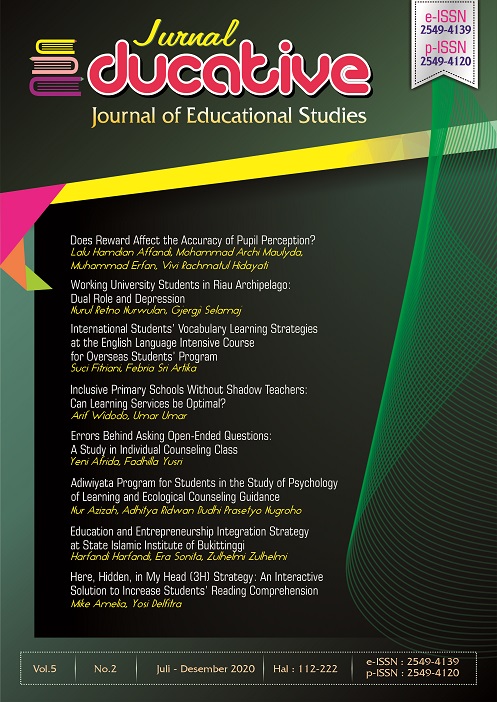
Does Reward Affect the Accuracy of Pupil Perception?
DOI:
https://doi.org/10.30983/educative.v5i2.3169Keywords:
reward, the accuracy of perceptionsAbstract
References
Book
KrejÄÃ, Jana. “Fuzzy Set Theory.†In Studies in Fuzziness and Soft Computing. 5th ed. (Reston: Sanata Dharma University Press, 2018).
Creswell, J. W. Educational Research: Planning, Conducting, and Evaluating Quantitative and Qualitative Research (4th Ed.). 4th ed. (Boston, MA: Pearson, 2012.)
Hake, R.R. Sign-Based Research in Physics Education Research: A Review," in A.E. Kelly, R.A. Lesh, & J.Y. Baek, Eds. (in Press), Handbook of Design Research Methods in Mathematics, Science, and Technology Education. 1st ed. (New York: SAGE Publication, 2007.)
Lieberman, Ann, and Ann Lieberman. “Improving Schools.†In Teaching, Learning and Living. 2nd ed. (New Jersey: Joosey-Bass Publishers, 2018.)
Journal
Ansyar, Mohammad. “Pengembangan Kurikulum Dari Materi Pelajaran Ke Pengalaman Belajar.†2Jurnal Ilmu Pendidikan 8, no. 1 (2016): p, 28–37.
Croft, Tony, Eirini Kouvela, and Paul Hernandez-Martinez. “This Is What You Need to Be Learning: An Analysis of Messages Received by First-Year Mathematics Pupils during Their Transition to University.†Math Ed Res J 30, no. 1 (2018): p, 165–183.
Daniel, João R, Rita R Silva, António J Santos, Jordana Cardoso, Leandra Coelho, Miguel Freitas, OlÃvia Ribeiro, Nina Brück, and Johannes Gutenberg-universität. “Perception Accuracy of Affiliative Relationships in Elementary School Children and Young Adolescents.†Frontiers in Psychology 8, no. 11 (2017): p, 55–65.
Handayani, Fitri. “Structure and Written Expression Section on Paper-Based TOEFL : Perceived Difficulties by Nursing Pupils of Poltekes Solok , West Sumatera.†Jurnal EUCATIVE:Journal of Educational Studies 4, no. 2 (2019): p, 135–149.
Hoque, Enamul. “Memorization: A Proven Method of Learning.†International Journal of Applied Research 22, no. 1 (2017): p, 142–150.
Ikhwanuddin. “Pendekatan Reward Active Cooperative (RAC) Pada Pembelajaran Praktik Gambar Teknik Mahasiswa Non Reguler Jurusan Teknik Sipil Dan Perencanaan Fakultas Teknik UNY.†JPTK 18, no. 2 (2019): p, 170–188.
Ledue, Emily E., Yu Chieh Chen, Aera Y. Jung, Anupama Dahanukar, and Michael D. Gordon. “Pharyngeal Sense Organs Drive Robust Sugar Consumption in Drosophila.†Nature Communications 12, no. 3 (2015): p, 456–467.
Lestari, Isnania, and Budi Tri Siswanto. “The Effect of School On-The Job Experiences, Pupil Achievment in Productive and Social Support on Pupil Work Readiness of Vocational High School.†Jurnal Pendidikan Vokasi 5, no. 2 (2017): p, 183–194.
Luman, Marjolein, Catharina S. Van Meel, Jaap Oosterlaan, and Hilde M. Geurts. “Reward and Punishment Sensitivity in Children with ADHD: Validating the Sensitivity to Punishment and Sensitivity to Reward Questionnaire for Children (SPSRQ-C).†Journal of Abnormal Child Psychology 5, no. 3 (2012): p, 56–78.
Niehorster, Diederick C, and Li Li. “Accuracy and Tuning of Flow Parsing for Visual Perception of Object Motion During.†i-Perception 2, no. 3 (2017): p, 90–108.
Portillo, MarÃa, and Javier Fernández-baena. “PsicologÃa Educativa Social Self-Perception in Adolescents : Accuracy and Bias in Their Perceptions of Acceptance / Rejection.†Psicologia Educativa 26, no. 1 (2020): p, 1–6.
Powell, Elisabeth M., Leslie A. Frankel, and Daphne C. Hernandez. “The Mediating Role of Child Self-Regulation of Eating in the Relationship between Parental Use of Food as a Reward and Child Emotional Overeating.†Appetite 56, no. 3 (2017): p, 452–478.
Roberts, Lindsey, Jenna M. Marx, and Dara R. Musher-Eizenman. “Using Food as a Reward: An Examination of Parental Reward Practices.†Appetite (2018).
Senkbeil, Jason C, Kelsey N Ellis, and Jacob R Reed. “The Influence of Tornado Activity , Impact , Memory , and Sentiment on Tornado Perception Accuracy among College Pupils.†atmosphere Article 10, no. 2 (2019): p, 198–211.
Slamet, and Samsul Maarif. “Pengaruh Bentuk Tes Formatif Assosiasi Pilihan Ganda Dengan Reward Dan Punishment Score Pada Pembelajaran Matematika Siswa Sma.†Infinity: Journal of Mathematics Education 3, no. 1 (2014): p, 59–80.
Van Garderen, D, and M Montague. “Visual-Spatial Representation, Mathematical Problem Solving, and Pupils of Varying Abilities.†Learning Disabilities Research and Practice 18, no. 4 (2003): p, 246–254.
Wagemans, Johan, James H. Elder, Michael Kubovy, Stephen E. Palmer, Mary A. Peterson, Manish Singh, and Rüdiger von der Heydt. “A Century of Gestalt Psychology in Visual Perception: I. Perceptual Grouping and Figure-Ground Organization.†Psychological Bulletin 34, no. 2 (2012): p, 556–567.
Wahyu, Dita, Ningtyas Tuty, Emi Widiyanti, and Wahyu Utami. “Korelasi Faktor Pembentuk Persepsi Dengan Persepsi Konsumen Terhadap Media Pemasaran Online†3984, no. 2 (2017): p, 108–115.
Winarti, Destina Wahyu, Siti Maghfirotun Amin, Agung Lukito, and Frans Van Gallen. “Learning The Concept of Area and Perimeter by Exploring Their Relation.†IndoMS. J.M.E 3, no. 1 (2012): p, 41–54.
Online database
Maulyda, Mohammad Archi. “Representasi Matematis Anak Yang Berbakat Di Bidang Musik Dalam Menyelesaikan Masalah Matematika.†http://karya-ilmiah.um.ac.id/index.php/disertasi/article/view/69262.> {accessed 3 October 2020}
Downloads
Published
How to Cite
Issue
Section
Citation Check
License
Authors who publish with this journal agree to the following terms:
1. Authors retain copyright and grant the journal right of first publication with the work simultaneously licensed under a Creative Commons Attribution License that allows others to share the work with an acknowledgment of the work's authorship and initial publication in this journal.
2. Authors are able to enter into separate, additional contractual arrangements for the non-exclusive distribution of the journal's published version of the work (e.g., post it to an institutional repository or publish it in a book), with an acknowledgment of its initial publication in this journal.
3. Authors are permitted and encouraged to post their work online (e.g., in institutional repositories or on their website) prior to and during the submission process, as it can lead to productive exchanges, as well as earlier and greater citation of published work (See The Effect of Open Access).