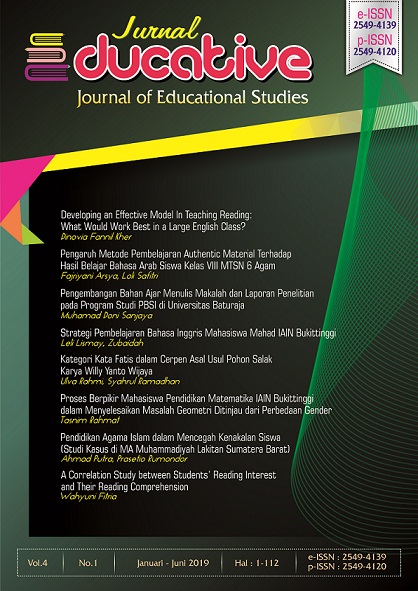
Variasi Fatis dalam Cerpen Asal Usul Pohon Salak Karya Willy Yanto Wijaya dan Implikasinya dalam Pembelajaran
DOI:
https://doi.org/10.30983/educative.v4i1.1389Keywords:
short story, phatic, learningAbstract
References
Agustina. 2007. Kelas Kata Bahasa Mianangkabau. Padang: FBSS UNP.
Kridalaksana, Harimurti. 1994. Kelas Kata dalam Bahasa Indonesia. Jakarta:Gramedia.
Rahardi. R. Kunjana. 2005. Kajian Sosiolinguistik Ihwal Kode dan Alih Kode. Bogor: Ghalia Indonesia
Jurnal Ilmiah
Afifah, Roza, ‘FATIS BAHASA MINANGKABAU: LINGUISTIK BANDINGAN’, JURNAL ARBITRER, 2.2 (2017), 196 <https://doi.org/10.25077/ar.2.2.196-200.2015>
Azis, Abdul, and Mukhtar, ‘PEMBELAJARAN KOMPETENSI MENULIS CERPEN MELALUI METODE SHOW NOT TELL Dr. Abdul Azis Abdul’, SEMANTIK, 2012, 1–28
Faizah, Hasnah, ‘Kategori Fatis Dalam Bahasa Melayu Riau Dialek Kuok’, Litera, 11.1 (2012), 60–71
Imron, Hadi, ‘Fatis Bahasa Melayu Dialek Musi Dalam Tuturan Sehari-Hari Masyarakat Petaling’, Sawerigading, 23.1 (2017), 105–16
Jumanto, DR., ‘Phatic Communication: How English Native Speakers Create Ties of Union’, American Journal of Linguistics, 3.1 (2014), 9–16 <https://doi.org/10.5923/j.linguistics.20140301.02>
Malik, Rini Siti Parida, ‘KATEGORI FATIS BAHASA SUNDA SUKABUMI’, Arkhais - Jurnal Ilmu Bahasa Dan Sastra Indonesia, 6.2 (2015), 63 <https://doi.org/10.21009/arkhais.062.02>
Nicolle, Steve, and Billy Clark, ‘Phatic Interpretations: Standarisation and Conventionalisation’, Revista Alicantina de Estudios Ingleses, 11, 1998, 183–91 <https://doi.org/10.14198/raei.1998.11.14>
Rahardi, R. Kunjana, Yuliana Setyaningsih, and Rishe Purnama Dewi, ‘KATA FATIS PENANDA KETIDAKSANTUNAN PRAGMATIK DALAM RANAH KELUARGA’, AdabiyyÄt: Jurnal Bahasa Dan Sastra, 13.2 (2014), 149 <https://doi.org/10.14421/ajbs.2014.13201>
Ramadhanty, Sari, ‘Penggunaan Komunikasi Fatis Dalam Pengelolaan Hubungan Di Tempat Kerja’, Jurnal Ilmu Komunikasi, 5.1 (2015), 1–12
Thaufik, Gherry, Hasnah Faizah, and Ermanto, ‘FATIS DALAM BAHASA MELAYU KAMPAR KIRI KABUPATEN KAMPAR’, Jurnal Bahasa, Sastra, Dan Pembelajaran, 3.1 (2015), 46–56
Wahya, and Muhamad Adji, ‘PENGGUNAAN FATIS AEH, EUH, DAN IH PADA PERCAKAPAN ANTARTOKOH DALAM TIGA NOVEL BERBAHASA SUNDA: KAJIAN STRUKTUR DAN PRAGMATIK’, Jurnal TUTUR, 3.2 (2017), 171–87
Yuliana, Siti, ‘Penanda Fatis Dalam Bahasa Jawa Yang Digunakan Oleh Masyarakat Madura Di Jember’, SEMIOTIKA: Jurnal Ilmu Sastra Dan Linguistik, 18.1 (2017), 81 <https://doi.org/10.19184/semiotika.v18i1.5189>
Yulisna, Risa, ‘KONTRIBUSI KEMAMPUAN MEMAHAMI CERPEN TERHADAP KETERAMPILAN MENULIS CERPEN SISWA KELAS XI SMA NEGERI 4 PADANG’, Gramatika STKIP PGRI Sumatera Barat, 2.2 (2016) <https://doi.org/10.22202/jg.2016.v2i2.1101>
Žegarac, Vlad, and Billy Clark, ‘Phatic Interpretations and Phatic Communication’, Journal of Linguistics, 35.2 (1999), 321–46 <https://doi.org/10.1017/S0022226799007628>
Makalah Ilmiah dan Artikel
Wahya, (2015). Euy sebagai Sarana Pragmatik dalam Novel Kolebat Kuwung-Kuwung Kinasih Katumbirian Karya Tatang Sumarsono‖. Makalah pada International Conference Linguistics Scientific Meeting, 28 Mei 2015 di Progarm Pascasarjana Universitas Padjadjaran, Bandung.
Wahya. 2014. ―Sekilas tentang Kategori Fatis dalam Bahasa Sunda: Kajian Pragmatik‖. Makalah pada Seminar Internasional Semiotik, Pragmatik, dan Kebudayaan bertemakan ―Peran Semiotik dan Pragmatik dalam Memaknai Kebudayaan Global dan Lokal‖ pada17 Juni 2014 di Fakultas Ilmu Pengetahuan Budaya, Universitas Indonesia, Derpok.
Downloads
Published
How to Cite
Issue
Section
Citation Check
License
Authors who publish with this journal agree to the following terms:
1. Authors retain copyright and grant the journal right of first publication with the work simultaneously licensed under a Creative Commons Attribution License that allows others to share the work with an acknowledgment of the work's authorship and initial publication in this journal.
2. Authors are able to enter into separate, additional contractual arrangements for the non-exclusive distribution of the journal's published version of the work (e.g., post it to an institutional repository or publish it in a book), with an acknowledgment of its initial publication in this journal.
3. Authors are permitted and encouraged to post their work online (e.g., in institutional repositories or on their website) prior to and during the submission process, as it can lead to productive exchanges, as well as earlier and greater citation of published work (See The Effect of Open Access).