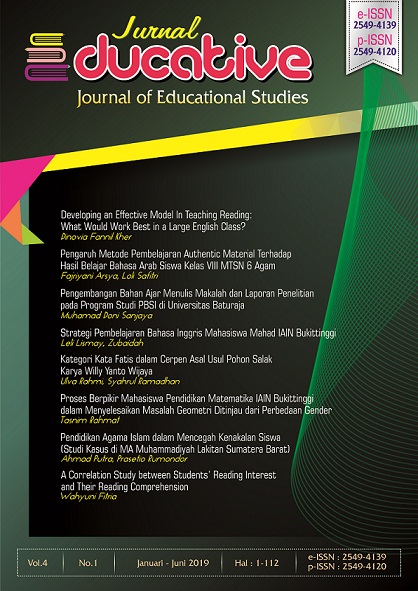
Reading Interest and Reading Comprehension : A Correlational Study
DOI:
https://doi.org/10.30983/educative.v4i1.1333Keywords:
kuantitatif, studi korelasi, minat baca, pemahaman membaca, SMP Ahmad Dahlan Kota JambiAbstract
References
Baier, Rebecca J, ‘Reading Comprehension and Reading Strategies. The Journal of Education, 5th Edition’, Reading, 2005, 1–53
Bojovic, M, ‘Reading Skills and Reading Comprehension in English for Specific Purposes’, The International Language Conference on The Importance of Learning Professional Foreign Languages for Communication between Cultures 2010, September 2010, 2010, 1–5
Curtis, Andrew, ‘Survey And’, 2004, 225–60
Dai, Wenji, ‘Correlates of the Reading Interest of Chinese High School Students in International Schools’, Asian Social Science, 9.3
(2013), 164–76 <https://doi.org/10.5539/ass.v9n3p164>
Daniel, Eyisi, ‘The Usefulness of Qualitative and Quantitative Approaches and Methods in Researching Problem-Solving Ability in Science Education Curriculum’, 7.15 (2016), 91–100
Donal, Andri, ‘Reading Interest ( A Case Study at FKIP…’, Journal of English Education, 1.1 (2015), 23–32
Eijansantos-remanente, Maria Cecilia, ‘Factors Affecting the Academic Reading Habits of Hospitality Management’, 2008, 1–19
Endah, Sri, Harris Effendi Thahar, and Yasnur Asri, ‘The Contribution of Reading Interest on Literature and Reading Comprehension toward Students’ Ability in Writing Fantasy Story’, 2015, 2018, 955–60 <https://doi.org/10.29210/20181137>
Fahrurrozi, Dr., ‘Relationship between Students’ Reading Interest and Vocabulary Mastery with Reading Comprehension Ability’, 118 (2017), 357–63 <https://doi.org/10.2991/icset-17.2017.59>
First, Reading, ‘Comprehension : Essential for Sustainability Welcome’, 8, 2009
Jayanti, Fernandita Gusweni, ‘Reading Difficulties: Comparison on Students and Teachers Perception’, Fourth International Seminar OnEnglish Language and Teaching, 2016, 296–301
Khairuddin, Zurina, ‘A Study of Students’ Reading Interests in a Second Language’, International Education Studies, 6.11 (2013),
–70 <https://doi.org/10.5539/ies.v6n11p160>
Kintsch, ‘Levels of Comprehension’, 9.2 (1980), 87–98
Kirby, John R, ‘Reading Comprehension: Its Nature and Development’, Encyclopedia of Language and Literacy Development, August, 2007, 0–8
Miñoza, Manilyn Vegare, and Marites Atilano Montero, ‘Reading Comprehension Level among Intermediate Learners.’, Online Submission, 31.3 (2019), 561–68
Pasaribu, Eben, ‘The Correlation of Students’ English Reading Interest At Library on Students’ Vocabulary Achievement At the Teacher Training Faculty of Nommensen University Pematangsiantar’, IOSR Journal Of Humanities And Social Science (IOSR-JHSS, 21.2 (2016), 39–44 <https://doi.org/10.9790/0837-21213944>
Remanente, Maria Cecilia Eijansantos-, ‘Factors Affecting Academic Reading among Students’, November 2015, 2017, 0–19
Rumainah, ‘Undergraduate Students ’ Reading Interest and Reading Comprehension Achievement in a State Islamic University’, Ta’dib: Journal of Islamic Education, 23.June (2018), 54–64
Spear-Swerling, Louise, ‘Common Types of Reading Problems and How to Help Children Who Have Them’, Reading Teacher, 69.5 (2016), 513–22 <https://doi.org/10.1002/trtr.1410>
Downloads
Additional Files
Published
How to Cite
Issue
Section
Citation Check
License
Authors who publish with this journal agree to the following terms:
1. Authors retain copyright and grant the journal right of first publication with the work simultaneously licensed under a Creative Commons Attribution License that allows others to share the work with an acknowledgment of the work's authorship and initial publication in this journal.
2. Authors are able to enter into separate, additional contractual arrangements for the non-exclusive distribution of the journal's published version of the work (e.g., post it to an institutional repository or publish it in a book), with an acknowledgment of its initial publication in this journal.
3. Authors are permitted and encouraged to post their work online (e.g., in institutional repositories or on their website) prior to and during the submission process, as it can lead to productive exchanges, as well as earlier and greater citation of published work (See The Effect of Open Access).