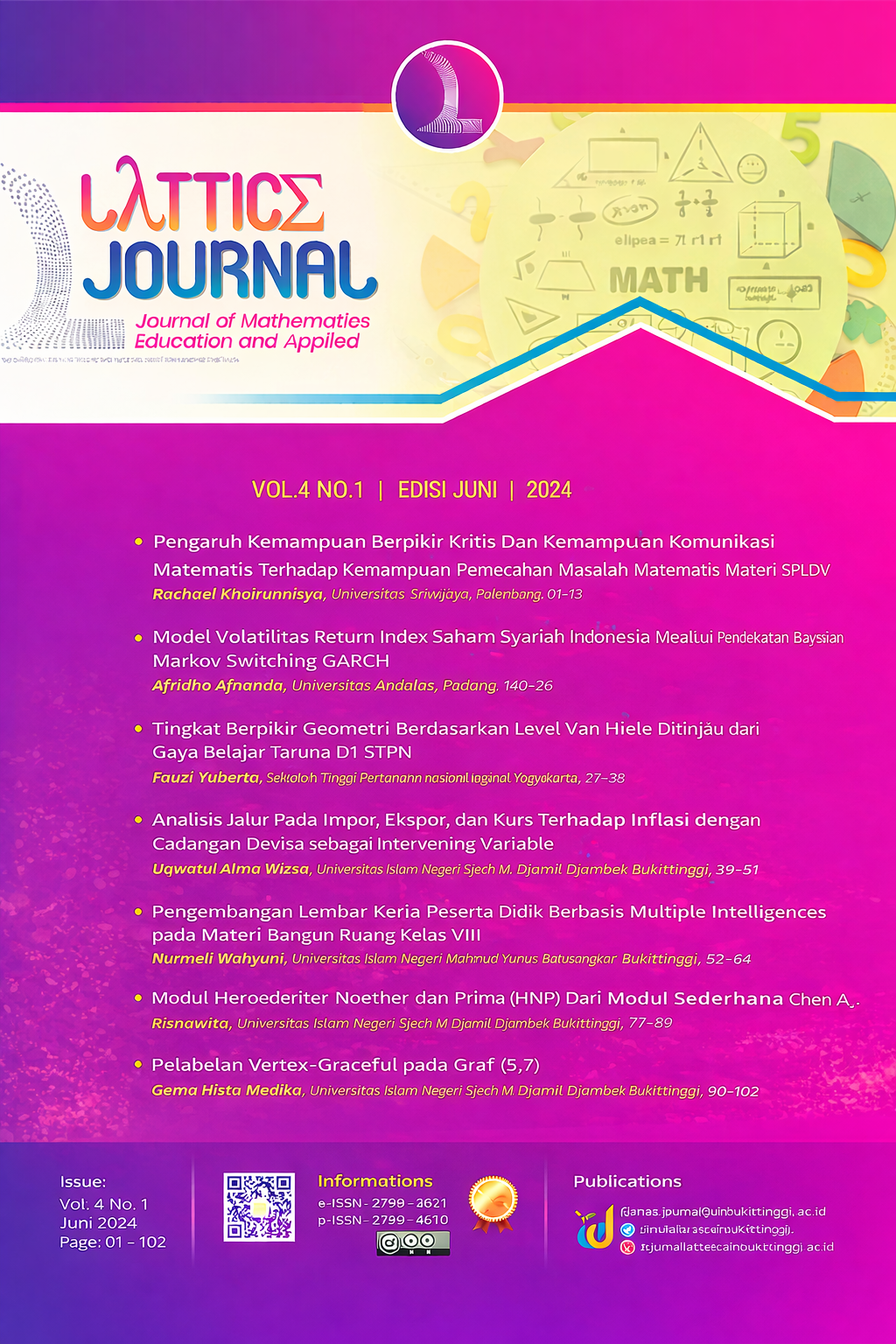
Analisis Jalur Pada Impor, Ekspor, dan Kurs Terhadap Inflasi dengan Cadangan Devisa sebagai Intervening Variable
DOI:
https://doi.org/10.30983/lattice.v4i1.8420Keywords:
Impor, Ekspor, Kurs, Cadangan Devisa, InflasiAbstract
References
M. Idris, “Indonesia Masuk Negara Maju atau Berkembang? Ini Penjelasan WTO Artikel ini telah tayang di Kompas.com dengan judul ‘Indonesia Masuk Negara Maju atau Berkembang? Ini Penjelasan WTO’, Klik untuk baca: https://money.kompas.com/read/2020/02/22/115252426/indo,” Kompas.com, 2020. https://money.kompas.com/read/2020/02/22/115252426/indonesia-masuk-negara-maju-atau-berkembang-ini-penjelasan-wto?page=all (accessed Jun. 18, 2024).
“Menko Airlangga: Indonesia Siap Menuju Negara Maju Berpenghasilan Tinggi dengan Manfaatkan Bonus Demografi,” ekon.go.id, 2023. https://www.ekon.go.id/publikasi/detail/5283/menko-airlangga-indonesia-siap-menuju-negara-maju-berpenghasilan-tinggi-dengan-manfaatkan-bonus-demografi#:~:text=Indonesia sendiri termasuk dalam kategori,USD4%2C580 (2022).
D. P. Devisa, “Okt. 2014,” 2014.
M. A. R. Muchammad Aris Setia Budi, Ratna Dewi Setiawati, Rizki Ananda Putri, “As-Syirkah : Islamic Economics & Finacial Journal,” As-Syirkah Islam. Econ. Finacial J., vol. 1, no. 1, pp. 39–56, 2022, doi: 10.56672/assyirkah.v3i2.161.
K. A. Adinda Marethasya Fortuna, Sri Muljaningsih, “Analisis Pengaruh Ekspor, Nilai Tukar Rupiah, dan Utang Luar Negeri Terhadap Cadangan Devisa Indonesia,” Equilibrium, vol. 10, no. 2, pp. 113–120, 2021, doi: 10.21107/bep.v2i1.13847.
B. Adhitya, “Analisis Determinan Cadangan Devisa di Indonesia,” J. Ilm. Univ. Batanghari Jambi, vol. 21, no. 1, p. 184, 2021, doi: 10.33087/jiubj.v21i1.1237.
G. Jalunggono, Y. T. Cahyani, and W. Juliprijanto, “Pengaruh Ekspor, Impor Dan Kurs Terhadap Cadangan Devisa Indonesia Periode Tahun 2004 – 2018,” J. Ekon. Bisnis, dan Akunt., vol. 22, no. 2, pp. 171–181, 2020, doi: 10.32424/jeba.v22i2.1593.
Elva Dona, Habibatul Hidayati, Khairil Aswan, Rusdandi Oktavian, and Irwan Muslim, “Berpengaruhkah Jumlah Uang Beredar, Suku Bunga, Ekspor dan Impor terhadap Inflasi di Indonesia?,” J. Ekobistek, vol. 11, no. 4, pp. 355–360, 2022, doi: 10.35134/ekobistek.v11i4.411.
“Data BPS,” 2024. https://www.bps.go.id/id
“Data BI,” 2024. https://www.bi.go.id/id/default.aspx
N. M. E. Andriandita Wijayanto, “Analisis Pengaruh Ekspor Dan Impor Terhadap Cadangan Devisa Indonesia,” Yos Soedarso Econ. Jouenal, vol. 4, no. 1, pp. 12–27, 2022.
D. S. Annisa Tri Utami, “Penentu Inflasi di Indonesia; Jumlah Uang Beredar, Nilai Tukar, Ataukah Cadangan Devisa?,” J. Ekon. dan Stud. Pembang., vol. 14, no. 2, pp. 144–152, 2013.
D. Marlianda Bolung, Syafri, and N. Ratnawati, “Analisis Pengaruh Tingkat Inflasi, Kurs, Jumlah Uang Beredar, Ekspor, Dan Impor Terhadap Cadangan Devisa Indonesia,” J. Ekon. Trisakti, vol. 3, no. 1, pp. 249–258, 2023, doi: 10.25105/jet.v3i1.15404.
M. J. Lachowicz, K. J. Preacher, and K. Kelley, “A novel measure of effect size for mediation analysis,” Psychol. Methods, vol. 23, no. 2, pp. 244–261, 2018, doi: 10.1037/met0000165.
S. Ogbeibu, C. J. C. Jabbour, J. Gaskin, A. Senadjki, and M. Hughes, “Leveraging STARA competencies and green creativity to boost green organisational innovative evidence: A praxis for sustainable development,” Bus. Strateg. Environ., vol. 30, no. 5, pp. 2421–2440, 2021, doi: 10.1002/bse.2754.
Downloads
Published
How to Cite
Issue
Section
Citation Check
License
Copyright (c) 2024 Uqwatul Alma Wizsa, Wikasanti Dwi Rahayu, Deby Handayani

This work is licensed under a Creative Commons Attribution-ShareAlike 4.0 International License.
Authors who publish with Lattice Journal : Journal of Mathematics Education and Applied agree to the following terms: Authors retain copyright and grant the Lattice Journal : Journal of Mathematics Education and Applied right of first publication with the work simultaneously licensed under a Creative Commons Attribution License (CC BY-SA 4.0) that allows others to share (copy and redistribute the material in any medium or format) and adapt (remix, transform, and build upon the material) the work for any purpose, even commercially with an acknowledgement of the work's authorship and initial publication in Lattice Journal : Journal of Mathematics Education and Applied. Authors are able to enter into separate, additional contractual arrangements for the non-exclusive distribution of the journal's published version of the work (e.g., post it to an institutional repository or publish it in a book), with an acknowledgement of its initial publication in Lattice Journal : Journal of Mathematics Education and Applied. Authors are permitted and encouraged to post their work online (e.g., in institutional repositories or on their website) prior to and during the submission process, as it can lead to productive exchanges, as well as earlier and greater citation of published work (See The Effect of Open Access).