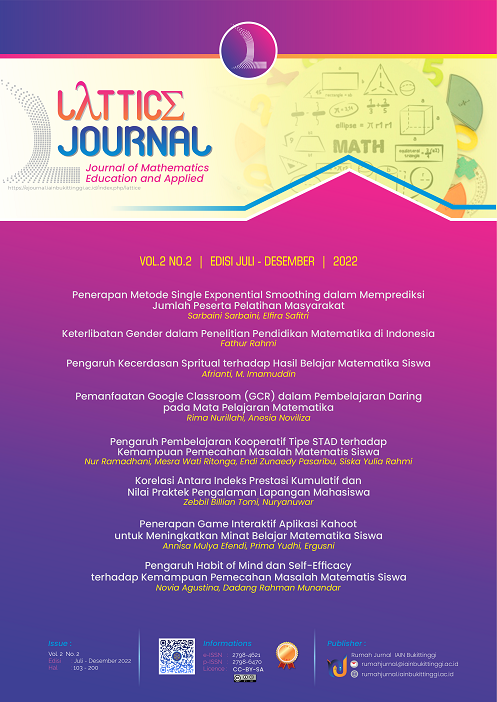
Keterlibatan Gender dalam Penelitian Pendidikan Matematika di Indonesia
DOI:
https://doi.org/10.30983/lattice.v2i2.6016Keywords:
Gender, Pendidikan MatematikaAbstract
References
S. K. Salmina, Mik & Nisa, “Kemampuan Penalaran Matematis Siswa Berdasarkan Gender Pada Materi Geometri,†J. Numer., pp. 41–48, 2018.
Z. A. MZ, “Perspektif Gender Dalam Pembelajaran Matematika,†Marwah J. Perempuan, Agama dan Jender, vol. 12, no. 1, p. 15, 2013, doi: 10.24014/marwah.v12i1.511.
B. S. Bloom, “Taxonomy Of Educational Objectives,†in Cataloging and Classification Quarterly, 1956.
NCTM, Principles Standards And For School Mathematics. United States Of America, 2000.
S. Revina and F. K. S. Leung, “Educational Borrowing and Mathematics Curriculum: Realistic Mathematics Education in the Dutch and Indonesian Primary Curriculum,†Int. J. Emerg. Math. Educ., vol. 2, no. 1, p. 1, 2018, doi: 10.12928/ijeme.v2i1.8025.
D. Purwaningsih and A. Ardani, “Kemampuan Pemecahan Masalah Matematis Materi Eksponen Dan Logaritma Ditinjau Dari Gaya Belajar Dan Perbedaan Gender,†AKSIOMA J. Progr. Stud. Pendidik. Mat., vol. 9, no. 1, p. 118, 2020, doi: 10.24127/ajpm.v9i1.2632.
F. Rendani and I. M. Arnawa, “Pengaruh Model Reciprocal Teaching Terhadap Kemampuan Komunikasi Matematis Ditinjau Dari Gender Dan Level Sekolah,†AKSIOMA J. Progr. Stud. Pendidik. Mat., vol. 9, no. 3, p. 727, 2020, doi: 10.24127/ajpm.v9i3.2882.
R. Ramadhani, F. Farid, F. Lestari, and A. Machmud, “Improvement of Creative Thinking Ability through Problem-Based Learning with Local Culture Based on Students’ Gender and Prior Mathematics Ability,†Al-Jabar J. Pendidik. Mat., vol. 11, no. 1, pp. 61–72, 2020, doi: 10.24042/ajpm.v11i1.4961.
M. R. Yuwono, U. Udiyono, D. H. Maarif, and S. Sulistiana, “Students ’Critical Thinking Profile To Solve The Problem Of Analytical Geometry Viewed From Gender,†Al-Jabar J. Pendidik. Mat., vol. 10, no. 1, pp. 37–46, 2019, doi: 10.24042/ajpm.v10i1.3768.
R. & Suesthi and R. Jayanti, “High Order Thinking Skills (HOTS) Students in Solving Mathematics Problem of Group Theory Based on Gender,†Al-Jabar, vol. 10, no. 2, pp. 243–250, 2019.
F. E. Subekti and T. Krisdiani, “Deskripsi Kemampuan Pemecahan Masalah Matematis Ditinjau Dari Gender Pada Materi Bangun Ruang,†AKSIOMA J. Progr. Stud. Pendidik. Mat., vol. 10, no. 2, p. 903, 2021, doi: 10.24127/ajpm.v10i2.3534.
D. I. Sari, I. K. Budayasa, and D. Juniati, “Analisis Penyelesaian Tugas Probabilitas Sisanalisis Penyelesaian Tugas Probabilitas Siswa Sd Ditinjau Dari Perbedaan Kemampuan Matematika Dan Gender,†AKSIOMA J. Progr. Stud. Pendidik. Mat., vol. 7, no. 1, p. 124, 2018, doi: 10.24127/ajpm.v7i1.1344.
N. Aini and E. Suryowati, “Mengeksplor Penalaran Spasial Siswa dalam Menyelesaikan Soal Geometri Berdasarkan Gender,†Mosharafa J. Pendidik. Mat., vol. 11, no. 1, pp. 61–72, 2022, doi: 10.31980/mosharafa.v11i1.1183.
L. S. Wahyuniar, N. Shofia, and S. Rochana, “PROSES BERPIKIR ALJABAR SISWA MTs KELAS VIII MENURUT TAKSONOMI SOLO DITINJAU DARI PERBEDAAN GENDER,†J. Aksioma, vol. 7, no. 2, pp. 275–282, 2018.
D. D. Pratiwi, “Analisis Kemampuan Komunikasi Matematis Dalam Pemecahan Masalah Matematika Sesuai Dengan Gaya Kognitif Dan Gender,†Al-Jabar J. Pendidik. Mat., vol. 6, no. 2, pp. 131–142, 2015, doi: 10.24042/ajpm.v6i2.28.
L. Lestariningsih, N. S. Maulidah, and M. Lutfianto, “Students’ Quantitative Literacy in Solving PISA Problem Based on Gender Differences,†J. Elem., vol. 7, no. 2, pp. 438–449, 2021, doi: 10.29408/jel.v7i2.3557.
I. Nurhikmayati, “Pembelajaran Dengan Pendekatan Metaphorical Thinking untuk Meningkatkan Kemampuan Pemahaman dan Penalaran Matematis Siswa SMP,†vol. 1, no. 2, pp. 42–50, 2017.
L. A. Romadhoni and R. Setyaningsih, “PEMECAHAN MASALAH MATEMATIS SISWA DALAM MENYELESAIKAN SOAL PISA KONTEN SPACE AND SHAPE DITINJAU DARI GENDER,†AKSIOMA, vol. 11, no. 3, pp. 2015–2028, 2022.
E. R. Diandita, R. Johar, and T. F. Abidin, “Kemampuan Komunikasi Matematis Dan Metakognitif Siswa Smp Pada Materi Lingkaran Berdasarkan Gender,†J. Pendidik. Mat., vol. 11, no. 2, pp. 79–97, 2017, doi: 10.22342/jpm.11.2.2533.
F. Apriyono, “Profil Kemampuan Koneksi Matematika Siswa SMP dalam Memecahkan Masalah Matematika Ditinjau dari Gender,†Mosharafa J. Pendidik. Mat., vol. 5, no. 2, pp. 159–168, 2018, doi: 10.31980/mosharafa.v5i2.271.
A. N. A. Widodo and S. R. Amalia, “Creative Problem Solving Dan Resource Based Learning Terhadap Kemampuan Pemecahan Masalah Matematis Ditinjau Dari Gender,†AKSIOMA J. Progr. Stud. Pendidik. Mat., vol. 9, no. 1, p. 158, 2020, doi: 10.24127/ajpm.v9i1.2660.
Y. Yerizon, P. Wahyuni, and A. Fauzan, “Pengaruh Problem Based Learning Terhadap Kemampuan Pemecahan Masalah Matematis Ditinjau Dari Gender Dan Level Sekolah,†AKSIOMA J. Progr. Stud. Pendidik. Mat., vol. 10, no. 1, p. 105, 2021, doi: 10.24127/ajpm.v10i1.2812.
B. S. Anggoro, “Analisis Persepsi Siswa SMP terhadap Pembelajaran Matematika ditinjau dari Perbedaan Gender dan Disposisi Berpikir Kreatif Matematis,†Al-Jabar J. Pendidik. Mat., vol. 7, no. 2, pp. 153–166, 2016, doi: 10.24042/ajpm.v7i2.30.
et al., “Pengukuran Prestasi Belajar Matematika Siswa dengan Menggunakan Tes Model Testlet ditinjau dari Status Sekolah dan Gender,†J. Elem., vol. 7, no. 2, pp. 366–380, 2021, doi: 10.29408/jel.v7i2.3337.
H. Hodiyanto, “Pengaruh model pembelajaran problem solving terhadap kemampuan komunikasi matematis ditinjau dari gender,†J. Ris. Pendidik. Mat., vol. 4, no. 2, p. 219, 2017, doi: 10.21831/jrpm.v4i2.15770.
A. Soraya, W. Rahayu, and L. Ambarwati, “Peningkatan kemampuan pemecahan masalah matematis dengan metode make a match dalam inkuiri ditinjau dari perbedaan gender,†Pythagoras J. Pendidik. Mat., vol. 13, no. 1, pp. 33–42, 2018, doi: 10.21831/pg.v13i1.15341.
C. Sadijah, W. Murtafiah, L. Anwar, R. Nurhakiki, and E. T. D. Cahyowati, “Teaching higher-order thinking skills in mathematics classrooms: Gender differences,†J. Math. Educ., vol. 12, no. 1, pp. 159–179, 2021, doi: 10.22342/jme.12.1.13087.159-180.
Patmaniar, S. M. Amin, and R. Sulaiman, “STUDENTS’ GROWING UNDERSTANDING in SOLVING MATHEMATICS PROBLEMS BASED on GENDER: ELABORATING FOLDING BACK,†J. Math. Educ., vol. 12, no. 3, pp. 507–530, 2021, doi: 10.22342/JME.12.3.14267.507-530.
W. Lestari, T. A. Kusmayadi, and F. Nurhasanah, “Kemampuan Pemecahan Masalah Matematika Ditinjau Dari Perbedaan Gender,†AKSIOMA J. Progr. Stud. Pendidik. Mat., vol. 10, no. 2, p. 1141, 2021, doi: 10.24127/ajpm.v10i2.3661.
Y. Rosania, M. Mujib, and F. I. Suri, “Pendekatan Teori Belajar Andragogi Terhadap Kemampuan Menyelesaikan Soal Matematika Ditinjau Dari Gender,†AKSIOMA J. Progr. Stud. Pendidik. Mat., vol. 8, no. 1, pp. 103–111, 2019, doi: 10.24127/ajpm.v8i1.1739.
Ibrahim, “KETERAMPILAN BERPIKIR MATEMATIS TINGKAT TINGGI SISWA MADRASAH ALIYAH DITINJAU DARI GENDER DAN STATUS SEKOLAH,†Suparyanto dan Rosad (2015, vol. 5, no. 3, pp. 248–253, 2020.
T. Harmini, P. Annurwanda, and S. Suprihatiningsih, “Computational Thinking Ability Students Based on Gender in Calculus Learning,†AKSIOMA J. Progr. Stud. Pendidik. Mat., vol. 9, no. 4, p. 977, 2020, doi: 10.24127/ajpm.v9i4.3160.
E. Kurniadi, N. Sari, and D. Darmawijoyo, “Cognitive Processes of Using Representational Form in Mathematical Modeling Based on Gender Differences,†J. Elem., vol. 7, no. 2, pp. 463–474, 2021, doi: 10.29408/jel.v7i2.3627.
A. B. Wicaksono, A. N. Chasanah, and H. Sukoco, “Kemampuan Pemecahan Masalah Geometri Berbasis Budaya Ditinjau Dari Gender Dan Gaya Belajar,†AKSIOMA J. Progr. Stud. Pendidik. Mat., vol. 10, no. 1, p. 240, 2021, doi: 10.24127/ajpm.v10i1.3256.
K. D. Nur’aini and S. L. Pagiling, “Analisis pedagogical content knowledge guru matematika sekolah menengah pertama ditinjau dari segi gender [Analysis of lower secondary mathematics teachers’ pedagogical content knowledge viewed from gender],†AKSIOMA J. Progr. Stud. Pendidik. Mat., vol. 9, no. 4, p. 1036, 2020.
Downloads
Published
How to Cite
Issue
Section
Citation Check
License
Copyright (c) 2022 Fathur Rahmi

This work is licensed under a Creative Commons Attribution-ShareAlike 4.0 International License.
Authors who publish with Lattice Journal : Journal of Mathematics Education and Applied agree to the following terms: Authors retain copyright and grant the Lattice Journal : Journal of Mathematics Education and Applied right of first publication with the work simultaneously licensed under a Creative Commons Attribution License (CC BY-SA 4.0) that allows others to share (copy and redistribute the material in any medium or format) and adapt (remix, transform, and build upon the material) the work for any purpose, even commercially with an acknowledgement of the work's authorship and initial publication in Lattice Journal : Journal of Mathematics Education and Applied. Authors are able to enter into separate, additional contractual arrangements for the non-exclusive distribution of the journal's published version of the work (e.g., post it to an institutional repository or publish it in a book), with an acknowledgement of its initial publication in Lattice Journal : Journal of Mathematics Education and Applied. Authors are permitted and encouraged to post their work online (e.g., in institutional repositories or on their website) prior to and during the submission process, as it can lead to productive exchanges, as well as earlier and greater citation of published work (See The Effect of Open Access).