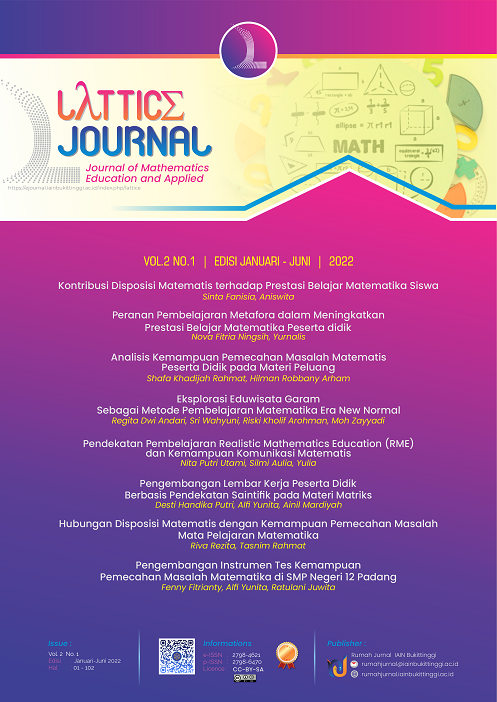
Analisis Kemampuan Pemecahan Masalah Matematis Peserta Didik pada Materi Peluang
DOI:
https://doi.org/10.30983/lattice.v2i1.5542Keywords:
Analysis, Problem-Solving Ability, OpportunitiesAbstract
References
Journal article
D. Nuryana and T. Rosyana, “Analisis Kesalahan Siswa Smk Dalam Menyelesaikan Soal Pemecahan Masalah Matematik Pada Materi Program Linear,†J. Pendidik. Mat., vol. 3, no. 1, pp. 11–20, 2019.
R. H. Azzahra, H. Pujiastuti, U. Sultan, and A. Tirtayasa, “Pada Materi Sistem Persamaan Linear Tiga Variabel,†vol. 4, no. 1, pp. 153–162, 2020.
S. Mariam, E. E. Rohaeti, and R. Sariningsih, “Analisis Kemampuan Pemecahan Masalah Matematis Siswa Madrasah Aliyah pada Materi Pola Bilangan,†J. Educ., vol. 1, no. 2, pp. 156–162, 2018.
Article by DOI
S. Khadijah and D. R. Munandar, “Analisis Kemampuan Pemecahan Masalah Matematis Siswa Kelas VIII pada Materi SPLDV,†J. Ilm. Dikdaya, vol. 12, no. 1, pp. 7–13, 2022, doi: http://dx.doi.org/10.33087/dikdaya.v12i1.263.
I. Purnamasari and W. Setiawan, “Analisis Kemampuan Pemecahan Masalah Matematis Siswa SMP pada Materi SPLDV Ditinjau dari Kemampuan Awal Matematika,†J. Medives J. Math. Educ. IKIP Veteran Semarang, vol. 3, no. 2, p. 207, 2019, doi: 10.31331/medivesveteran.v3i2.771.
T. Yuwono, M. Supanggih, and R. D. Ferdiani, “Analisis Kemampuan Pemecahan Masalah Matematika dalam Menyelesaikan Soal Cerita Berdasarkan Prosedur Polya,†J. Tadris Mat., vol. 1, no. 2, pp. 137–144, 2018, doi: 10.21274/jtm.2018.1.2.137-144.
Umrana, E. Cahyono, and M. Sudia, “Analisis Kemampuan Pemecahan Masalah Matematis Ditinjau Dari Gaya Belajar Siswa,†J. Pembelajaran Berpikir Mat., vol. 4, no. 1, pp. 67–76, 2019, doi: 10.22202/horizon.v1i3.5257.
N. Prihartini, Puspita Sari, and Ibnu Hadi, “Design Research: Mengembangkan Pembelajaran Konsep Peluang Dengan Pendekatan Pendidikan Matematika Realistik Indonesia Pada Siswa Kelas IX di SMPN 220 Jakarta,†J. Ris. Pembelajaran Mat. Sekol., vol. 4, no. 1, pp. 1–8, 2020, doi: 10.21009/jrpms.041.01.
R. Anggraeni and G. Kadarisma, “Analisis Kemampuan Pemecahan Masalah Siswa Madrasah Tsanawiyah Kelas VII pada Materi Himpunan,†J. Cendekia J. Pendidik. Mat., vol. 4, no. 2, pp. 1072–1082, 2020, doi: https://doi.org/10.31004/cendekia.v4i2.334.
P. Akbar, A. Hamid, M. Bernard, and A. I. Sugandi, “Analisis Kemampuan Pemecahan Masalah Dan Disposisi Matematik Siswa Kelas Xi Sma Putra Juang Dalam Materi Peluang,†J. Cendekia J. Pendidik. Mat., vol. 2, no. 1, pp. 144–153, 2017, doi: 10.31004/cendekia.v2i1.62.
N. P. Setiana, N. Fitriani, and R. Amelia, “Analisis Kemampuan Pemecahan Masalah Matematis Siswa SMA Pada Materi Trigonometri Berdasarkan Kemampuan Awal Matematis Siswa,†JPMI (Jurnal Pembelajaran Mat. Inov., vol. 4, no. 4, p. 908, 2021, doi: 10.22460/jpmi.v4i4.899-910.
Book
R. E. T., Pendidikan Matematika 3. Jakarta: Depdikbud, 1991.
K. E. Lestari and M. R. Yudhanegara, Penelitian Pendidikan Matematika. Bandung: Refika Aditama, 2015.
M. Rahardjo and A. Waluyati, Pembelajaran Soal Cerita Operasi Hitung Campuran di Sekolah Dasar. Yogyakarta: P4TK Matematika, 2011.
Sugiyono, Metode Penelitian Pendidikan Pendekatan Kuantitatif, Kualitatif, dan R&D. Bandung: Alfabeta, 2015.
J. W. Creswell, Research Design: Pendekatan metode kualitatif, kuantitatif, dan campuran, 4th ed. Yogyakarta: Pustaka Pelajar, 2014.
Book chapter
U. Sumarmo, “Asesmen Soft Skill dan Hard Skill Matematik Siswa Dalam Kurikulum 2013,†Semin. Pendidik. Mat., pp. 1–30, 2014.
Downloads
Published
How to Cite
Issue
Section
Citation Check
License
Copyright (c) 2022 Shafa Khadijah Rahmat, Hilman Robbany Arham

This work is licensed under a Creative Commons Attribution-ShareAlike 4.0 International License.
Authors who publish with Lattice Journal : Journal of Mathematics Education and Applied agree to the following terms: Authors retain copyright and grant the Lattice Journal : Journal of Mathematics Education and Applied right of first publication with the work simultaneously licensed under a Creative Commons Attribution License (CC BY-SA 4.0) that allows others to share (copy and redistribute the material in any medium or format) and adapt (remix, transform, and build upon the material) the work for any purpose, even commercially with an acknowledgement of the work's authorship and initial publication in Lattice Journal : Journal of Mathematics Education and Applied. Authors are able to enter into separate, additional contractual arrangements for the non-exclusive distribution of the journal's published version of the work (e.g., post it to an institutional repository or publish it in a book), with an acknowledgement of its initial publication in Lattice Journal : Journal of Mathematics Education and Applied. Authors are permitted and encouraged to post their work online (e.g., in institutional repositories or on their website) prior to and during the submission process, as it can lead to productive exchanges, as well as earlier and greater citation of published work (See The Effect of Open Access).