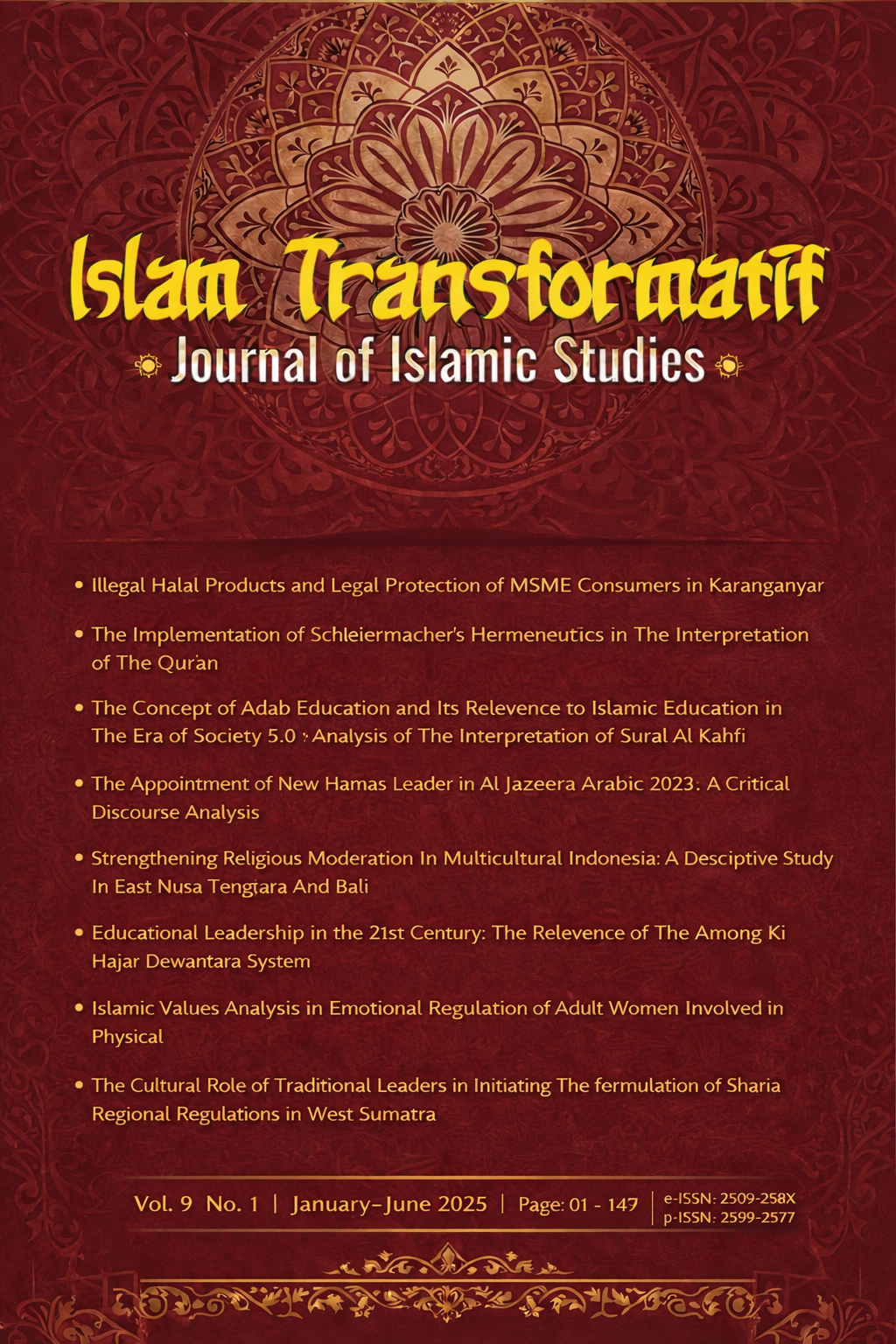
Educational Leadership in the 21st Century: The Relevance of The Among Ki Hajar Dewantara System
DOI:
https://doi.org/10.30983/it.v9i1.8797Keywords:
21st Century, Educational Leadership, Ki Hajar Dewantara, The Among SystemAbstract
References
Abdallah, Siraje, Shaimah Nalubega, and Siti Kholijah Kassim. “The Impact of Teacher Professional Development and School Climate and Culture on Innovative Student-Centered Teaching for 21st Century Skills: The Mediating Roles of Collaborative Planning and Community Engagement.” NAMA International Journal of Education and Development 1, no. 2 (2024).
Ahonen, Arto Kalevi, and Päivi Kinnunen. “How Do Students Value the Importance of Twenty-First Century Skills?” Scandinavian Journal of Educational Research 59, no. 4 (July 4, 2015): 395–412. https://doi.org/10.1080/00313831.2014.904423.
Argyris, Chris. “Teaching Smart People How to Learn.” Reflections 4, no. 2 (1991): 4–15.
Benade, Leon. Being A Teacher in the 21st Century. A Critical New Zealand Research. Singapore: Springer Singapore, 2017. https://doi.org/10.1007/978-981-10-3782-5.
Carneiro, Roberto, and Alexandra Draxler. “Education for the 21st Century: Lessons and Challenges.” European Journal of Education 43, no. 2 (2008): 149–60.
Chayko, Mary. “Techno‐social Life: The Internet, Digital Technology, and Social Connectedness.” Sociology Compass 8, no. 7 (July 27, 2014): 976–91. https://doi.org/10.1111/soc4.12190.
Davis, Diana. “The Ideal Supervisor from The Candidate’s Perspective: What Qualities Do Students Actually Want?” Journal of Further and Higher Education 44, no. 9 (October 20, 2020): 1220–32. https://doi.org/10.1080/0309877X.2019.1669772.
Dewantara, Ki Hajar. Ki Hadjar Dewantara. Jogjakarta: Majelis Leluhur Taman Siswa, 1967.
Dewey, John. Experience and Education: Pendidikan Berbasis Pengalaman. Translated by Hani’ah. Bandung: Teraju, 2004.
Edwards, Margaret, Beth Perry, and Katherine Janzen. “The Making of an Exemplary Online Educator.” Distance Education 32, no. 1 (May 2011): 101–18. https://doi.org/10.1080/01587919.2011.565499.
Harun, Nor Farida, Khairiyah Mohd Yusof, Mohammad Zamry Jamaludin, and Syed Ahmad Helmi Syed Hassan. “Motivation in Problem-Based Learning Implementation.” Procedia - Social and Behavioral Sciences 56 (October 2012): 233–42. https://doi.org/10.1016/j.sbspro.2012.09.650.
Hasibuan, Ahmad Tarmizi, and Andi Prastowo. “Konsep Pendidikan Abad 21: Kepemimpinan Dan Pengembangan Sumber Daya Manusia SD/MI.” MAGISTRA: Media Pengembangan Ilmu Pendidikan Dasar Dan Keislaman 10, no. 1 (2019).
Hasibuan, Malayu S P. Manajemen Sumber Daya Manusia (Edisi Revisi). Jakarta: Bumi Aksara, 2020.
Hendratmoko, Taufik, Dedi Kuswandi, and Punaji Setyosari. “Tujuan Pembelajaran Berlandaskan Konsep Pendidikan Jiwa Merdeka Ki Hajar Dewantara.” JINOTEP (Jurnal Inovasi Dan Teknologi Pembelajaran): Kajian Dan Riset Dalam Teknologi Pembelajaran 3, no. 2 (2017): 152–57.
Hifza, Hifza, Muhamad Suhardi, Aslan Aslan, and Silvia Ekasari. “Kepemimpinan Pendidikan Islam Dalam Perspektif Interdisipliner.” Nidhomul Haq : Jurnal Manajemen Pendidikan Islam 5, no. 1 (March 7, 2020): 46–61. https://doi.org/10.31538/ndh.v5i1.518.
Hulawa, Djeprin E. “Literasi Abad 21 Dalam Perspektif Islam Dan Implikasinya Terhadap Pembentukan Kompetensi Dan Kualitas Karakter Peserta Didik.” Universitas Islam Negeri Sultan Syarif Kasim Riau, 2021.
Kusumastita, Imelda Indah. “Implementasi Trilogi Pendidikan Ki Hajar Dewantara Untuk Tenaga Pendidik Di Indonesia.” JURNAL REFORMA 9, no. 2 (December 11, 2020): 104. https://doi.org/10.30736/rf.v9i2.318.
Mawas, Nour El, and Cristina Hava Muntean. “Supporting Lifelong Learning through Development of 21st Century Skills.” In 10th International Conference on Education and New Learning Technologies. Spain, 2018. https://hal.science/hal-02250150.
Muliati, Indah, and Rini Rahman. “Teori Pedagogik Pendidikan Mahmud Yunus.” Islam Transformatif : Journal of Islamic Studies 3, no. 2 (December 18, 2019): 169. https://doi.org/10.30983/it.v3i2.2342.
Noventari, Widya. “Konsepsi Merdeka Belajar Dalam Sistem Among Menurut Pandangan Ki Hajar Dewantara.” PKn Progresif: Jurnal Pemikiran Dan Penelitian Kewarganegaraan 15, no. 1 (June 1, 2020): 83. https://doi.org/10.20961/pknp.v15i1.44902.
Rahayuning Tyas, Nashria. “Model Kepemimpinan Pendidikan Nabi Muhammad SAW.” Muslim Heritage 4, no. 2 (December 30, 2019). https://doi.org/10.21154/muslimheritage.v4i2.1851.
Sari, Milya, and Asmendri Asmendri. “Penelitian Kepustakaan (Library Research) Dalam Penelitian Pendidikan IPA.” Natural Science 6, no. 1 (June 10, 2020): 41–53. https://doi.org/10.15548/nsc.v6i1.1555.
Singh, Michael, and Jinghe Han. “Teacher Education for World English Speaking Pre-Service Teachers: Making Transnational Knowledge Exchange for Mutual Learning.” Teaching and Teacher Education 26, no. 6 (August 2010): 1300–1308. https://doi.org/10.1016/j.tate.2010.03.004.
Skilling, Peter, Fiona Hurd, Marjolein Lips-Wiersma, and Peter McGhee. “Navigating Hope and Despair in Sustainability Education: A Reflexive Roadmap for Being with Eco-Anxiety in the Classroom.” Management Learning 54, no. 5 (November 23, 2023): 655–79. https://doi.org/10.1177/13505076221098957.
Soeratman, Darsiti. Ki Hajar Dewantara. Edited by Sutrisno Kutoyo. 2nd ed. Jakarta: Direktorat Sejarah Dan Nilai Tradisional, 1989.
Sudiarja, A. Pendidikan Dalam Tantangan Zaman. Edited by Chris Subagya. Yogyakarta: PT Kanisius, 2014.
Sugiarta, I Made, Ida Bagus Putu Mardana, Agus Adiarta, and Wayan Artanayasa. “Filsafat Pendidikan Ki Hajar Dewantara (Tokoh Timur).” Jurnal Filsafat Indonesia 2, no. 3 (September 20, 2019): 124–36. https://doi.org/10.23887/jfi.v2i3.22187.
Suratno, Nurul Komaria, Yushardi, Dafik, and Iwan Wicaksono. “The Effect of Using Synectics Model on Creative Thinking and Metacognition Skills of Junior High School Students.” International Journal of Instruction 12, no. 3 (2019): 133–50.
Susilo, Agus, and Sarkowi Sarkowi. “Peran Guru Sejarah Abad 21 Dalam Menghadapi Tantangan Arus Globalisasi.” Historia: Jurnal Pendidik Dan Peneliti Sejarah 2, no. 1 (November 1, 2018): 43. https://doi.org/10.17509/historia.v2i1.11206.
Syam, Aminuddin. “Kepemimpinan Pendidikan Yang Inovatif.” Al-Ta’lim Journal 19, no. 2 (July 20, 2012): 151–57. https://doi.org/10.15548/jt.v19i2.16.
Szymkowiak, Andrzej, Boban Melović, Marina Dabić, Kishokanth Jeganathan, and Gagandeep Singh Kundi. “Information Technology and Gen Z: The Role of Teachers, the Internet, and Technology in the Education of Young People.” Technology in Society 65 (2021): 101565.
Templier, Mathieu, and Guy Paré. “A Framework for Guiding and Evaluating Literature Reviews.” Communications of the Association for Information Systems 37, no. 1 (2015): 6. https://doi.org/10.17705/1CAIS.03706.
Thevenin, Melissa K, Jonathan W Elliott, and Ben F Bigelow. “Mentors, Role Models, and Observed Differences in Students’ Construction Education Self-Efficacy and Motivation.” International Journal of Construction Education and Research 12, no. 3 (July 2, 2016): 162–78. https://doi.org/10.1080/15578771.2015.1118169.
Yanuarti, Eka. “Pemikiran Pendidikan Ki Hajar Dewantara Dan Relevansinya Dengan Kurikulum 13.” Jurnal Penelitian 11, no. 2 (2017): 237–65.
Downloads
Published
How to Cite
Issue
Section
Citation Check
License
Copyright (c) 2025 Ivan Riyadi, Sri Sumarni

This work is licensed under a Creative Commons Attribution-ShareAlike 4.0 International License.
Authors who publish with this journal agree to the following terms:
- Authors retain copyright and grant the journal right of first publication with the work simultaneously licensed under a Creative Commons Attribution-ShareAlike 4.0 International License that allows others to share the work with an acknowledgment of the work's authorship and initial publication in this journal.
- Authors are able to enter into separate, additional contractual arrangements for the non-exclusive distribution of the journal's published version of the work (e.g., post it to an institutional repository or publish it in a book), with an acknowledgment of its initial publication in this journal.
- Authors are permitted and encouraged to post their work online (e.g., in institutional repositories or on their website) prior to and during the submission process, as it can lead to productive exchanges, as well as earlier and greater citation of published work (See The Effect of Open Access).