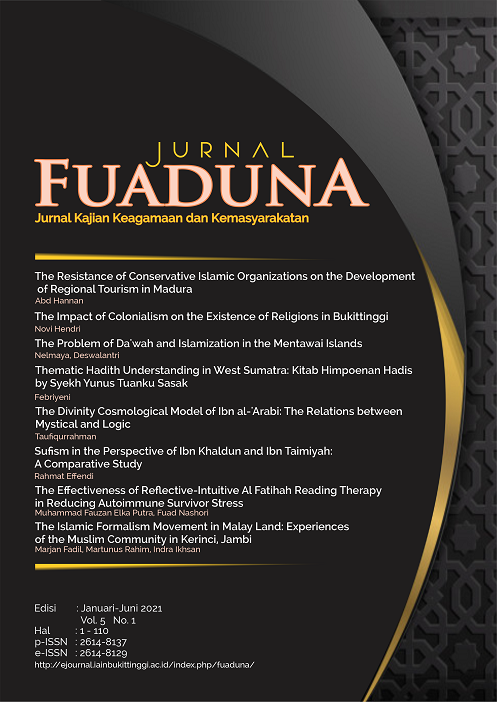
The Islamic Formalism Movement in Malay Land: Experiences of the Muslim Community in Kerinci, Jambi
DOI:
https://doi.org/10.30983/fuaduna.v5i1.4596Keywords:
Islamic Formalism, Muslim Community, Malay WorldAbstract
References
Achmad, Ubaidillah. “Islam Formalis Versus Islam Lokalis: Studi Pribumisasi Islam Walisongo Dan Kiai Ciganjur.†ADDIN 10, no. 1 (2016): 233–62.
Ahmad Zuhdi (Ketua DPD Jam’iyyatul Islamiyah). Wawancara (September 2020).
Ali dkk, Yunasril. Adat Basendi Syara’: Sebagai Fondasi Membangun Masyarakat Madani Di Kerinci. Kerinci: STAIN Kernci Press, 2005.
Ali, Muhammad. “Between Faith and Social Relations: The Muhammadiyah and Nahdlatul Ulama’s Fatwas and Ideas on Non-Muslims and Interreligious Relations.†Journal The Muslim World 110, no. 8 (2020): 458–80.
Anwar, M. Syafii. Pemikiran Dan Aksi Islam Di Indonesia. Jakarta: Paramadina, 1995.
Azra, Azyumardi. Konteks Berteologi Di Indonesia: Pengalaman Islam. Jakarta Selatan: Paramadina, 1999.
Bogel, Fredric V. New Formalist Criticism. New York: Palgrave Macmillan, 2013.
BPS Kabupaten Kerinci. Statistik Daerah Kabupaten Kerinci 2020. Kerinci: BPS Kabupaten Kerinci, 2020.
Dodi, Limas. “Metamorfosis Gerakan Sosial Keagamaan: Antara Polemik, Desiminasi, Ortodoksi, Dan Penerimaan Terhadap Ideologi Lembaga Dakwah Islam Indonesia (LDII).†AL-TAHRIR: Jurnal Pemikiran Islam 17, no. 1 (2017): 227–46.
Elhady, Aminullah. “Islamic Reform Movement In Indonesia: Role Of Muhammadiyah In Social Empowerment.†International Journal of Academic Research in Business and Social Sciences 7, no. 8 (2017): 340–50.
Fadil, Marjan. “Dimensi Kontekstual Dalam Tafsir Hizbut Tahrir Indonesia.†AL-DZIKRA 12, no. 1–20 (2018).
Hasan, Noorhaidi. “The Salafi Movement in Indonesia: Transnational Dynamics and Local Development.†Comparative Studies of South Asia, Africa and the Middle East 27 (January 2007): 83–94. https://doi.org/10.1215/1089201x-2006-045.
Kemenag. “Pesan Kakamenag Di Pengajian MPU,†n.d.
Khilafatul Muslimin. “Maklumat,†n.d.
Lembaga Adat Propinsi Jambi. Dinamika Adat Jambi Dalam Era Global. Jambi: Lembaga Adat Propinsi, 2003.
M. Van, Bruinessen. “Introduction: Contemporary Developments in Indonesian Islam and the ‘Conservative Turn’ of the Early Twenty-First Century.†In Contemporary Developments in Indonesian Islam: Explaining the “Conservative Turn.†Singapura: Institute of Southeast Asian Studies, 2013.
Mahmuddin. “Formalisme Agama Dalam Perspektif Gerakan Sosial: Prospek Dan Tantangan Di Masa Depan.†Jurnal Diskursus Islam 3, no. 1 (2015): 37–48.
Majelis Tafsir Al-Qur’an. “Profil MTA,†n.d.
Muhammadiyah. “AD-ART Muhammadiyah,†2020.
Noor, Irfan. “Sufisme Seyyed Hossein Nasr Dan Formalisme Agama Di Indonesia.†AL-BANJARI 13, no. 2 (2014): 143–264.
Shihab, M. Quraish. Islam Yang Saya Anut Dasar-Dasar Ajaran Islam. Tangerang: Lentera Hati, 2018.
Suprayogo, Imam. “Jam’iyyatul Islamiyah Menjadi Perekat Persatuan Umat,†n.d.
Watson, C. W. Kerinci: Two Historical Studies. Canterbury: University of Kent, 1984.
Yakub, Nurdin. Minangkabau Tanah Pusaka (Sejarah Minangkabau). Bukit Tinggi: Pustaka Indonesia, 1996.
“Mendeeling Encyclopedisch Burean Aflevering.†In Note Betreffende de Afdeeling Korintji, 1915.
Interviews
Anonim (Vice Chairman of Khilafatul Muslimin), Interview, 9 April 2020.
Indra (Member of Komunitas Yuk Ngaji), Interview, 19 April 2021.
Edi Komarudin (Head of LDII in Autonomy Field), Interview, 6 April 2021.
Ahmad Zuhdi (Head of DPD Jam’iyyatul Islamiyah), Interview, 2 September 2020.
Martunus Rahim (Head of MPU), Interview, 20 October 2020.
Suhirman (Vice Chairman of MTA), Interview, 16 April 2021.
Downloads
Published
How to Cite
Issue
Section
Citation Check
License
Authors who publish with this journal agree to the following terms:
- Authors retain copyright and grant the journal right of first publication with the work simultaneously licensed under a Creative Commons Attribution-ShareAlike 4.0. that allows others to share the work with an acknowledgment of the work's authorship and initial publication in this journal.
- Authors are able to enter into separate, additional contractual arrangements for the non-exclusive distribution of the journal's published version of the work (e.g., post it to an institutional repository or publish it in a book), with an acknowledgment of its initial publication in this journal.
- Authors are permitted and encouraged to post their work online (e.g., in institutional repositories or on their website) prior to and during the submission process, as it can lead to productive exchanges, as well as earlier and greater citation of published work (See The Effect of Open Access).