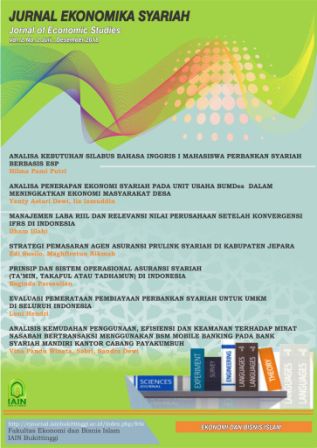
ANALISA KEBUTUHAN SILABUS BAHASA INGGRIS I MAHASISWA PERBANKAN SYARIAH BERBASIS ESP
DOI:
https://doi.org/10.30983/es.v2i2.663Abstract
References
Arikunto, Suharsimi., dkk. 2008. Penelitia.
Tindakan Kelas. Jakarta: Bumi. Aksara
Daeng Sudiro. 2002. Otonomi Perguruan
Tinggi Hubungannya dengan Otonomi Daerah. Manajerial. Vol.01. No.1:72-29
Departemen Pendidikan Nasional, 2003. Undang-Undang Nomor 20 Tahun 2003, Tentang Sistem Pendidikan Nasional, Jakarta: Depdiknas.
Gary. R, Morrison, 2001. Designing Effective
Instruction, Third
Edition. USA: John Wiley and Sons
Hamalik, Oemar. 2011. Kurikulum dan Pembelajaran. Jakarta: Bumi Aksara.
Hutchinson Tom, Alan Waters. 1987. English for Specific Purposes. A Learning-Centred Approach. Cambridge: Cambridge University Press.
Kusumaningputri, R. 2008. Pengembangan
Materi ESP untuk Mahasiswa Jurusan Sastra Sejarah, Fakultas Sastra, Universitas Jember: Lemlit Universitas Jember
Mulyasa, E. 2003. Kurikulum Berbasis
Kompetensi. Konsep; Karakteristik dan Implementasi. Bandung : P.T. Remaja Rosdakarya.
Nunan, David. 2004. Task-Based Language Teaching. Cambridge: Cambridge University Press
Downloads
Published
How to Cite
Issue
Section
Citation Check
License
Authors who publish with this journal agree to the following terms:
- Authors retain copyright and grant the journal right of first publication with the work simultaneously licensed under a Creative Commons Attribution-ShareAlike 4.0 International License that allows others to share the work with an acknowledgment of the work's authorship and initial publication in this journal.
- Authors are able to enter into separate, additional contractual arrangements for the non-exclusive distribution of the journal's published version of the work (e.g., post it to an institutional repository or publish it in a book), with an acknowledgment of its initial publication in this journal.
- Authors are permitted and encouraged to post their work online (e.g., in institutional repositories or on their website) prior to and during the submission process, as it can lead to productive exchanges, as well as earlier and greater citation of published work (See The Effect of Open Access).