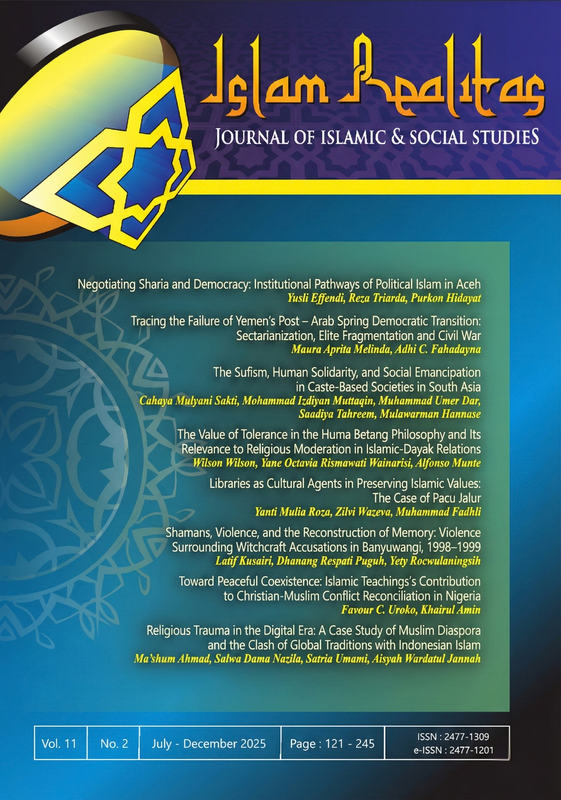
The Sufism, Human Solidarity, and Social Emancipation in Caste-Based Societies in South Asia
DOI:
https://doi.org/10.30983/islam_realitas.v11i2.9612Keywords:
Sufism, Humanity, Caste SystemAbstract
References
Freire, Paulo. Pedagogy of Hope: Reliving Pedagogy of the Oppressed. Continuum, 2000.
Freire, Paulo, and Donaldo P. Macedo. Pedagogy of the Oppressed: 30th Anniversary Edition. 30th anniversary edition. Translated by Myra Bergman Ramos. Bloomsbury Publishing, 2014.
Abdullah, Limon. Influence of Sufism on Lalon Fakir. n.d. Accessed October 6, 2025. https://www.academia.edu/32872637/influence_of_sufism_on_lalon_fakir.
Abid, Sobia, Muhammad Zahid Bilal, and Aleena Begum. Music and trans culturalism: analyzing the role of coke studio music in pakistan. n.d.
Aboobackar, Abdul. “Dalits and Their Conversion to Islam: An Analytical Study of The Event in Meenakshipuram.” ĪQĀN 4 (June 2022): 1–13. https://doi.org/10.36755/iqan.v4i02.385.
Abubakar, Abubakar. “The Values of Sufism As Foundation of Tolerance and Brotherhood in Multicultural Society.” International Journal on Advanced Science, Education, and Religion 8, no. 2 (2025): 156–68. https://doi.org/10.33648/ijoaser.v8i2.906.
Ahmad, Sarfraz. “Socio-Economic and Cultural Impact of Sufi Shrines: A Case Study of Mitthan Kot.” Sukkur IBA Journal of Educational Sciences and Technologies 2, no. 1 (2022): 35–47. https://doi.org/10.30537/sjest.v2i1.1087.
“Appropriation of Caste Spaces in Pakistan: The Theo-Politics of Short Stories in Sindhi Progressive Literature.” Accessed October 3, 2025. https://www.mdpi.com/2077-1444/10/11/627.
Ashari, Mohamad Zulfazdlee Abul Hassan, Ezad Azraai Jamsari, and Mohd Roslan Mohd Nor. “[A Retrospective Analysis of The Arrival of Islam to India and Its Impact on Regional Geopolitics] Analisis Retrospektif Kemasukan Islam Ke India Dan Impaknya Terhadap Geopolitik Serantau.” Jurnal Islam Dan Masyarakat Kontemporari 22, no. 1 (2021): 140–50. https://doi.org/10.37231/jimk.2021.22.1.552.
Azad, Abul Kalam, Abdul Mua’ti @Zamri Ahmad, Moniza Waheed, and Sharifah Sofiah Syed Zainudin. “Rhetorical Criticism of Baul Lalon Shah’s Songs: A Perspective on Humanity.” Journal of Ecohumanism 3, no. 7 (2024): 1909–22. https://doi.org/10.62754/joe.v3i7.4344.
Bishwakarma, Khem Lal, and Saowalak Roongtawanreongsri. “Emerging Themes and Qualitative Evidence of the Role of the Caste System in Climate Change Vulnerability in South Asia.” Human Ecology 52, no. 6 (2024): 1251–67. https://doi.org/10.1007/s10745-024-00556-8.
Charan, Iftikhar Ahmed, Shen Xin, Wang Zezhuang, and Dewei Yao. “Rethinking Efficacy: People’s Perception of Ritual Healing and Trance Religious Practices at Shrines in Pakistan.” Asian Journal of Psychiatry 52 (August 2020): 102020. https://doi.org/10.1016/j.ajp.2020.102020.
Chowdury, Dr. Saeyd Rashed Hasan. “Sufism, Modernisation, and Social Transformation: The Impact of Twelve Awliya in South Asia’s Coastal Region of Chittagong.” Eskişehir Osmangazi Üniversitesi İlahiyat Fakültesi Dergisi 12, no. 1 (2025): 285–306. https://doi.org/10.51702/esoguifd.1575615.
Dutta, Uttaran. “Sufi and Bhakti Performers and Followers at the Margins of the Global South: Communication Strategies to Negotiate Situated Adversities.” Religions 10, no. 3 (2019): 206. https://doi.org/10.3390/rel10030206.
Faslan, Mohamed. “Egalitarianism and Social Stratification: An Overview of the Caste System Among the Muslims of Southern Sri Lanka.” Journal of Muslim Minority Affairs 43, nos. 1–2 (2023): 53–59. https://doi.org/10.1080/13602004.2025.2472598.
“Full Article: ‘Genderless Souls?: Sufi Women in Sociopolitical Contexts.’” Accessed October 6, 2025. https://www.tandfonline.com/doi/full/10.1080/14755610.2024.2426343.
Göktaş, Vahi̇T, and Saeyd Rashed Hasan Chowdury. “Freedom of Religion, Faith and Religious Tolerance in Bangladesh: A Case Study on the Islamic Mysti- Cism.” Freedom of Religion, 2019.
Halim, Wahyuddin. “The Sufi Sheikhs and Their Socio-Cultural Roles in the Islamization of Bengal during the Mughal Period (1526-1858).” JICSA (Journal of Islamic Civilization in Southeast Asia) 7, no. 2 (2018): 175–94. https://doi.org/10.24252/jicsa.v7i2.7045.
“In Search of a Utopian Society: Situating ‘Dalit’ Conversions in Contemporary India Situating ‘Dalit’ Conversions in Contemporary India on JSTOR.” Accessed October 6, 2025. https://www.jstor.org/stable/48749130?seq=1.
“In Search of Al-Insān: Sufism, Islamic Law, and Gender | Journal of the American Academy of Religion | Oxford Academic.” Accessed October 6, 2025. https://academic.oup.com/jaar/article-abstract/77/4/781/746634.
Kumar, Anurag. “Unequal Spaces: An In-Depth Analysis of Caste Discrimination in Indian Universities.” Contemporary Education Dialogue 22 (November 2024). https://doi.org/10.1177/09731849241292863.
Mansoor, Hafiza Sana, Sabar Narimo, Harun Joko Prayitno, Sofyan Anif, and Abdul Bari Khan. “Healing the Spirit: The Social and Religious Impact of Sufi Shrine Practices in Pakistan.” International Journal of Innovative Research and Scientific Studies 8, no. 2 (2025): 221–27. https://doi.org/10.53894/ijirss.v8i2.5139.
Mehmood, Asif, and Sajjad Hasnain. “The Lactosocial at Data Saheb’s Shrine (Lahore-Pakistan): Piety, Flows, Commons, and the Community.” Human Geography, ahead of print, SAGE PublicationsSage UK: London, England, February 19, 2024. Sage UK: London, England. https://doi.org/10.1177/19427786241228496.
Miya, Mr shaik syed. “a note on dargah culture in medieval andhra desa (1287 CE – 1707 CE).” Social Sciences 8, no. 1 (2023).
Munir, Misbachol, and Nida’ul Munafiah. “The Liberation Theology of Asghar Ali Engineer And Its Relevance To Islamic Education Objectives.” Sunan Kalijaga International Journal on Islamic Educational Research 2, no. 1 (2019): 1–18. https://doi.org/10.14421/skijier.2018.2018.21.01.
Mustafa, Nusrat, and Dr Sibghatullah Bhutto. “ہندوستان میں سلسلہ چشت کا تعارف اور ارتقاء: the introduction and evolution of chishtiya sufi order in india.” Al misbah research journal 4, no. 03 (2024): 75–85. https://doi.org/10.5281/zenodo.14455346.
“(PDF) An Evaluation of Muînüddîn Chishti’s Sufi Influences in the Indian Subcontinent: The Case of Chishti Tariqa (Muînüddîn Çiştî’nin Hint Yarımadası’ndaki Tasavvufi Etkilerine Dair Bir Değerlerndirme: Çiştiyye Tarikatı Örneği).” Accessed October 4, 2025. https://www.researchgate.net/publication/371112445_An_Evaluation_of_Muinuddin_Chishti's_Sufi_Influences_in_the_Indian_Subcontinent_The_Case_of_Chishti_Tariqa_Muinuddin_Cisti'nin_Hint_Yarimadasi'ndaki_Tasavvufi_Etkilerine_Dair_Bir_Degerlerndirme_Cistiy.
“(PDF) Baul-Sufi Interface and Cultural Tourism: A Study in Northern Rarh of West Bengal, India.” Accessed October 6, 2025. https://www.researchgate.net/publication/360750463_Baul-Sufi_Interface_and_Cultural_Tourism_A_Study_in_Northern_Rarh_of_West_Bengal_India.
“(PDF) Khawaja and Sufism: Representing Islam in the Time of Disruptions.” Accessed October 6, 2025. https://www.researchgate.net/publication/383693398_Khawaja_and_Sufism_Representing_Islam_in_the_Time_of_Disruptions
Rahman, M Shahinoor, Mossammad Salma, and M Mostafizur Rahman. “The Creation of Tradition and the Alteration of Social Structure by the Mystic Baul Fakir Lalon Shah.” Praxis International Journal of Social Science and Literature 6 (May 2023): 47–54. https://doi.org/10.51879/PIJSSL/060506.
Raza, Shozab. “The Sufi and the Sickle: Theorizing Mystical Marxism in Rural Pakistan.” Comparative Studies in Society and History 64, no. 2 (2022): 300–334. https://doi.org/10.1017/S0010417522000068.
“Rethinking Efficacy: People’s Perception of Ritual Healing and Trance Religious Practices at Shrines in Pakistan - ScienceDirect.” Accessed October 4, 2025. https://www.sciencedirect.com/science/article/abs/pii/S1876201820301313.
Rohmawati, Hanung Sito, and Zulkifli Zulkifli. “The Role of Sufi Orders in Social Change in Indonesia: A Systematic Literature Review”. Teosofia: Indonesian Journal of Islamic Mysticism, vol. 13, no. 2, Dec. 2024, pp. 187-12, doi:10.21580/tos.v13i2.22567.
Shaikh, Saʼdiyya. “Friendships, Fidelities and Sufi Imaginaries: Theorizing Islamic Feminism.” Religions 14, no. 9 (20231231): 1.
“Songs of the Bauls: Voices from the Margins as Transformative Infrastructures.” Accessed October 5, 2025. https://www.mdpi.com/2077-1444/10/5/335.
“South Asian History and Culture: Vol 7, No 2.” Accessed October 3, 2025. https://www.tandfonline.com/toc/rsac20/7/2?nav=tocList.
Tahir, Tayyaba. “An Anthropological Study of Religious Economies at the Shrine of Shah Rukn-e- Alam, Multan.” Global Economics Review VI (June 2021): 202–11. https://doi.org/10.31703/ger.2021(VI-II).16.
“The Baul Philosophy - In Search of Self-Esteem and Self-Sufficiency for a Society | RESEARCH REVIEW International Journal of Multidisciplinary.” Accessed October 6, 2025. https://rrjournals.com/index.php/rrijm/article/view/402.
Takona, John P. “Transformative Education: Paulo Freire’s Pedagogy of the Oppressed and Its Contemporary Resonance.” Journal of Global Education and Research, vol. 9, no. 1, 2025, pp. 87–107. https://doi.org/10.5038/2577-509X.9.1.1351
“The Promise of Memory: Politics of Memory and Caste Inequality in Collective Memory Consolidation Politics of Memory and Caste Inequality in Collective Memory Consolidation on JSTOR.” Accessed October 3, 2025. https://www.jstor.org/stable/48778674.
Uddin, Layli. “Casteist Demons and Working-Class Prophets: Subaltern Islam in Bengal, circa 1872–1928.” Journal of the Royal Asiatic Society 33 (October 2023): 1–25. https://doi.org/10.1017/S1356186323000366.
“Understanding Hegemony of Caste in Political Islam and Sufism in Sindh, Pakistan - Ghulam Hussain, 2019.” Accessed October 4, 2025. https://journals.sagepub.com/doi/abs/10.1177/0021909619839430.
“Varna: A Historical Review.” Research Review International Journal of Multidisciplinary, n.d. Accessed October 3, 2025. https://old.rrjournals.com/past-issue/varna-a-historical-review/.
Downloads
Published
How to Cite
Issue
Section
Citation Check
License
Copyright (c) 2025 Cahaya Mulyani Sakti, Mohammad Izdiyan Muttaqin, Muhammad Umer Dar, Saadiya Tahreem, Mulawarman Hannase

This work is licensed under a Creative Commons Attribution-ShareAlike 4.0 International License.
Authors who publish with this journal agree to the following terms:
- Authors retain copyright and grant the journal right of first publication with the work simultaneously licensed under a Creative Commons Attribution License that allows others to share the work with an acknowledgment of the work's authorship and initial publication in this journal.
- Authors are able to enter into separate, additional contractual arrangements for the non-exclusive distribution of the journal's published version of the work (e.g., post it to an institutional repository or publish it in a book), with an acknowledgment of its initial publication in this journal.
- Authors are permitted and encouraged to post their work online (e.g., in institutional repositories or on their website) prior to and during the submission process, as it can lead to productive exchanges, as well as earlier and greater citation of published work (See The Effect of Open Access).