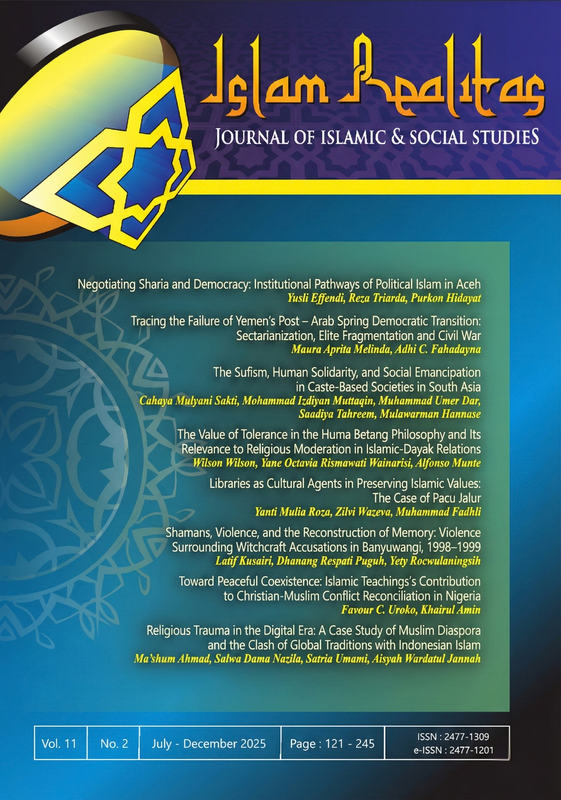
Religious Trauma in the Digital Era: A Case Study of Muslim Diaspora and the Clash of Global Traditions with Indonesian Islam
DOI:
https://doi.org/10.30983/islam_realitas.v11i2.10146Keywords:
Indonesian Muslim Diaspora, Religious Trauma, Digital Religion, Social ExegesisAbstract
References
Az-Zuhaili, Wahbah, Tafsīr al-Munīr, trans. Abdul Hayle al-Kattani et al., Vol. 6 (Jakarta: Gema Insani, 2008)
Caruth, Cathy, Unclaimed Experience: Trauma, Narrative, and History (Baltimore: Johns Hopkins University Press, 1996)
Herman, Judith, Trauma and Recovery (New York: Basic Books, 1992)
Ichwan, Moch Nur, Ahmad Muttaqin Perdamaian, and Program Studi Agama dan Filsafat Program Pascasarjana Universitas Islam Negeri Sunan Kalijaga, Agama: Dari Potensi Menuju Aksi (CR-Peace Sunan Kalijaga) (Yogyakarta: UIN Sunan Kalijaga, n.d.)
Katsir, Ibnu, Tafsīr al-Qur’ān al-‘Aẓīm, trans. M. Abdul Goffar, Vol. 5 (Riyadh: Dar al-Tayyibah, 2004)
Mas’ud, Abd Rahman, Abd Muin, Achmad Habibullah, Achmad Supardi, and Akmal Salim Ruhana, Islam dan Diaspora Indonesia (Jakarta: Litbangdiklat Press, 2021)
Shihab, M. Quraish, Tafsir al-Mishbah: Pesan, Kesan dan Keserasian al-Qur’an, Vol. X (Jakarta: Lentera Hati, 2002)
Abdullah, Shodiq, Mufid Mufid, Ju’Subaidi Ju’subaidi, and Purwanto Purwanto, ‘Religious Confusion and Emptiness: Evaluating the Impact of Online Islamic Learning among Indonesian Muslim Adolescents’, HTS Teologiese Studies / Theological Studies, 80 (2024) <https://doi.org/10.4102/hts.v80i1.9510>
Ahmadi, Rizqa, and Muhammad Muntahibun Nafis, ‘Sense of Community dan Fragmentasi Identitas Diaspora Muslim Indonesia: Studi Kasus AIMF-ACT dan IMCV di Australia’, Refleksi: Jurnal Kajian Agama dan Filsafat, 23 (2024), 301–24 <https://doi.org/10.15408/ref.v23i2.41351>
Akbaş, Arif, ‘Filistin Diasporasının Sosyal Medyada Kimlik İnşası: Dijital Etnografi Çalışması’, Journal of Islamicjerusalem Studies, 25 (2025), 39–68 <https://doi.org/10.31456/beytulmakdis.1616144>
Averianova, Nina, ‘The Concept of “Diaspora” in Research Works of Foreign Scientists: Particularities of Interpretations and Use’, Almanac of Ukrainian Studies, 28 (2021), 8–13 <https://doi.org/10.17721/2520-2626/2021.28.1>
Bhandari, Nagendra Bahadur, ‘Diaspora and Cultural Identity: A Conceptual Review’, Journal of Political Science, 21 (2021), 100–108 <https://doi.org/10.3126/jps.v21i0.35268>
Carminati, Lara, and Ying Fei Gao Héliot, ‘Professional and Religious Identity Conflict: Individual and Organizational Dynamics in Ethically-Charged Circumstances’, Self and Identity, 22 (2023), 1065–92 <https://doi.org/10.1080/15298868.2023.2248686>
Downie, Alison, ‘Christian Shame and Religious Trauma’, Religions, 13 (2022) <https://doi.org/10.3390/rel13100925>
Driezen, Ariadne, Gert Verschraegen, and Noel Clycq, ‘Negotiating a Contested Identity: Religious Individualism among Muslim Youth in a Super-Diverse City’, International Journal of Intercultural Relations, 82 (2021), 25–36 <https://doi.org/10.1016/j.ijintrel.2021.03.003>
Edoli, Anas, ‘Concepts on Diaspora: Reflections on Time and Space’, International Journal of Advanced Research, 6 (2018), 471–74 <https://doi.org/10.21474/IJAR01/6461>
Elvina, Julia, Meylani Eka Putri, and Siti Nabila, ‘Metode Pembelajaran dalam Surah An-Nahl Ayat 125’, IHSANIKA: Jurnal Pendidikan Agama Islam, 2 (2024), 207–17 <https://doi.org/10.59841/ihsanika.v2i3.1425>
van Engelenhoven, Gerlov, ‘From Indigenous Customary Law to Diasporic Cultural Heritage: Reappropriations of Adat throughout the History of Moluccan Postcolonial Migration’, International Journal for the Semiotics of Law, 34 (2021), 695–721 <https://doi.org/10.1007/s11196-020-09781-y>
Hamilton, Jessica L., John Torous, Hannah S. Szlyk, Candice Biernesser, Kaylee P. Kruzan, Michaeline Jensen, et al., ‘Leveraging Digital Media to Promote Youth Mental Health: Flipping the Script on Social Media-Related Risk’, Current Treatment Options in Psychiatry (2024), 67–75 <https://doi.org/10.1007/s40501-024-00315-y>
Hannan, Abdul, and Ach. Fatayillah Mursyidi, ‘Social Media and the Fragmentation of Religious Authority among Muslims in Contemporary Indonesia’, Journal of Indonesian Islam, 17 (2023)
Hartimah, Tati, Nina Farlina, Setyadi Sulaiman, and Endi Aulia Garadian, ‘Expressing National Identity: National Issues from the Indonesian Muslim Diaspora’, Jurnal Studi Komunikasi, 9 (2025), 41–53 <https://doi.org/10.25139/jsk.v9i1.9385>
Hyett, Nerida, Amanda Kenny, and Virginia Dickson-Swift, ‘Methodology or Method? A Critical Review of Qualitative Case Study Reports’, International Journal of Qualitative Studies on Health and Well-Being, 9 (2014), 1–12 <https://doi.org/10.3402/qhw.v9.23606>
Kasim, Fajri M., and Abidin Nurdin, ‘Study of Sociological Law on Conflict Resolution through Adat in Aceh Community According to Islamic Law’, Samarah, 4 (2020), 375–97 <https://doi.org/10.22373/sjhk.v4i2.8231>
Lim, Weng Marc, ‘What Is Qualitative Research? An Overview and Guidelines’, Australasian Marketing Journal, 33 (2025), 199–229 <https://doi.org/10.1177/14413582241264619>
Mattes, Astrid, Miriam Haselbacher, Katharina Limacher, and Christoph Novak, ‘Religion and Politics of Belonging in Digital Times: Youth Religiosity in Focus’, Frontiers in Political Science, 6 (2024), 1–11 <https://doi.org/10.3389/fpos.2024.1476762>
Mubin, Syahrul, ‘Pengaruh Globalisasi terhadap Identitas Keagamaan dalam Kalangan Pemuda Muslim’, Religion: Jurnal Agama, Sosial, dan Budaya, 1 (2020), 1093–1104
Putra, Hardiantama Rizki, Annas Fajar Rohmani, and Luqman Abdulhakim, ‘Empowering Muslim Adolescents through Progressive Islamic Digital Literacy to Combat Cyberbullying’, Multicultural Islamic Education Review, 3 (2025), 53–62 <https://doi.org/10.23917/mier.v3i1.9916>
Rofiq, Ahmad, Johan Arifin, and Purwanto, ‘Islamophobia in the Netherlands: The Adaptation Strategy of the Indonesian Muslim Diaspora’, Qudus International Journal of Islamic Studies, 12 (2024), 119–46 <https://doi.org/10.21043/qijis.v12i1.22466>
Sahruman, ‘Adolescence under Pressure: Religious Trauma and Identity in Dill’s Narrative’, Lire Journal, 9 (2025), 342–52 <https://doi.org/10.33019/lire.v9i2.453>
Sarfraz, Muhammad Rizwan, Muhammad Imran Khan, Hina Ijaz, and Saba Bashir, ‘Influence of Internet Language Hate Speech on Young Adults’ Mental Health and Its Detection Method’, Pakistan Journal of Medical and Health Sciences, 16 (2022), 315–16 <https://doi.org/10.53350/pjmhs22167315>
Srimulyani, Eka, ‘Indonesian Muslim Diaspora in Contemporary South Korea: Living as Religious Minority Group in Non-Muslim Country’, Jurnal Hukum Keluarga dan Hukum Islam, 5 (2021)
Udwan, Ghadeer, Koen Leurs, and Amanda Alencar, ‘Digital Resilience Tactics of Syrian Refugees in the Netherlands’, Social Media and Society, 6 (2020) <https://doi.org/10.1177/2056305120915587>
Rose, S., Bisson, J., and Wessely, S., ‘Psychological Debriefing for Preventing Post-Traumatic Stress Disorder (PTSD)’, Cochrane Database of Systematic Reviews (2002)
Seminar Nasional Indonesia, Opi Irawansah, Melyana R. Pugu, ‘Tradisi Lokal sebagai Penanda Identitas: Respon Keagamaan’, Prosiding Seminar Nasional, 3 (2025), 169–78
Soufi, Muhammad, Cahya Gemilang, Riqko Nur, and Ardi Windayanto, ‘Memijak Bumi, Menjunjung Langit: Identitas Kelompok Diaspora Muslim di Eropa’ <https://doi.org/10.21043/jp.v14i2> [accessed 23 January 2026]
Downloads
Published
How to Cite
Issue
Section
Citation Check
License
Copyright (c) 2025 Ma’shum Ahmad, Salwa Dama Nazila, Satria Umami, Aisyah Wardatul Jannah

This work is licensed under a Creative Commons Attribution-ShareAlike 4.0 International License.
Authors who publish with this journal agree to the following terms:
- Authors retain copyright and grant the journal right of first publication with the work simultaneously licensed under a Creative Commons Attribution License that allows others to share the work with an acknowledgment of the work's authorship and initial publication in this journal.
- Authors are able to enter into separate, additional contractual arrangements for the non-exclusive distribution of the journal's published version of the work (e.g., post it to an institutional repository or publish it in a book), with an acknowledgment of its initial publication in this journal.
- Authors are permitted and encouraged to post their work online (e.g., in institutional repositories or on their website) prior to and during the submission process, as it can lead to productive exchanges, as well as earlier and greater citation of published work (See The Effect of Open Access).