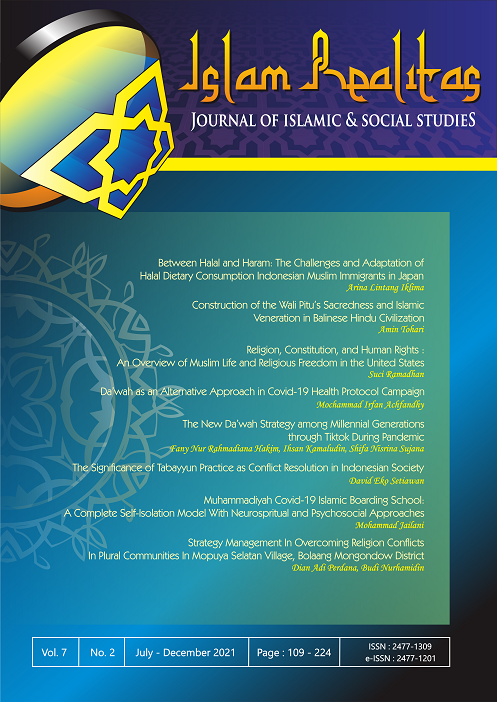
Between Halal and Haram: The Challenges and Adaptation of Halal Dietary Consumption Indonesian Muslim Immigrants in Japan
DOI:
https://doi.org/10.30983/islam_realitas.v7i2.4660Keywords:
Halal Dietary, Challenges and Adaptation, Muslim Immigrants, JapanAbstract
References
Journals
Ainur Rofiq & Titan Achsan, ‘Examining the Impacts of Religiosity , Attitude , and Subjective Norm Toward Intention to Purchase Halal Food : A Study on Indonesian Muslim Consumers’, Jurnal Ilmiah Mahasiswa Fakultas Ekonomi Dan Bisnis, 05 (2017)
<https://jimfeb.ub.ac.id/index.php/jimfeb/article/view/3850>
Amin, Ali, ‘From Mushalla to Mosque: The Formation of South and Southeast Asian Muslim Communities in Japan’, Al-Albab, 8.1 (2019), 3 <https://doi.org/10.24260/alalbab.v8i1.1050>
Annabi, Carrie Amani, and Olufunbi Olajumoke Ibidapo-Obe, ‘Halal Certification Organizations in The United Kingdom: An Exploration of Halal Cosmetic Certification’, Journal of Islamic Marketing, 8.1 (2017), 107–26 <https://doi.org/10.1108/JIMA-06-2015-0045>
Arata, Mariko, ‘Getting Halal Food in the Netherlands: From Indonesian Consumers’ Perspective’, in Proceedings of the International Workshop on Halal Food Consumption in East and West, 2018, pp. 35–48 <https://www.academia.edu/>
Deniar, Shannaz Mutiara, and Tonny Dian Effendi, ‘Halal Food Diplomacy in Japan and South Korea’, Journal of Social and Political Sciences, 2.3 (2019), 805–13 <https://doi.org/10.31014/aior.1991.02.03.121>
Fasa, Muhammad Iqbal, ‘Critical Review: Is Religiousity an Important Determinant on Muslim Consumer Behavior in Malaysia?’, IJRDO-Journal of Applied Management Science, 2.8 (2016), 13–21
Fathil, Fauziah, and Fathiah Fathil, ‘Islam in Minority Muslim Countries: A Case Study on Japan and Korea’, World Journal of Islamic History and Civilization, 1.2 (2011), 130–41 <http://irep.iium.edu.my/24131/>
Mokhlis, Safiek, ‘Relevancy and Measurement of Religiosity in Consumer Behavior Research’, International Business Research, 2.3 (2009) <https://doi.org/10.5539/ibr.v2n3p75>
Murphy, Daniel S., and Mathew B. Robinson, ‘The Maximizer: Clarifying Merton’s Theories of Anomie and Strain’, Theoretical Criminology, 12.4 (2008), 501–21 <https://doi.org/10.1177/1362480608097154>
Nakano, Sachiko, Yuri Okunishi, and Tomoko Tanaka, ‘在日ムスリム留å¦ç”Ÿã®ç¤¾ä¼šç”Ÿæ´»ä¸Šã®å›°é›£"Social Life Difficulties of Muslim Students in Japan"’, 岡山大å¦å¤§å¦é™¢ç¤¾ä¼šæ–‡åŒ–科å¦ç ”究科紀è¦, 39, 2015, 137–51 <http://ci.nii.ac.jp/naid/120005593532/ja/>Ainur Rofiq & Titan Achsan, ‘Examining the Impacts of Religiosity , Attitude , and Subjective Norm Toward Intention to Purchase Halal Food : A Study on Indonesian Muslim Consumers’, Jurnal Ilmiah Mahasiswa Fakultas Ekonomi Dan Bisnis, 05 (2017) <https://jimfeb.ub.ac.id/index.php/jimfeb/article/view/3850>
Amin, Ali, ‘From Mushalla to Mosque: The Formation of South and Southeast Asian Muslim Communities in Japan’, Al-Albab, 8.1 (2019), 3 <https://doi.org/10.24260/alalbab.v8i1.1050>
Annabi, Carrie Amani, and Olufunbi Olajumoke Ibidapo-Obe, ‘Halal Certification Organizations in The United Kingdom: An Exploration of Halal Cosmetic Certification’, Journal of Islamic Marketing, 8.1 (2017), 107–26 <https://doi.org/10.1108/JIMA-06-2015-0045>
Arata, Mariko, ‘Getting Halal Food in the Netherlands: From Indonesian Consumers’ Perspective’, in Proceedings of the International Workshop on Halal Food Consumption in East and West, 2018, pp. 35–48 <https://www.academia.edu/>
BP2MI, Data Penempatan Dan Pelindungan Pekerja Migran Indonesia (PMI) Tahun 2019, 2019 <https://bp2mi.go.id/uploads/statistik/images/data_19-02-2020_Laporan_Pengolahan_Data_BNP2TKI____2019(2).pdf>
Deniar, Shannaz Mutiara, and Tonny Dian Effendi, ‘Halal Food Diplomacy in Japan and South Korea’, Journal of Social and Political Sciences, 2.3 (2019), 805–13 <https://doi.org/10.31014/aior.1991.02.03.121>
DinarStandard, ‘State of the Global Islamic Economy Report 2020/2021’, Salaam Gateway, 2019, 3–4 <https://cdn.salaamgateway.com/special-coverage/sgie19-20/full-report.pdf>
Fasa, Muhammad Iqbal, ‘Critical Review: Is Religiousity An Important Determinant On Muslim Consumer Behavior In Malaysia?’, IJRDO-Journal of Applied Management Science, 2.8 (2016), 13–21
Fathil, Fauziah, and Fathiah Fathil, ‘Islam in Minority Muslim Countries: A Case Study on Japan and Korea’, World Journal of Islamic History and Civilization, 1.2 (2011), 130–41 <http://irep.iium.edu.my/24131/>
Hajis, Hiji, ‘The Number of Muslims in Japan Is Growing Fast’, The Economist, 2021 <https://www.economist.com/asia/2021/01/07/the-number-of-muslims-in-japan-is-growing-fast>
Halawa, Abdelhadi, ‘Acculturation of Halal Food to the American Food Culture through Immigration and Globalization: A Literature Review’, Journal of Ethnic and Cultural Studies, 5.2 (2018), 53–63 <https://doi.org/10.29333/ejecs/89>
Jasso, ‘Result of an Annual Survey of International Students in Japan 2020’, March, 2021, 1–4 <https://www.studyinjapan.go.jp/en/_mt/2021/04/date2020z_e.pdf>
Mokhlis, Safiek, ‘Relevancy and Measurement of Religiosity in Consumer Behavior Research’, International Business Research, 2.3 (2009) <https://doi.org/10.5539/ibr.v2n3p75>
Murphy, Daniel S., and Mathew B. Robinson, ‘The Maximizer: Clarifying Merton’s Theories of Anomie and Strain’, Theoretical Criminology, 12.4 (2008), 501–21 <https://doi.org/10.1177/1362480608097154>
Nakano, Sachiko, Yuri Okunishi, and Tomoko Tanaka, ‘在日ムスリム留å¦ç”Ÿã®ç¤¾ä¼šç”Ÿæ´»ä¸Šã®å›°é›£"Social Life Difficulties of Muslim Students in Japan"’, 岡山大å¦å¤§å¦é™¢ç¤¾ä¼šæ–‡åŒ–科å¦ç ”究科紀è¦, 39, 2015, 137–51 <http://ci.nii.ac.jp/naid/120005593532/ja/>
Nakhleh, Emile A, Keiko Sakurai, and Michael Penn, ‘Islam in Japan: A Cause for Concern?’, Asia Policy, 5.5 (2008), 61–104
Oki, Yoshinori, Mitsui & Co. Global Strategic Studies Institute Monthly Report May 2019, 2019 <https://www.mitsui.com/mgssi/en/report/detail/__icsFiles/afieldfile/2019/07/03/1905d_oki_e.pdf>
Pradana, M., R. Huertas-GarcÃa, and F. Marimon, ‘Purchase Intention of Halal Food Products in Spain: The Moderating Effect of Religious Involvement’, International Food Research Journal, 27.4 (2020), 735–44
Ramly, Zulkufly, Lau Teck Chai, and Choe Kum Lung, ‘Religiosity as a Predictor of Consumer Ethical Behaviour: Some Evidence from Young Consumers from Malaysia’, Journal of Business Systems, Governance and Ethics, 3.4 (2008) <https://doi.org/10.15209/jbsge.v3i4.147>
Rehman, Ateeqâ€urâ€, and Muhammad Shahbaz Shabbir, ‘The Relationship Between Religiosity and New Product Adoption’, Journal of Islamic Marketing, 1.1 (2010), 63–69 <https://doi.org/10.1108/17590831011026231>
SESRIC, ‘Muslim Communities and Minorities in Non-OIC Member States: Japan’, Global Muslim Diaspora Project. Human and Social Development Studies., 2019, 8
Tanada, Hirofumi, ‘“Estimate of Muslim Population in the World and Japan, 2018†料 世界ã¨æ—¥æœ¬ã®ãƒ ス ãƒªãƒ äººå£ 2018 å¹´ 店田 廣文’, Ningenkagaku KenkyÅ«, 32.2 (2019), 253–62
Wahidati, Lufi, and Eska Nia Sarinastiti, ‘Perkembangan Wisata Halal Di Jepang’, Jurnal Gama Societa, 1.1 (2018), 9–19
Yakin, Ayang utriya, and Ima Sri Rahmani, ‘Halal Food Consumption among the Indonesian Muslim Minority in Belgium’, in Proceedings of the International Workshop on ‘Halal Food Consumption in East and West’ (Tokyo: Institute for Asian Muslim Studies, Waseda University, 2018), pp. 123–50
Yamaguchi, Hiroko Kurosaki, ‘The Potential and Challenge of Halal Foods in Japan’, Journal of Asian Rural Studies, 3.1 (2019), 1 <https://doi.org/10.20956/jars.v3i1.1712>
Yulita, Irma Rachmi, and Susy Ong, ‘The Changing Image of Islam in Japan: The Role of Civil Society in Disseminating Better Information about Islam’, Al-Jami’ah, 57.1 (2019), 51–82 <https://doi.org/10.14421/ajis.2019.571.51-82>
Online Database
BP2MI, Data Penempatan Dan Pelindungan Pekerja Migran Indonesia (PMI) Tahun 2019, 2019 <https://bp2mi.go.id/uploads/statistik/images/data_19-02-2020_Laporan_Pengolahan_Data_BNP2TKI____2019(2).pdf>
DinarStandard, ‘State of the Global Islamic Economy Report 2020/2021’, Salaam Gateway, 2019, 1–178 <https://cdn.salaamgateway.com/special-coverage/sgie19-20/full-report.pdf>
Hajis, Hiji, ‘The Number of Muslims in Japan Is Growing Fast’, The Economist, 2021 <https://www.economist.com/asia/2021/01/07/the-number-of-muslims-in-japan-is-growing-fast>
Jasso, ‘Result of an Annual Survey of International Students in Japan 2020’, March, 2021 <https://www.studyinjapan.go.jp/en/_mt/2021/04/date2020z_e.pdf>
Nakhleh, Emile A, Keiko Sakurai, and Michael Penn, ‘Islam in Japan: A Cause for Concern?’, Asia Policy, 5.5 (2008), 61–104
Oki, Yoshinori, Mitsui & Co. Global Strategic Studies Institute Mnthly Report May 2019, 2019 <https://www.mitsui.com/mgssi/en/report/detail/__icsFiles/afieldfile/2019/07/03/1905d_oki_e.pdf>
Downloads
Additional Files
Published
How to Cite
Issue
Section
Citation Check
License
Authors who publish with this journal agree to the following terms:
- Authors retain copyright and grant the journal right of first publication with the work simultaneously licensed under a Creative Commons Attribution License that allows others to share the work with an acknowledgment of the work's authorship and initial publication in this journal.
- Authors are able to enter into separate, additional contractual arrangements for the non-exclusive distribution of the journal's published version of the work (e.g., post it to an institutional repository or publish it in a book), with an acknowledgment of its initial publication in this journal.
- Authors are permitted and encouraged to post their work online (e.g., in institutional repositories or on their website) prior to and during the submission process, as it can lead to productive exchanges, as well as earlier and greater citation of published work (See The Effect of Open Access).