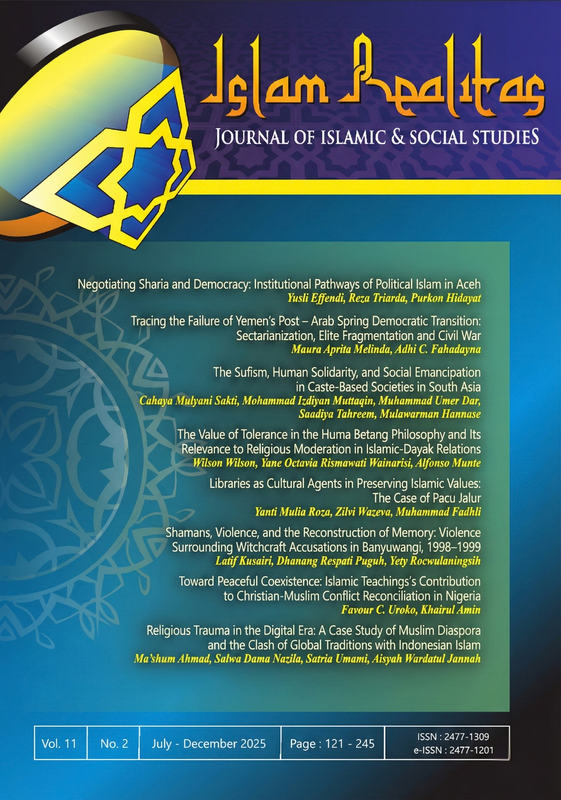
Toward Peaceful Coexistence: Islamic Teachings’s Contribution to Christian-Muslim Conflict Reconciliation in Nigeria
DOI:
https://doi.org/10.30983/islam_realitas.v11i2.10049Keywords:
Christian-Muslim Relation, Islamic Teachings, Peaceful Coexistence, Reconciliation, NigeriaAbstract
References
Al-Raysuni, Ahmad, and Nancy Roberts, Al-Shura: The Qur’anic Principle of Consultation (Herndon, VA: International Institute of Islamic Thought, 2011) https://doi.org/10.2307/j.ctvkc67gn
Council, Nigeria Inter-Religious, Building Bridges of Understanding and Peace (Abuja: NIREC Publications, 2000)
Esposito, John L., Islam: The Straight Path, 5th edn (Oxford: Oxford University Press, 2011)
Falola, Toyin, The History of Nigeria (Cambridge: Cambridge University Press, 2020)
———, Violence in Nigeria: The Crisis of Religious Politics and Secular Ideologies (Rochester, NY: University of Rochester Press, 1998)
International Saheeh, The Qur’an: Arabic Text with English Meanings (Jeddah: Abul-Qasim Publishing House / Al-Muntada al-Islami, 1997)
Kukah, Matthew Hassan, Religion, Politics and Power in Northern Nigeria (Ibadan: Spectrum Books, 1993)
Marozzi, Justin, Baghdad: City of Peace, City of Blood: A History in Thirteen Centuries (London: Allen Lane, 2014)
Menocal, María Rosa, The Ornament of the World: How Muslims, Jews, and Christians Created a Culture of Tolerance in Medieval Spain (New York: Back Bay Books, 2002)
Mosher, Lucinda, and David Marshall (eds), Sin, Forgiveness, and Reconciliation: Christian and Muslim Perspectives (Washington, DC: Georgetown University Press, 2016) http://www.jstor.org/stable/j.ctt1c84cfk
Obadare, Ebenezer, Pentecostal Republic: Religion and the Struggle for State Power in Nigeria (London: Zed Books, 2018)
Ostien, Philip, Jonah Jang and the Jasawa: Ethno-Religious Conflict in Jos, Nigeria, in Muslim-Christian Relations in Africa (Leiden: Brill, 2009)
Paden, John N., Faith and Politics in Nigeria: Nigeria as a Pivotal State in the Muslim World (Washington, DC: United States Institute of Peace, 2008)
Thurston, Alexander, Boko Haram: The History of an African Jihadist Movement (Princeton: Princeton University Press, 2016)
Çancı, Hakan, and Olatunji A. Odukoya, ‘Ethnic and Religious Crises in Nigeria: A Specific Analysis upon Identities (1999–2013)’, African Journal on Conflict Resolution, 16 (2016), 87–110
Cherian, Joyson K., ‘An Interreligious Initiative for Peace and Harmony’, Transformation, 36 (2019), 100–112 https://www.jstor.org/stable/26696448
George, Justin, Adesoji Adelaja, and Dave Weatherspoon, ‘Armed Conflicts and Food Insecurity’, American Journal of Agricultural Economics, 102 (2020), 114–31 https://www.jstor.org/stable/48601985
Hackett, Rosalind I. J., ‘Religion and Development in Nigeria: Some Ethical Considerations’, Journal of Religion in Africa, 31 (2001), 259–84
Ilerhunmwuwa, Issac, ‘Understanding the Emergence, the Impact, and the Countering of Boko Haram’, Journal of Global Faultlines, 12 (2025), 61–81
https://www.jstor.org/stable/48828320
Islam, Md. Thowhidul, ‘Peaceful Coexistence of Various Religious Groups in Islam’, Journal of Islamic Thought and Civilization, 8 (2018) https://journals.umt.edu.pk/index.php/JITC/article/view/112
Karpov, Victor P., ‘The Soviet Concept of Peaceful Coexistence and Its Implications for International Law’, Law and Contemporary Problems, 29 (1964), 858–64 https://doi.org/10.2307/1190698
Khan, Naveed, ‘A Sacred Duty: Islam and Social Justice’, Yaqeen Institute (2020) https://yaqeeninstitute.org/read/paper/a-sacred-duty-islam-and-social-justice
Khrushchev, Nikita S., ‘On Peaceful Coexistence’, Foreign Affairs, 38 (1959), 1–18 https://doi.org/10.2307/20029395
Laitin, David D., ‘The Sharia Debate and the Origins of Nigeria’s Second Republic’, The Journal of Modern African Studies, 20 (1982), 411–30 http://www.jstor.org/stable/160525
Lawan Yusufari, Mamman A., ‘The Application of Islamic Law in Nigeria’, Yearbook of Islamic and Middle Eastern Law Online, 4 (1997), 201–9 https://doi.org/10.1163/221129898X00099
Lipson, Leon, ‘Peaceful Coexistence’, Law and Contemporary Problems, 29 (1964), 871–81 https://doi.org/10.2307/1190700
Ludwig, Frieder, ‘Christian–Muslim Relations in Northern Nigeria since the Introduction of Shari‘ah in 1999’, Journal of the American Academy of Religion, 76 (2008), 602–37 http://www.jstor.org/stable/25484042
Nwaomah, Samuel M., ‘Religious Crises in Nigeria: Manifestation, Effect and the Way Forward’, Journal of Sociology, Psychology and Anthropology in Practice, 3 (2011), 94–104
Ogbuehi, Friday I., ‘Critical Appraisal of Dialogue as a Strategy for Religious Conflict Resolution in Nigeria’, UNIZIK Journal of Religion and Human Relations, 8 (2016), 158–74
Sulaiman, Kamaldeen O., ‘Peaceful Coexistence between Christians and Muslims in Nigeria’, Journal of Islamic Studies and Culture, 4 (2016), 17–25
Amnesty International, Nigeria: At Least 10,000 Civilians Died in Military Detention in Northeast (2021)<https://www.amnesty.org/en/latest/news/2020/12/nigeria-older-people-often-an-invisible-casualty-in-conflict-with-boko-haram/> [accessed 23 January 2026]
Anyanwu, Samuel, ‘Youths Are Critical in Promoting Peaceful Co-Existence – IPCR’, Federal Ministry of Information and National Orientation
<https://fmino.gov.ng/youths-are-critical-in-promoting-peaceful-co-existence-ipcr-2/> [accessed 23 January 2026]
Commonwealth, The, ‘Commonwealth Peace Prize Winners Celebrate 30 Years of Turning Conflict into Coexistence’ (2025)
<https://thecommonwealth.org/news/peace-prize-winners-celebrate-30-years-coexistence> [accessed 23 January 2026]
Crisis Group, Herders against Farmers: Nigeria’s Expanding Deadly Conflict (2017)
<https://www.crisisgroup.org/africa/west-africa/nigeria/252-herders-against-farmers-nigerias-expanding-deadly-conflict> [accessed 23 January 2026]
Human Rights Watch, Nigeria: Events of 2019 (2019)
<https://www.hrw.org/world-report/2019/country-chapters/nigeria> [accessed 23 January 2026]
Nigeria Inter-Religious Council, ‘Nigeria Inter-Religious Council’
<https://www.nirec.org.ng/> [accessed 23 January 2026]
Peace & Dialogue Platform, The, ‘Dialogue Process’ (2017)
<https://www.peaceinfrastructures.org/thematic/dialogue-process> [accessed 23 January 2026]
Peace News Network, ‘Voices Against Violence: Young Nigerian Peace Ambassadors Changing Lives in Conflict Zones’
<https://peacenews.com/voices-against-violence-young-nigerian-peace-ambassadors-changing-lives-iin-conflict-zones/ > [accessed 23 January 2026]
RuralPostNG, ‘Youth-Led Ambassadors Reach 30,000 Nigerians in SDG Push’ (2026)
<https://ruralpostng.com/2026/01/06/youth-led-ambassadors-reach-30000-nigerians-in-sdg-push/ > [accessed 23 January 2026]
UNHCR, Nigeria Emergency (2021)
<https://www.unhcr.org/hk/en/emergencies/nigeria-emergency> [accessed 23 January 2026]
UNICEF, Education in Emergencies: Nigeria (2020)
<https://www.unicef.org/nigeria/topics/education-emergencies> [accessed 23 January 2026]
Downloads
Published
How to Cite
Issue
Section
Citation Check
License
Copyright (c) 2025 Favour C. Uroko, Khairul Amin

This work is licensed under a Creative Commons Attribution-ShareAlike 4.0 International License.
Authors who publish with this journal agree to the following terms:
- Authors retain copyright and grant the journal right of first publication with the work simultaneously licensed under a Creative Commons Attribution License that allows others to share the work with an acknowledgment of the work's authorship and initial publication in this journal.
- Authors are able to enter into separate, additional contractual arrangements for the non-exclusive distribution of the journal's published version of the work (e.g., post it to an institutional repository or publish it in a book), with an acknowledgment of its initial publication in this journal.
- Authors are permitted and encouraged to post their work online (e.g., in institutional repositories or on their website) prior to and during the submission process, as it can lead to productive exchanges, as well as earlier and greater citation of published work (See The Effect of Open Access).