 CC BY-SA 4.0
 ADDITIONAL MENU
About the Journal
FOCUS
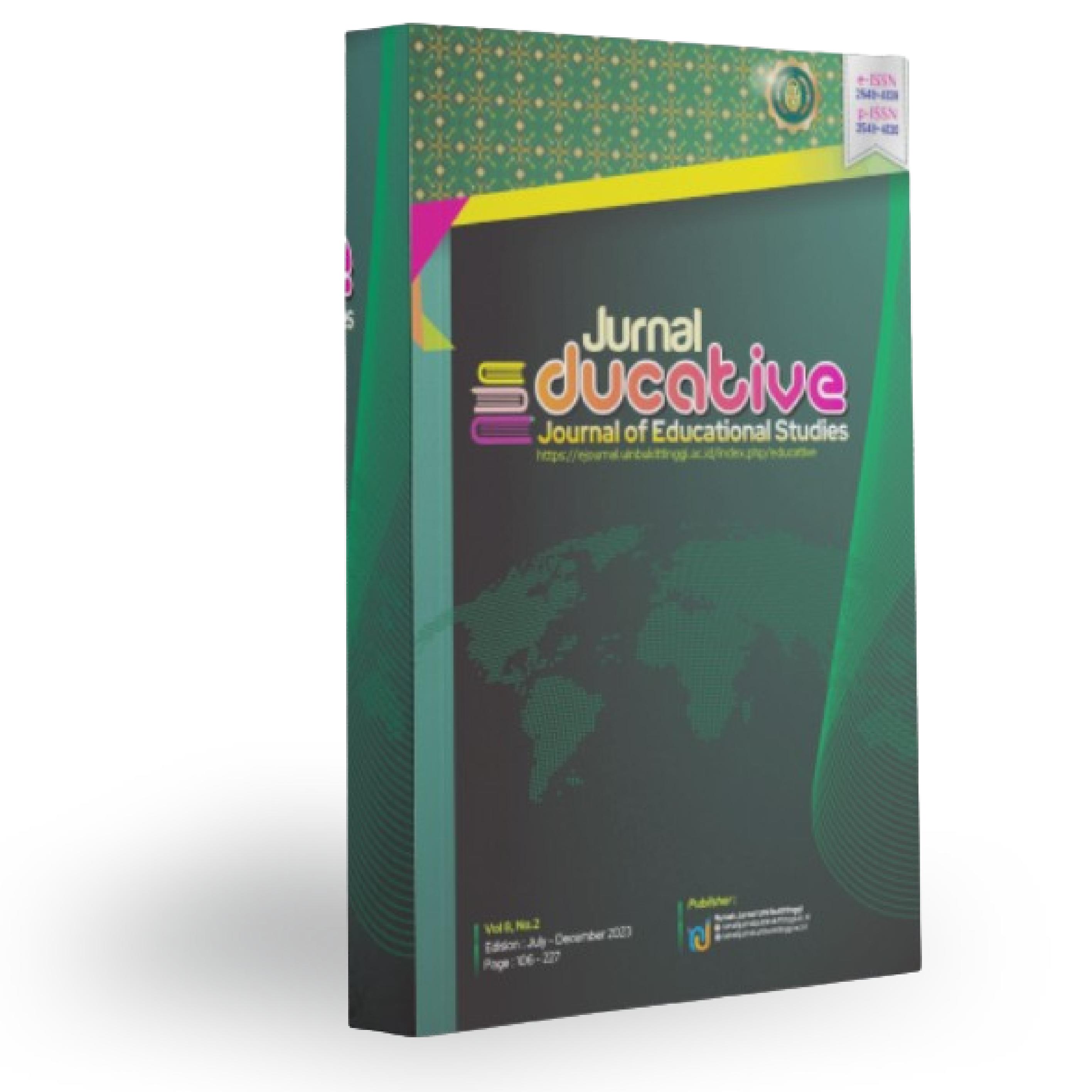
Jurnal Educative: Journal of Educational Studies is a peer-reviewed scholarly journal devoted to research on context-responsive learning innovation and educational transformation.
The journal examines how pedagogical approaches, digital technologies, teacher capabilities, assessment practices, learner literacies, and educational environments interact to create meaningful, inclusive, and sustainable learning.
Educative particularly encourages theoretically informed and methodologically rigorous research that moves beyond describing whether an educational intervention works to explain how, why, for whom, and under what conditions learning and educational change occur.
The journal welcomes scholarship from diverse geographical and educational contexts, with particular interest in Southeast Asia, the Global South, and other emerging or underrepresented educational settings. Comparative, cross-cultural, and cross-context studies are also encouraged when they contribute to broader debates in educational research.
The journal seeks to connect locally grounded educational problems and innovations with wider theoretical, methodological, and practical discussions in education.
SCOPE
Educative publishes original research and rigorous evidence syntheses addressing learning innovation and educational transformation in formal, non-formal, and technology-mediated learning environments.
The journal welcomes research in the following interconnected areas:
-
Learning and pedagogical innovation, including active, experiential, inquiry-based, collaborative, problem-based, project-based, student-centered, and other theoretically grounded approaches to meaningful and deep learning;
-
Digital learning and educational transformation, including online, blended, mobile, technology-enhanced and AI-supported learning, intelligent learning environments, educational chatbots, digital platforms, learning analytics, and responsible uses of emerging technologies;
-
Instructional and learning design, including the design, development, implementation, evaluation, and improvement of learning environments, educational media, instructional systems, and context-responsive learning experiences;
-
Teacher learning and professional capacity, including teacher competence, professional development, pedagogical knowledge, digital competence, instructional leadership, and teacher readiness for educational change;
-
Assessment, evaluation, and evidence for learning, including innovative assessment practices, educational measurement, instrument development and validation, program evaluation, feedback, and the use of evidence to improve learning and instruction;
-
Learner literacies and capabilities, including digital, information, media, data, and AI literacy, critical thinking, collaboration, creativity, self-regulated learning, engagement, and other capabilities relevant to contemporary education;
-
Inclusive, equitable, and sustainable learning, including inclusive education, accessibility, educational equity, culturally responsive pedagogy, Education for Sustainable Development, and learning innovations for diverse or underserved learners and communities;
-
Curriculum and educational innovation, particularly studies examining how curriculum, pedagogy, technology, assessment, and contextual factors interact to transform teaching and learning;
-
Educational policy and institutional transformation when the study demonstrates a direct and substantive connection to teaching, learning, teacher development, educational innovation, or the transformation of learning environments; and
-
Comparative and context-responsive educational research that examines how educational innovations operate across cultural, social, institutional, geographical, or technological contexts.
Educative welcomes quantitative, qualitative, mixed-method, experimental, quasi-experimental, design-based, development, ethnographic, case-study, comparative, and other rigorous educational research approaches.
Systematic reviews, meta-analyses, and other forms of evidence synthesis are considered when they employ transparent and rigorous methods and produce a substantive conceptual, theoretical, methodological, or policy contribution beyond descriptive mapping of existing publications.
Subject-specific studies—including mathematics, science, language, civic, vocational, religious, physical, early childhood, and other fields of education—are considered when their principal contribution advances broader understanding of learning, pedagogy, teacher development, assessment, educational innovation, or educational transformation.
Studies centred primarily on institutional management, religious doctrine, subject-matter content, technology development, or descriptive perceptions are generally outside the journal's core scope unless they demonstrate a clear and substantial contribution to educational theory, learning, teaching, or educational transformation.