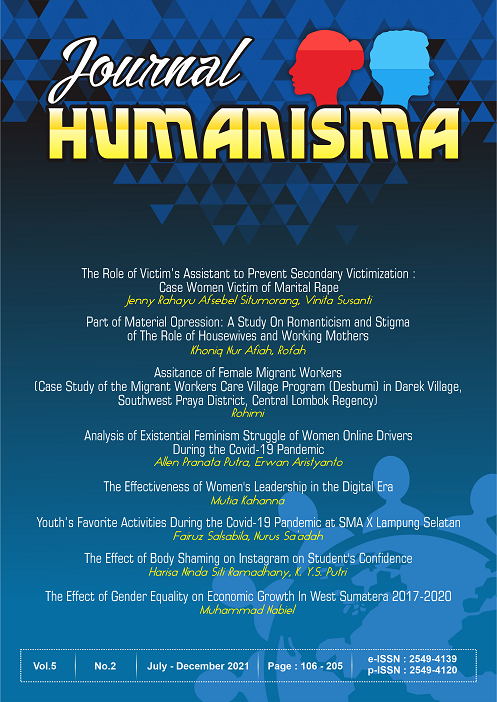
Youth’s Favorite Activities During the Covid-19 Pandemic at SMA X Lampung Selatan
DOI:
https://doi.org/10.30983/humanisme.v5i2.4818Keywords:
Teenagers, Favorite Activities, Pendemi Period,Abstract
References
Journal ;
Ahmadi, D. Interaksi Simbolik : Suatu pengantar. Jurnal Komunikasi. Vol. 9, No. 2. 2008. h, 303.
Arifa, F,N. Tantangan Pelaksanaan Kebijakan Belajar Dari Rumah dalam Masa Darurat Covid19. Kajian Singkat terhadap Isu Aktual dan Strategis. Vol. 12, No. 7. 2020. h, 15.
Astawa, I.N.T. ‘Perubahan Perilaku Remaja Hindu dalam Menjalankan Aktivitas Keagamaan di Kota Denpasar’, Guna Widya: Jurnal Pendidikan Hindu, Vol. 5 No.1 2018.
Aylie, N.S., Mekonen, M.A., Mekuria, R.M. The Psychology Impacts of COVID-19 Pandemic among Univercity Students in Bench-Sheko Zone, South-West Ethiopia: a Community-Based Cross-Sectional Study. Psychol. Res. BehaviorManaged. 13. 2020. 813-821.
Baber, H. Modeling the Acceptance of E-learning During the Pandemic of COVID-19- A Study of South korea. Journal of Management Education. Vol. 19, No. 2. 2021.
Banggur, M.D.V, Situmorang, R. & Rusmono. Pengembangan Pembelajaran Berbasis Blended Learning pada Mata Pelajaran Etimologi Multimedia. Jurnal Teknologi Pendidikan. Vol. 20, No. 2. 2018.
Basilaia, G. & Kavavadze, D. Transition to Online Education in Schools during a SARS-CoV-2 Coronavirus (COVID-19) Pandemic in Georgia. Journal of Pedagogical Research. Vol. 5, No. 4. 2020.
Batubara, B.M. The Problems of the World of Education in the Middle of the Covid-19 Pandemic. Budapest International Research and Critics Institute-Journal. Vol. 4, No. 1. 2021.
Budiman, A. Aktivitas Olahraga Tradisional pada Kalangan Remaja di Masa Pandemi Covid-19. Journal of Physical and Outdoor Education. Vol. 3, No. 1. 2021.
Budiyati, G,A. & Eka, O. Stres dan Resiliensi Remaja Di Masa Pandemi Covid-19. Jurnal Kesehatan. Vol. l, No. 2. 2020. h, 13.
Bujang, J.S. Sulastri. & Pradita, I.A. ‘Olahraga Volly Sebagai Sarana Mengurangi Game Online bagi Remaja di desa Jambat Akar Kabupaten Saluma’. Jurnal Dharma Pendidikan dan Keolahragaan, Vol. 1 No. 1. 2021.
Chaidirman, Indriastuti, D., & Narmi. Fenomena Kecanduan Penggunaan Gawai (Gedget) pada Kalangan Remaja Suku Bajo. Journal of Holistic Nursing and Health Science. Vol. 2, No. 2. 2019.
Clark, M. & Adams, D. The Self-identified Positive Attributes and Favorite activities of children on the autism spectrum. Elsevier. 2020.
Elanda, Y. The Construction of an Ideal Mother Amid the Covid-19 Pandemi : Gender Injustice Experienced by Career Women While Working From Home. Humanisma: Journal of Gender Studies. Vol. 5, No. 1. 2021.
Felita, P. dkk. Pemakaian Media Sosial dan Self Concept pada Remaja. Jurnal Ilimiah Psikologi MANASA. Vol. 5, No. 1. 2016. h, 32.
Goldschmidt. The COVID-19 Pandemic: Technology Use to Support the Welbeing of Chlidren. Journal of Pedriatic Nursing. 2020.
Haris, A. Asrinda, A. Makna dan Simbol dalam Proses Interaksi Sosial (Sebuah Tinjauan Komunikasi). Jurnal Risalah. Vol. 29, No. 1. 2018. h, 18.
Jasni. ‘Partisipasi Remaja Putri terhadap Aktivitas Nasyiatul Aisyiyah di Sunga Pinang Kecamatan Hulu Kuantan’. Jurnal Pendidikan Sosial, Sains, dan Humaniora. Vol. 4 No. 3. 2018.
Lee, A. Wuhan Novel Coronavirus (COVID-19): Why Global Control is Challenging?. Public Health. 179. A1-A2. 2020.
Lestari, P.A.S & Gunawan. The Impact of Covid-19 Pandemic on Learning Implementation of Primary and Secondary School Levels. Journal of Elementary and Childhood Eduction. Vol. 1, No. 2. 2020.
Makarova, E. A. Aggressive Behavior in Online Games and Cybervictimization of Teenagers and Adolescents. International Electronic Journal of Elementary Education. Vol. 12, No. 2. 2019.
Nurhasanah. Women Student Motivation in Learning Arabic Language During the Covid-19 Pandemic. Humanisma : Journal of Gender Studies. Vol. 5, No. 1. 2021.
Putra, R.S & Irwansyah, I. Media Komunikasi Digital, Efektif Namun Tidak Efisien, Studi Meida Richness Theory dalam Pembelajaran Jarak Jauh Berbasis Teknologi di Masa Pandemi. Jurnal Ilmu Sosial dan Ilmu Politik. Vol. 1, No. 2. 2020.
Putra, Y,W. & Amalia, S,R. Indekx Massa Tubuh (IMT) Mempengaruhi Aktivitas Remaja Putri SMP Negeri 1 Sumberwangi. Jurnal Aiska-University. Vol. 16, No. 1. 2018. 107.
Putri, R.A. Lestari, P. Nilawati, I. ‘Gerakan Remaja Sehat dan Produktif (GERATIF) sebagai Upaya Preventif Perilaku Beresiko Remaja’, Indonesian Journal of Community Empowerment, Vol. 2 No. 1. 2020.
Rokhmawan, T. Dkk. Pengembangan Kegiatan Seni dan Budaya Islami Sebagai Bentuk Kegiatan Positif Remaja Pada Masa Pandemi diDesa Sumber Dawe Sari Kecamatan Greti Kabupaten Pasuruan. Jurnal Pengabdian Kepada Masyarakat. Vol. 1, No. 2. 2020.
Rohr, S., Mullier, F., Jung, f., Apfelbacher, C., Seidler, A., Riedel-Heller, S.G. Psychosoziale Folgen von Quarantanemabnahmen bei schwerweigenden Coronavirus-Ausbruchen: ein Rapid Review. Psychiatr. Vol. 47, No.4. 2020.
S. Royant Parola, V. Londe, S. Trehout & S. Harley. (2018). ‘The Use of Social Media Modifies Teenagers’ Sleep-Related Behavior’. Elsevier. 44(1).
Saputra, D. Muh, A. & Ambo, U. Potret Sosial Remaja Masa Kini (Study pada Remaja Pengguna Smartphone di Kelurahan Kambu Kambu Kota Kediri). Jurnal Neo Societal. Vol. 3, No. 3. 2018. h, 550.
Siregar, N, S,S. Kajian Tentang Interaksionisme Simbolik. Jurnal Ilmu Sosial. Vol. 1, No. 2. 2016. h, 103.
Sultan,M. ‘Studi Paradigma Naratif Walter Fisher Pada Aktivitas
“Nongkrong†Di Kalangan Remaja Madya’. Jurnal Al-Khitabah. Vol. 3 No. 1. 2017.
Van Bavel, J.J., Baicker, K., Bogio, P.S., Capraro, V., Cichocka, A., Cikara, M., Crockett, M.J., Crum, A.J., Douglas, K.M., Druckman, J.N. Drury, J. Using Social and Behavioral Science to Supprot COVID-19 Pandemic Respons. Nat.Hum. Behavior. Vol. 4, No. 5. 2020. 460-471.
Wardhani, R,A. Euis, S. & Istiqlaliyah, M. Ancaman, Faktor Profektif, Aktivitas dan Resiliensi Remaja : Analisis Berdasarkan Tipologi Sosiodemografi. Jurnal Ilmu Keluarga dan Konsumen. Vol. 10, No. 1. 2017. 49.
Yonandi, R. & Mochamad, N. Kecanduang Game Online (Profil Pecandu, Faktor Penyebab dan Penanganannya. Jurnal BK UNES. Vol. 11, No. 5. 2020. 766.
Books;
Ali, M. & Mohammad,A. (2014). Psikologi Remaja: Perkembangan Peserta Didik. Jakarta: PT. Bumi Aksara.
Elizabeth, Hurlock B. (1980). Psikologi Perkembangan Sebuah Pendekatan Sepanjang Rentang Kehidupan Edisi Kelima. Erlangga.
Sanusi, A. (2011). Metodologi Penelitian Bisnis. Jakarta Selatan: Selemba Empat.
Article;
Herlina,https://nasional.kontan.co.id/news/update-corona-indonesia-senin264-tambah-5944-kasus-hindari-kerumunan. Diakses pada tanggal 26 April 2021.
WH0,https://www.who.int/emergencies/disease/novel-coronavirus-2019.WHOCoronavirus(covid-19)Dashboard. Diakses pada tanggal 22 April 2021.
Interview
TN, (Siswa SMA X Lampung Selatan), Wawancara, { Kamis, 29 April 2021}
DA, (Siswa SMA X Lampung Selatan), Wawancara, { Kamis, 29 April 2021}
AF, (Siswa SMA X Lampung Selatan), Wawancara, { Kamis, 29 April 2021}
LA, (Siswa SMA X Lampung Selatan), Wawancara, { Kamis, 29 April 2021}
SY, (Siswa SMA X Lampung Selatan), Wawancara, { Kamis, 29 April 2021}
TO, (Siswa SMA X Lampung Selatan), Wawancara, { Kamis, 29 April 2021}
ZN, (Siswa SMA X Lampung Selatan), Wawancara, { Kamis, 29 April 2021}
IM, (Siswa SMA X Lampung Selatan), Wawancara, { Kamis, 29 April 2021}
AA, (Siswa SMA X Lampung Selatan), Wawancara, { Kamis, 29 April 2021}
NA, (Siswa SMA X Lampung Selatan), Wawancara, { Kamis, 29 April 2021}
Downloads
Published
How to Cite
Issue
Section
Citation Check
License
Authors who publish with this journal agree to the following terms:
- Authors retain copyright and grant the journal right of first publication with the work simultaneously licensed under a Creative Commons Attribution-ShareAlike 4.0. that allows others to share the work with an acknowledgment of the work's authorship and initial publication in this journal.
- Authors are able to enter into separate, additional contractual arrangements for the non-exclusive distribution of the journal's published version of the work (e.g., post it to an institutional repository or publish it in a book), with an acknowledgment of its initial publication in this journal.
- Authors are permitted and encouraged to post their work online (e.g., in institutional repositories or on their website) prior to and during the submission process, as it can lead to productive exchanges, as well as earlier and greater citation of published work (See The Effect of Open Access).