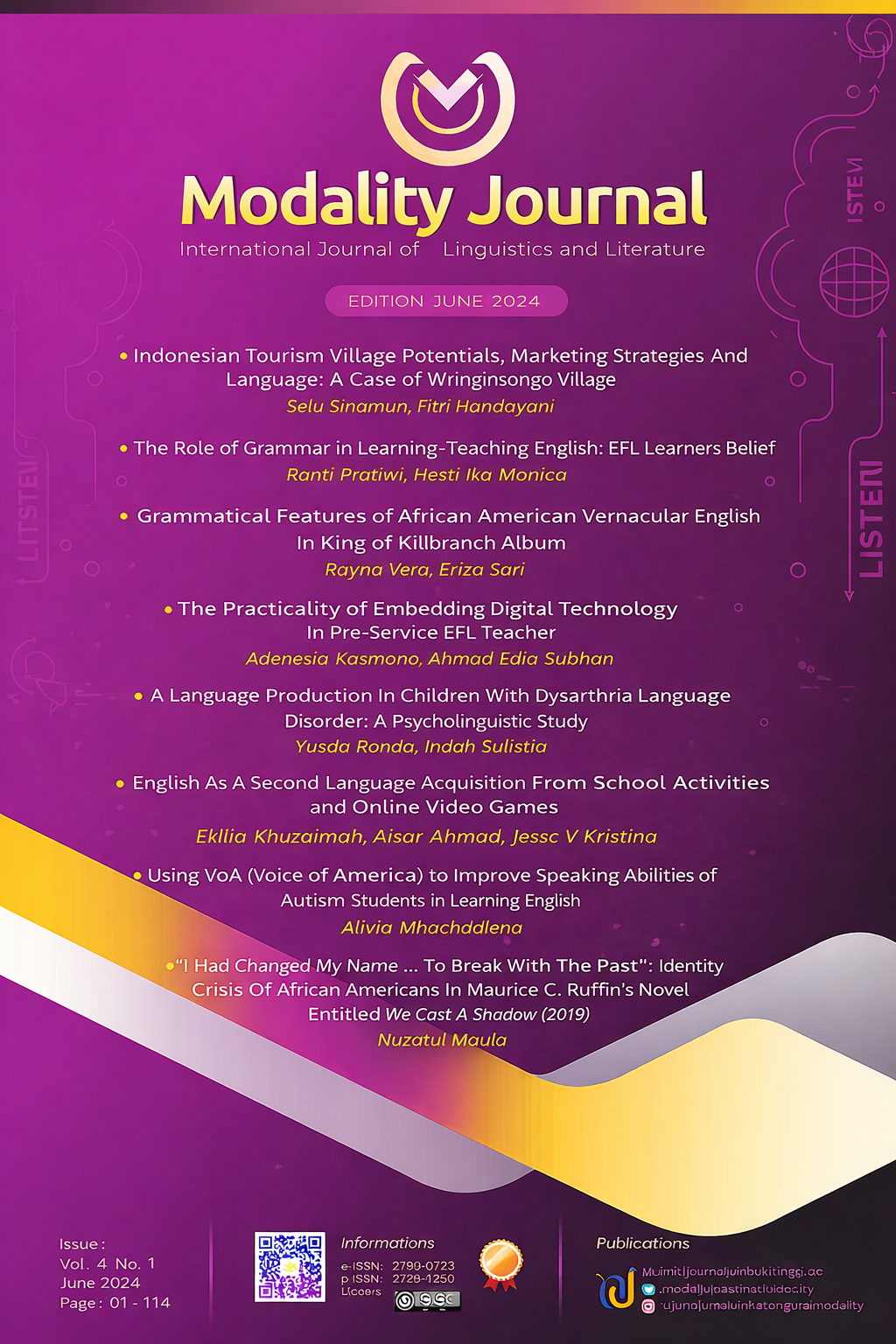
Using VoA (Voice of America) to Improve Speaking Abilities of Autism Students in Learning English
DOI:
https://doi.org/10.30983/mj.v4i1.8342Keywords:
Learning English, Autism Students, VoA (Voice of America)Abstract
References
Deb, S., Suraksha, & Bhattacharya, P. (2018). Augmented Sign Language Modeling(ASLM) with interaction design on smartphone - An assistive learning and communication tool for inclusive classroom. Procedia Computer Science, 125, 492–500. https://doi.org/10.1016/j.procs.2017.12.064
Dermawan, O. (2018). Strategi Pembelajaran Bagi Anak Berkebutuhan Khusus Di Slb. Psympathic: Jurnal Ilmiah Psikologi, 6(2), 886–897. https://doi.org/10.15575/psy.v6i2.2206
Desai, T., Chow, K., Mumford, L., Hotze, F., & Chau, T. (2014). Implementing an iPad-based alternative communication device for a student with cerebral palsy and autism in the classroom via an access technology delivery protocol. Computers and Education, 79, 148–158. https://doi.org/10.1016/j.compedu.2014.07.009
Deskriptif, S., Sd, D. I., Smp, D. A. N., & Alam, S. (2012). Tinjauan Psikologis Kesiapan Guru Dalam Menangani Peserta Didik Berkebutuhan Khusus Pada Program Inklusi (Studi Deskriptif Di Sd Dan Smp Sekolah Alam Ar-Ridho). Educational Psychology Journal, 1(berkebutuhan khusus), 1–10.
Hamalik, Oemar. (2014). Proses Belajar Mengajar. Jakarta: PT Bumi Aksara.
Idris, N. (2018). Social Skill Analysis in Children with Special Needs. Jurnal Nalar Pendidikan, 6, 148. Retrieved from file: //pdfs.semanticscholar.org/ce13/a35840150f5715155edcb3a94ff946a64c99.pdf
Itkampus.com. (2020). Pengertian Gadget. https://itkampus.com/pengertian-gadget/ (Diakses pada 16 November 2020).
Mahfud, M. N., & Wulansari, A. (2018). Penggunaan Gadget untuk Menciptakan Pembelajaran yang Efektif. Seminar Nasional Pendidikan, 58–63.
Mutia, F. (2011). Kemampuan anak autis menyerap informasi melalui proses belajar di sekolah inklusi. Jurnal Palimpsest, 2(2), 1–10.
Rahayu, S., R. (2013). Memenuhi Hak Anak Berkebutuhan Khusus Anak Usia Dini Melalui Pendidikan Inklusif. Jurnal Pendidikan Anak, pp. 355–363.
Rofiah, N. H. (2015). Proses Identifikasi: Mengenal Anak Kesulitan Belajar Tipe Disleksia Bagi Guru Sekolah Dasar Inklusi. Inklusi, 2(1), 109. https://doi.org/10.14421/ijds.020110
Mahmudah, L., Izzah, L., Ar-rahmaniyah, S. D. P., Tangerang, S., Jakarta, U. M., & Tangerang, S. (2019). Students’ Understanding on Simple Past Tense through VOA Learning English YouTube Channel. 2622–3597, 89–94.
Makiabadi, H., & Square, A. (n.d.). Learning English Listening And Speaking Through Bbc Voa Podcasts : 19(2), 101–108.
Mendes, A. P., Brown, W. S., Rothman, H. B., & Sapienza, C. (2004). Effects of Singing Training on the Speaking Voice of Voice Majors. 18(1), 83–89. https://doi.org/10.1016/j.jvoice.2003.07.006
Moris and Novia. (2010). Spoken English. Spoken English. Indonesia: ESB (International).
Nan, Y., & Mingfang, Z. (2009). Using VOA Special English to Improve Advanced English Learners‟ Productive Use of High Frequency Words. English Teaching Forum, 47(3), 26–31.
Nunan, D. (2015). Teaching to speakers of other languages : an introduction. Retrieved from http://public.ebookcentral.proquest.com/choice/publicfullrecord.aspx?p=1974326
Nurfitri Alfin, Ikhsanudin, & Endang, S. (2013). The Effectiveness Of Voa Video Learning English “Education Report” To Teach Speaking. 1–10.
Pollard, A., & Anderson, J. (2010). Reflective teaching : evidence-informed professional practice. London; New York: Continuum International Pub. Group.
Downloads
Published
How to Cite
Issue
Section
Citation Check
License
Copyright (c) 2024 Amir Hamzah

This work is licensed under a Creative Commons Attribution-ShareAlike 4.0 International License.
Authors who publish with this journal agree to the following terms:
- Authors retain copyright and grant the journal right of first publication with the work simultaneously licensed under a Creative Commons Attribution License that allows others to share the work with an acknowledgment of the work's authorship and initial publication in this journal.
- Authors are able to enter into separate, additional contractual arrangements for the non-exclusive distribution of the journal's published version of the work (e.g., post it to an institutional repository or publish it in a book), with an acknowledgment of its initial publication in this journal.
- Authors are permitted and encouraged to post their work online (e.g., in institutional repositories or on their website) prior to and during the submission process, as it can lead to productive exchanges, as well as earlier and greater citation of published work (See The Effect of Open Access).