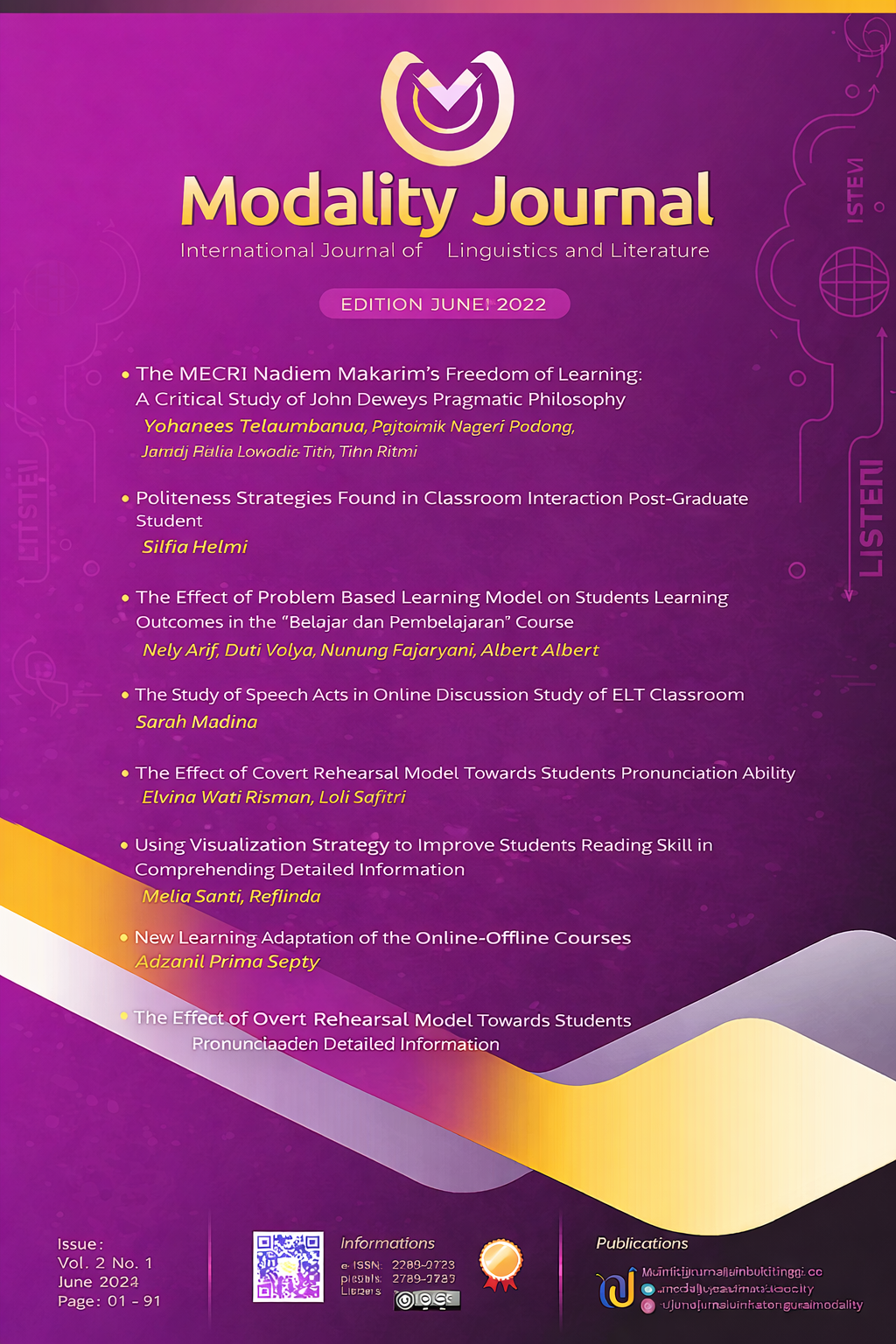
The MECRI Nadiem Makarims Freedom of Learning: A Critical Study of John Deweys Pragmatic Philosophy
DOI:
https://doi.org/10.30983/mj.v2i1.5392Keywords:
freedom of learning, john dewey, pragmatic philosophyAbstract
References
Book
Ansyar, M. (2015) Kurikulum: Hakikat, Fondasi, Desain, dan Pengembangan. Rawamangun. Jakarta: Prenadamedia Group.
Barnes, D. (1989) Active Learning. Leeds University TVEI Support Project.
Bonwell, C.; Eison, J. (1991) Active Learning: Creating Excitement in the Classroom. Washington, D.C.: School of Education and Human Development, George Washington University.
Hashemi, N. (2009) Secularism. The Oxford. Edited by John L. Esposito. Oxford: Oxford University Press.
Herrington, A. & Herrington, J. (2006) Authentic Learning Environments in Higher Education. Hershey, USA: Information Science Publishing.
Journal
Adeleye, J. O. (2017) ‘Pragmatism and its implications on teaching and learning in Nigerian schools’, Research Highlights in Education, pp. 2–6.
Al-Asfour, A. (2012) ‘“Online Teaching: Navigating Its Advantages, Disadvantages and Best Practices.â€â€™, Tribal College Journal of American Indian Higher Education, 23(3).
Wood, D. F. (2003) ‘“ABC of learning and teaching in medicine: Problem based learningâ€â€™, BMJ, 326(7384), pp. 328–330.
Bean, J. C. (2011) Engaging Ideas: The Professor’s Guide to Integrating Writing, Critical Thinking and Active Learning in the Classroom. 2ed edn. Florida: John Wiley & Sons. p. 384.
Buendgens-Kosten, J. (2014) ‘Authenticity’, ELT Journal, 68(4), pp. 457–459.
Johnson, H. M. (2007) ‘“Dialogue and the construction of knowledge in e-learning: Exploring students’’ perceptions of their learning while using Blackboard’s asynchronous discussion board.â€â€â€™, European Journal of Open, Distance and E-Learning, 10(1), pp. 75–96.
Yusuf, M. (2014) Metode Penelitian: Kuantitatif, Kualitatif dan Penenlitian Gabungan. 1st edn. Jakarta: Prenadamedia Group.
Zagranski, Richard, Whigham, T William, Dardenne, L, P. (2007) Understanding Standards-based Education: A Practical Guide for Teachers and Administrators. California: Corwin Press.
Renkl, A., Atkinson, R. K., Maier, U. H., & Staley, R. (2002) ‘From example study to problem solving: Smooth transitions help learning’, Journal of Experimental Education, 70(4), pp. 293–315.
Online References
Azzura, S. N. (2019) ‘“Pro Kontra Nadiem Makarim Jadi Menteri, Peningkatan Ekonomi Hingga Nasib Gojek,â€â€™ https://www.merdeka.com. Available at: https://www.merdeka.com/uang/pro-kontra-nadiem-makarim-jadi-menteri-peningkatan-ekonomi-hingga-nasib-gojek.html.
Beck, R. H. (2009) The Three R’s Plus: What Today’s Schools are Trying to Do and Why. Minesota, USA: U of Minnesota Press.
Boss, S. (2011) Project-Based Learning: A Short History. Available at: https://www.edutopia.org/project-based-learning-history.
Boyd, N. (2021) Pragmatism: Overview & Practical Teaching Examples. Available at: https://study.com/academy/lesson/pragmatism-overview-practical-teaching-examples.html.
Cohen, M., L. (2020) Philosophical Perspectives in Education Part 3. Available at: https://oregonstate.edu/instruct/ed416/PP3.html.
Dewey, J. (1948) Education and the Philosophic Mind. New York: MacMilian Co.
Drew, C. (2021) The 4 Principles of Pragmatism in Education. Available at: https://helpfulprofessor.com/pragmatism-in-education/.
Hantoro, J. (2019) ‘“Mendikbud Nadiem Makarim Hapus Ujian Nasional Mulai 2021â€â€™. Available at: https://nasional.tempo.co/read/1282545/mendikbud-nadiem-makarim-hapus-ujian-nasional-mulai-2021.
Hardiyan, Y. (2019) ‘Jokowi Lantik 38 Menteri Kabinet Indonesia Maju’, https://kabar24.bisnis.com/. Available at: https://kabar24.bisnis.com/read/20191023/15/1162368/jokowi-lantik-38-menteri-kabinet-indonesia-maju.
Harususilo, Y. E. (2019) ‘“4 Gebrakan Merdeka Belajar Mendikbud Nadiem, Termasuk Penghapusan UN!â€â€™ Available at: https://edukasi.kompas.com/read/2019/12/11/13091211/4-gebrakan-merdeka-belajar-mendikbud-nadiem-termasuk-penghapusan-un?page=all#page2.
Jannah, C. (2019) ‘“Merdeka Belajar: Kebijakan Lompat-lompat ala Nadiem Makarimâ€â€™.
John R. Shook (2017) The Oxford Handbook of Secularism. Oxford: Oxford University Press.
Karakaş-Özür, N. and Duman, N. (2019) ‘The Trends in Authentic Learning Studies and the Role of Authentic Learning in Geography Education’, International Education Studies, 12(12), p. 28. doi: 10.5539/ies.v12n12p28.
Kennedy, R. (2019) Progressive Education: How Children Learn. Available at: https://www.thoughtco.com/progressive-education-how-children-learn-today-2774713.
Kriyantono, R. (2006) Teknik Praktis Riset Komunikasi. Jakarta: Prenada.
Kyriacou, C. (1992) ‘“Active Learning in Secondary School Mathematicsâ€â€™, British Educational Research Journal, 18(3), pp. 309–318.
Lee, L., & Bullivant, S. (2016) ‘Secularism’. A Dictionary of Atheism. Oxford: Oxford University Press.
Leeuwen, F. (2016) Reflections on “Democracy and Education. Available at: https://www.ei-ie.org/en/item/21385:reflections-on-democracy-and-education.
Loutchko, Iouri; Kurbel, Karl; Pakhomov, A. (2002) ‘Production and Delivery of Multimedia Courses for Internet Based Virtual Education; the World Congress’, (The World Congress "Networked Learning in a Global Environment: Challenges and Solutions for Virtual Education, Berlin, Germany, 1–4 May 2002).
Luke, W. G. (2016) The Nonreligious: Understanding Secular People and Societies. Oxford: Oxford University Press.
Markham, T. (2011) ‘Project Based Learning’, Teacher Librarian, 39(2), pp. 38–42.
McMillan, H. J. (2008) Assessment Essentials for Standards-Based Education. California: Corwin Press.
Mueller, J. (2016) Authentic Assessment Toolbox: How Do You Create Authentic Assessments? Available at: http://jfmueller.faculty.noctrl.edu/toolbox/whatisit.htm.
Nita, C. N. (2019) ‘“Ujian Nasional Dihapus, Jumli: Ada Dampak Positif dan Negatifnyaâ€â€™. Available at: https://bangka.tribunnews.com/2019/12/13/ujian-nasional-dihapus-jumli-ada-dampak-positif-dan-negatifnya.
Nitko, A. J. (2001) Educational Assessment of Students. 3rded edn. Upper saddle River, New Jersey.: Prentice Hall/Merrill Education Publication.
Ornstein, C, A., & Hunkins, P. H. (2013) “Curriculum: Foundations, Principles and Issuesâ€. 6th edn. New York: Pearson.
Sadulloh, U. (2008) Pengantar Filsafat Pendidikan. Bandung: Alfabeta.
Safi’i, M. F. (2019) ‘“4 Pokok Kebijakan ‘Merdeka Belajar’, Ini Penjelasan Mendikbudâ€â€™. Available at: https://hot.liputan6.com/read/4131904/4-pokok-kebijakan-merdeka-belajar-ini-penjelasan-mendikbud.
Salahudin (2011) Filsafat Pendidikan. Bandung: CV. Pustaka Setia.
Sarah, S. (2018) ‘Pandangan Filsafat Pragmatis John Dewey dan Implikasinya dalam Pendidikan Fisika’, Prosiding Seminar Nasional Pendidikan Fisika FITK UNSIQ, 1(1), pp. 67–77. Available at: https://ojs.unsiq.ac.id/index.php/semnaspf/article/view/126.
Sharma, S. et al. (2018) ‘549 Pragmatism in Education’, 5(1), pp. 1549–1554. Available at: www.ijetsr.com.
Sugiyono (2007) Metode Penelitian Kuantitatif, Kualitatif dan R&D. Bandung: Alfabeta.
Tiffany, M. (no date) ‘Educational Portfolio: A Gardening Perspective’. Available at: http://misstiffanytucker.weebly.com/global-awareness.html.
Downloads
Published
How to Cite
Issue
Section
Citation Check
License
Copyright (c) 2022 Yohannes Telaumbanua, Yalmiadi, Titin Ritmi

This work is licensed under a Creative Commons Attribution-ShareAlike 4.0 International License.
Authors who publish with this journal agree to the following terms:
- Authors retain copyright and grant the journal right of first publication with the work simultaneously licensed under a Creative Commons Attribution License that allows others to share the work with an acknowledgment of the work's authorship and initial publication in this journal.
- Authors are able to enter into separate, additional contractual arrangements for the non-exclusive distribution of the journal's published version of the work (e.g., post it to an institutional repository or publish it in a book), with an acknowledgment of its initial publication in this journal.
- Authors are permitted and encouraged to post their work online (e.g., in institutional repositories or on their website) prior to and during the submission process, as it can lead to productive exchanges, as well as earlier and greater citation of published work (See The Effect of Open Access).