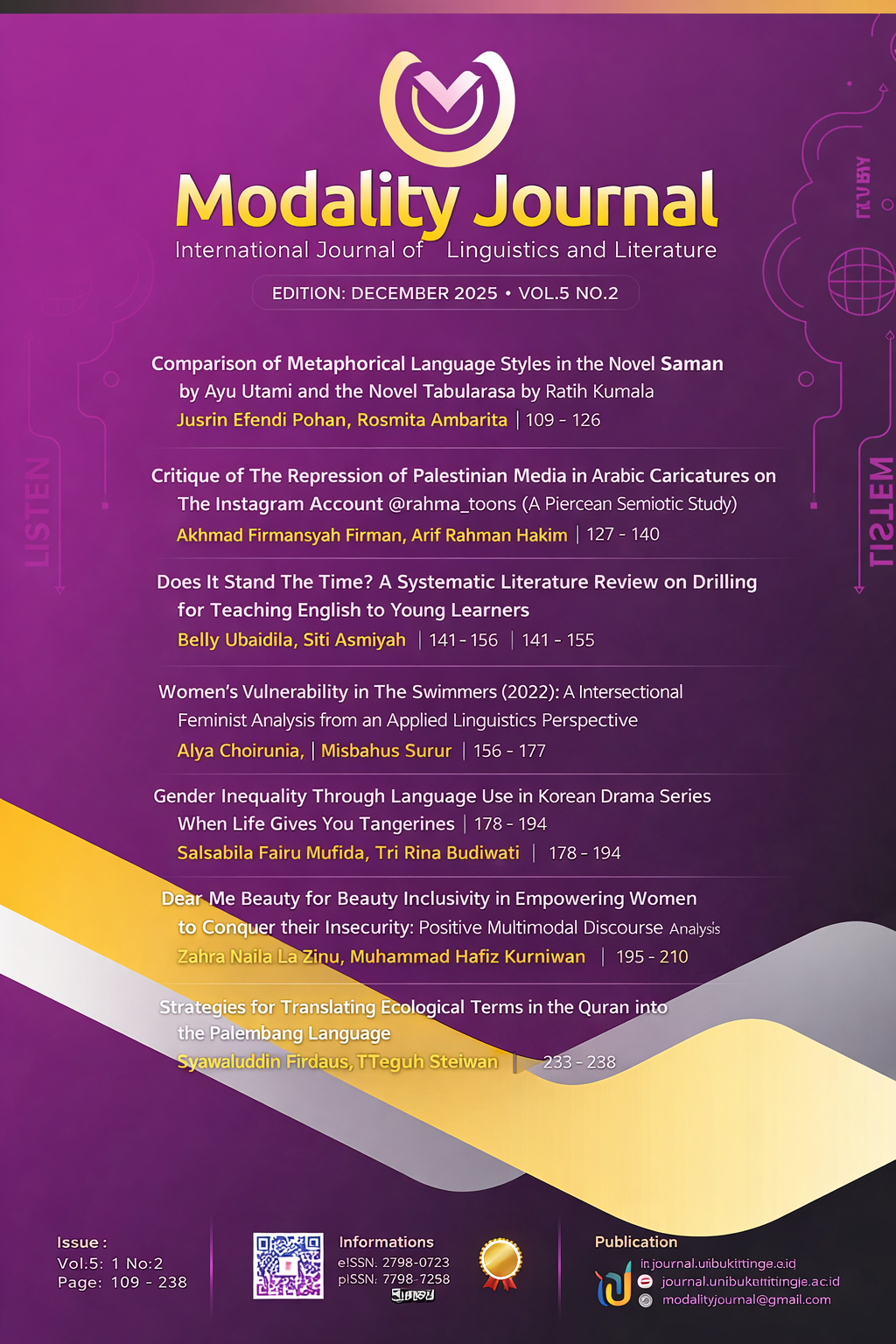
Does It Stand The Time? A Systematic Literature Review on Drilling for Teaching English to Young Learners
DOI:
https://doi.org/10.30983/modalityjournal.v5i2.10362Keywords:
Drilling, English as a Foreign Language (EFL), Teaching English to Young Learners (TEYL), Systematic Literature Review (SLR)Abstract
References
Afghari, A., & Khayatan, P. (2017). Collaborative learning and Iranian EFL learners’ vocabulary improvement through snowball and word-webbing techniques. International Journal of English Language & Translation Studies, 5(2), 122–131.
Albay, M. (2016). The Use of Drills in the Development of Speaking Skills. International Journal of Social Sciences & Educational Studies, 3(1).
Albiladi, W. S. (2019). Teaching English pronunciation revisited: The challenges of teaching EFL in non-English-speaking countries. European Journal of Foreign Language Teaching.
Ambawani, S., & Putranti, B. E. (2023). Pelatihan pelafalan (pronunciation) kosa kata bahasa Inggris dengan metode drilling bagi siswa sekolah dasar. AMMA: Jurnal Pengabdian Masyarakat, 11(2), 1429–1434.
Andarbeni, T. K. (2010). The Use of Drills to Improve the Students ’ Speaking Ability (Classroom Action Research in the First Grade of MTsNU Salatiga in the Academic of 2009/2010). IAIN SALATIGA.
Anggraini, D. (2018). Chain drill technique in teaching speaking. Channing: Journal of English Language Education and Literature, 3(1), 51–59.
Brown, H. D. (2010). Language Assessment: Principles and Classroom Practices.
Cameron, L. (2001). Teaching languages to young learners. Cambridge university press.
Celce-Murcia, M., Brinton, D. M., & Goodwin, J. M. (2010). Teaching pronunciation hardback with audio CDs (2): A course book and reference guide. Cambridge University Press.
Ghalebi, R., Sadighi, F., & Bagheri, M. S. (2021). A study of vocabulary learning strategies among high and low Iranian English vocabulary learners. Cogent Education, 8(1), 1834933.
Halimah, H., Nurviyani, V., Saepulah, A., Helmie, J., Wandawati, R. W., & Mutiah, S. (2022). Virtual reality-supported drilling strategy in teaching English vocabulary to young learners. Acitya: Journal of Teaching and Education, 4(1), 88–100.
Harmer, J. (2001). The practice of English language teaching. London/New York, 32(1), 401–405.
Harmer, J. (2007). How to teach English. Harlow, UK. Pearson education (Longman).
Hasselbring, T. S., Goin, L. I., & Bransford, J. D. (1988). Developing math automatically in learning handicapped children: The role of computerized drill and practice. Focus on Exceptional Children, 20(6).
Hidayat, Y., Herniawati, A., & Ihsanda, N. (2022). Use of Drilling Technique to Teach English Speaking to the Early Childhoods: A Descriptive Study. Journal Corner of Education, Linguistics, and Literature, 2(1), 73–80. https://doi.org/10.54012/jcell.v2i1.66
Larsen-Freeman, D., & Anderson, M. (2013). Techniques and Principles in Language Teaching 3rd edition. Oxford university press.
Lufri, L., Sudirman, S., & Rahmi, S. (2016). Mengembangkan Skill Mengajar (Teaching Skill) Mahasiswa Calon Guru Menggunakan Multy Strategies. Ta’dib, 15(1).
Mansyur, A., Dollah, S., & Muliati, A. (2023). The effects of drilling technique on the EFL students’ ability in answering the reading section of toefl test. Celebes Journal of Language Studies, 305–314.
Mayer, R. E. (2005). Cognitive theory of multimedia learning. The Cambridge Handbook of Multimedia Learning, 41(1), 31–48.
Mulyadi, M., Saefudin, D., & Bakhtiar, A. (2024). The Effect of Substitution Drill Technique On Students’ English Speaking Skill: Experimental Study at the fifth grade class of SDN 06 Makasar in East Jakarta. Journal of English Language Learning, 8(1), 471–478.
Munawarah, J., Kasim, U., & Daud, B. (2018). Improving speaking sub-skills by using the attention, relevance, confidence and satisfaction (ARCS) model. English Education Journal, 9(3), 356–376.
Oktaviani, D. (2018). Developing English Learning Material of Basic Vocabulary for Young Learners. Developing English Learning Material Of Basic Vocabulary For Young Learners.
Paulston, C. B. (1970). Structural pattern drills: A classification. Foreign Language Annals, 4(2), 187–193.
Piller, B., & Skillings, M. J. (2005). English Language Teaching Strategies Used by Primary Teachers in One New Delhi, India School. Tesl-Ej, 9(3), n3.
Pratiwi, T. L., & Simorangkir, A. R. U. (2022). Improving students’ English pronunciation through drilling technique at SDS Pelangi School.
PRISMA. (2020). PRISMA flow diagram. Retrieved on November 10, 2024 from https://www.prisma-statement.org/prisma-2020-flow-diagram
Rofi’ah, Y. A., & Huda, K. (2020). The effectiveness of the drilling method on enriching students vocabulary. JEET, Journal of English Education and Technology, 1(02), 78–91.
Scott, W. A., & Ytreberg, L. H. (n.d.). Teaching English to children. Longman.
Shanmugavelu, G., & Rk Sundaram, M. A. (2020). The Effectiveness of Using Language Arts in the English Language Curriculum to Teach Pronunciation and Vocabulary among Year One Students in One Semi Urban School in Malaysia. Shanlax International Journal of Education, 8(4), 20–26. https://doi.org/10.34293/education.v8i4.3249
Sidiq, U., Choiri, M., & Mujahidin, A. (2019). Metode penelitian kualitatif di bidang pendidikan. Journal of Chemical Information and Modeling, 53(9), 1–228.
Willis, J. (2008). How your child learns best: Brain-friendly strategies you can use to ignite your child’s learning and increase school success. Sourcebooks, Inc.
F, W., & Van Patten, B. (2003). The evidence is IN: Drills are OUT. Foreign Language Annals, 36(3), 403–423.
Zumrah, Z., & Manurung, K. (2021). A Study on the Use of Substitution Drill Technique in Teaching Grammar. E-Journal of ELTS (English Language Teaching Society), 9(3), 297–305.
Downloads
Published
How to Cite
Issue
Section
Citation Check
License
Copyright (c) 2025 Belly Ubaidila, Siti Asmiyah

This work is licensed under a Creative Commons Attribution-ShareAlike 4.0 International License.
Authors who publish with this journal agree to the following terms:
- Authors retain copyright and grant the journal right of first publication with the work simultaneously licensed under a Creative Commons Attribution License that allows others to share the work with an acknowledgment of the work's authorship and initial publication in this journal.
- Authors are able to enter into separate, additional contractual arrangements for the non-exclusive distribution of the journal's published version of the work (e.g., post it to an institutional repository or publish it in a book), with an acknowledgment of its initial publication in this journal.
- Authors are permitted and encouraged to post their work online (e.g., in institutional repositories or on their website) prior to and during the submission process, as it can lead to productive exchanges, as well as earlier and greater citation of published work (See The Effect of Open Access).