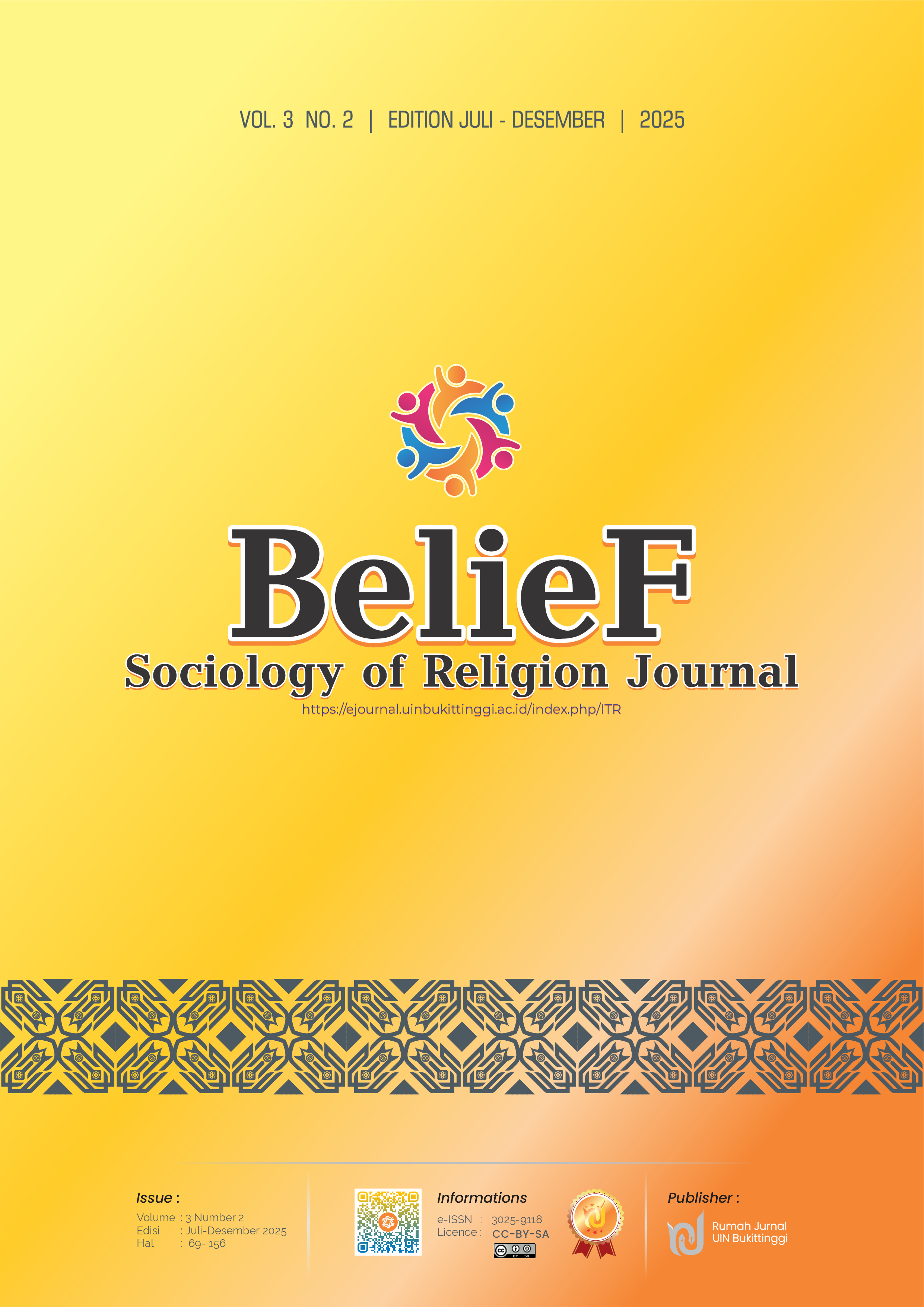
Latent Social Capital in the Marpege-Pege Wedding Tradition
DOI:
https://doi.org/10.30983/belief.v3i2.10066Keywords:
Angkola Batak Traditional Wedding, Marpege-pege Tradition, Social CapitalAbstract
References
Bourdieu, P. 1986. The forms of capital. In J. Richardson (Ed.), Handbook of theory and research for the sociology of education (pp. 241–258). Greenwood Press.
Bunihayu Village Cooperative Office. 2023. Developing social capital by the Gintingan tradition in Jalancagak community of Subang. Socio-Politica: Jurnal Ilmiah Jurusan Sosiologi, 11(2), 1–12. https://doi.org/10.15575/socio-politica.v11i2.21375
Creswell, J. W., & Poth, C. N. 2018. Qualitative inquiry and research design: Choosing among five approaches (4th ed.). Sage Publications.
Denzin, N. K., & Lincoln, Y. S. 2018. The Sage handbook of qualitative research (5th ed.). Sage Publications
Hasibuan, A. S., Cristy, S. N., Perangin-angin, A., & Liao, C. 2024. Makna semiotika perangkat adat dalam tradisi Marpege-Pege pada masyarakat Batak Angkola Padangsidimpuan. Literasi: Jurnal Ilmiah Pendidikan Bahasa, Sastra Indonesia dan Daerah, 14(1). https://doi.org/10.23969/literasi.v14i1.11400
Hasibuan, A., & Setia, E. 2023. Marpege-Pege: A Tradition in Batak Angkola Padangsidimpuan. Tradition and Modernity of Humanity, 3(2).
Khairul Anwar, R., Siti Khadijah, U. L., & Rizal, E. 2023. Harmony in diversity: Social capital and social cohesion in the Gintingan tradition of the Subang community. Jurnal Antropologi: Isu-Isu Sosial Budaya, 25(2), 244–251. https://doi.org/10.25077/jantro.v25.n2.p244-251.2023
Koentjaraningrat. 2009. Pengantar ilmu antropologi. Rineka Cipta.
Lincoln, Y. S., & Guba, E. G. 1985. Naturalistic inquiry. Sage Publications.
Merton, R. K. 1968. Social theory and social structure (Enlarged ed.). Free Press.
Miles, M. B., Huberman, A. M., & Saldaña, J. 2014. Qualitative data analysis: A methods sourcebook (3rd ed.). Sage Publications.
Patton, M. Q. 2015. Qualitative research & evaluation methods (4th ed.). Sage Publications.
Pertiwi, S. S., Siregar, K. A. W., Mayasari, M., & Zuindra, Z. 2025. The process of margondang in the traditional Batak Angkola wedding ceremony: semiotics studies. Gema Wiralodra, 14(2), 1–15. https://doi.org/10.31943/gw.v14i2.440
Siregar, A. R. 2024. Perubahan tradisi Marpege-Pege masyarakat Batak Angkola di Padangmatinggi Lestari, Sumatera Utara. Haluan Sastra Budaya.
Simamora, P. P., & Madina, D. D. 2023. Islamic legal values in the Angkola Batak community marriage tradition. Jurnal Mahkamah: Kajian Ilmu Hukum dan Hukum Islam, 8(2), 1–10. https://doi.org/10.25217/jm.v8i2.3894
Downloads
Published
How to Cite
Issue
Section
Citation Check
License
Copyright (c) 2025 Nurhalimah Nasution, Syafwan Rozi, Penmardianto

This work is licensed under a Creative Commons Attribution-ShareAlike 4.0 International License.