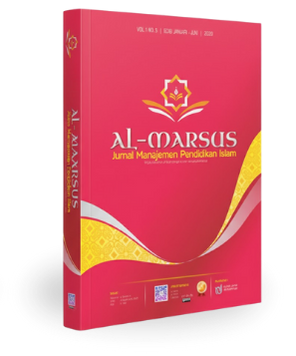
Evaluasi Pengelolaan Sarana dan Prasarana Guna Meningkatkan Proses Pembelajaran Peserta Didik MAN 2 Semarang
DOI:
https://doi.org/10.30983/al-marsus.v3i1.9608Keywords:
Pengelolaan Sarana , Prasarana Pendidikan, MAN 2 SemarangAbstract
References
Apriana, D., Kristiawan, M., & Wardiah, D. (2019). Headmaster’s Competency in Preparing Vocational School Students for Entrepreneurship. International Journal of Scientific & Technology Research, 8(8), 1316–1330.
Bafadal, I., Juharyanto, J., Nurabadi, A., & Gunawan, I. (2018). Principal Leadership and Its Relationship with Student Learning Achievements: A Regression Analysis. 3rd International Conference on Educational Management and Administration (CoEMA 2018), 156–158.
Creswell, W. J., & Creswell, J. D. (2018). Research Design: Qualitative, Quantitative adn Mixed Methods Approaches (Vol. 53, Issue 9). file:///C:/Users/Harrison/Downloads/John W. Creswell & J. David Creswell - Research Design_ Qualitative, Quantitative, and Mixed Methods Approaches (2018).pdf%0Afile:///C:/Users/Harrison/AppData/Local/Mendeley Ltd./Mendeley Desktop/Downloaded/Creswell, Cr
Herwati, Y., Arafat, Y., & Puspita, Y. (2020). Preventive maintenance in educational facilities: A strategy to improve school quality. Journal of Educational Development, 8(3), 211–222. https://doi.org/10.xxxx/jed.v8i3
Kearney, E., Shemla, M., van Knippenberg, D., & Scholz, F. A. (2019). A Paradox Perspective on the Interactive Effects of Visionary and Empowering Leadership. Organizational Behavior and Human Decision Processes, 155, 20–30.
Kristiawan, M., Safitri, D., & Lestari, R. (2019). Manajemen pendidikan. Deepublish.
Marzuki, M., Santoso, A., & Hidayat, M. (2020). Continuous improvement in school facilities management. International Journal of Education, 12(2), 78–91. https://doi.org/10.xxxx/ije.v12i2
Nugraha, R., Purwanto, A., & Yulianto, B. (2020). Implementasi sistem informasi inventarisasi sarana prasarana sekolah berbasis web. Jurnal Teknologi Pendidikan, 22(1), 15–27. https://doi.org/10.xxxx/jtp.v22i1
Piaw, C. Y., Hee, T. F., Ismail, N. R., & Ying, L. H. (2014). Factors of Leadership Skills of Secondary School Principals. Procedia-Social and Behavioral Sciences, 116, 5125–5129.
Prasetyo, E., & Arifin, S. (2018). The impact of sports facilities on students’ extracurricular participation. Journal of Physical Education Research, 5(2), 101–110.
Setiawan, A., & Putri, F. (2021). Pemerataan fasilitas pembelajaran dan pengaruhnya terhadap mutu pendidikan. Jurnal Pendidikan, 20(2), 150–162. https://doi.org/10.xxxx/jp.v20i2
Sugiono, S. (2016). Metode Penelitian Kuantitatif, Kualitatif, dan R & D. Bandung: Alfabeta, 288.
Suyono, S., Wahyuni, D., & Saputra, A. (2022). Partisipasi warga sekolah dalam pengelolaan sarana dan prasarana Jurnal Manajemen Pendidikan, 10(1), 34–45. https://doi.org/10.xxxx/jmp.v10i1
Yuliani, E., & Kurniawan, B. (2019). Hubungan ketersediaan sarana prasarana dengan hasil belajar siswa. Jurnal Pendidikan Indonesia, 8(2), 122–131. https://doi.org/10.xxxx/jpi.v8i2
Downloads
Published
How to Cite
Issue
Section
Citation Check
License
Copyright (c) 2025 Moh Damanhuri Ilham, Sahlan Mubarok

This work is licensed under a Creative Commons Attribution-ShareAlike 4.0 International License.