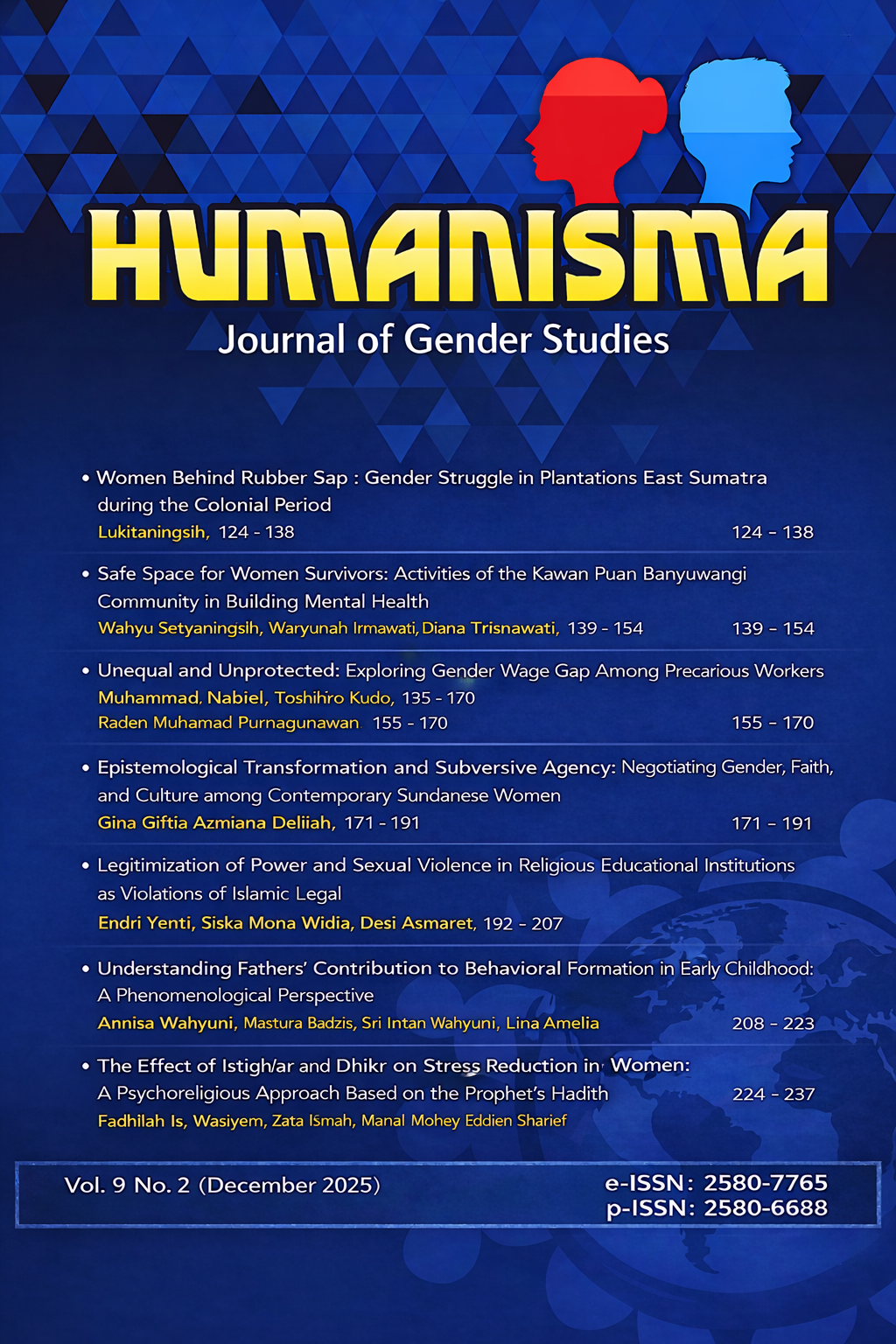
The Effect of Istighfar and Dhikr on Stress Reduction in Women: A Psychoreligious Approach Based on the Prophet’s Hadith
DOI:
https://doi.org/10.30983/humanisma.v9i2.9760Keywords:
Istighfar, Zikir, Female Stress, Islamic Psychology, Hadith of the ProphetAbstract
References
Al-Bukhārī, Abū ‘Abdillāh Muḥammad bin Ismā’īl, Ṣaḥīḥ al-Bukhārī, ed. oleh Muṣṭafā Dīb Al-Bugā (Damaskus: Dār Ibnu Kaṡīr, 1993)
Al-Khaṭṭābī, Abū Sulaimān Ḥamad bin Muḥamamad, Ma’ālim al-Sunan (Beirūt: Dār al-Kutb al-Ilmiyyah, 1997)
Al-Naisābūrī, Abū al-Ḥusain Muslim bin al-Ḥajjāj al-Qusyairi, Ṣaḥīḥ Muslim, ed. oleh Muḥammad Fuād ‘Abd Al-Bāqī (Kairo: Muṣṭafā al-Bābī al-Ḥalabī, 1955)
Al-Sijistānī, Abū Dāwud Sulaimān bin al-Asy’aṡ bin Isḥāq bin Basyīr bin Syaddād bin ‘Amr al-Azdī, Sunan Abī Dāwud, ed. oleh Muḥammad Muḥyiddīn ‘Abd Al-Ḥamīd (Beirūt: al-Maktabah al-Iṣriyah, 1993)
Avcı, Mahsum, “The repetition principle of traumatic dreams,” Scientific Reports, 15.1 (2025), 19945 <https://doi.org/10.1038/s41598-025-05246-z>
Avvenuti, Giulia, Andrea Leo, Luca Cecchetti, Maria Fatima Franco, Frederick Travis, Davide Caramella, et al., “Reductions in perceived stress following Transcendental Meditation practice are associated with increased brain regional connectivity at rest,” Brain and Cognition, 139 (2020), 105517 <https://doi.org/10.1016/j.bandc.2020.105517>
Bilosevych, Ivan, Mariia Oleksyuk, dan Natalia Savelyuk, “Religious Faith as a Tool for Psychological Support During Combat Operations,” Pharos Journal of Theology, 106.3 (2025), 1–13 <https://doi.org/10.46222/pharosjot.106.3026>
Chen, Gila, “Self-Forgiveness and Gratitude in Recovery from Substance Use Disorders,” Journal of Psychoactive Drugs, 57.3 (2025), 304–13 <https://doi.org/10.1080/02791072.2024.2366172>
Chou, Tina, Thilo Deckersbach, Bastien Guerin, Karianne Sretavan Wong, Benjamin M Borron, Anish Kanabar, et al., “Transcranial focused ultrasound of the amygdala modulates fear network activation and connectivity,” Brain Stimulation: Basic, Translational, and Clinical Research in Neuromodulation, 17.2 (2024), 312–20 <https://doi.org/10.1016/j.brs.2024.03.004>
Clarke, Patrick J F, Bram Van Bockstaele, Welber Marinovic, Joel A Howell, Mark E Boyes, dan Lies Notebaert, “The effects of left DLPFC tDCS on emotion regulation, biased attention, and emotional reactivity to negative content,” Cognitive, Affective, & Behavioral Neuroscience, 20.6 (2020), 1323–35 <https://doi.org/10.3758/s13415-020-00840-2>
Dolcos, Florin, Kelly Hohl, Yifan Hu, dan Sanda Dolcos, “Religiosity and Resilience: Cognitive Reappraisal and Coping Self-Efficacy Mediate the Link between Religious Coping and Well-Being,” Journal of Religion and Health, 60.4 (2021), 2892–2905 <https://doi.org/10.1007/s10943-020-01160-y>
Eames, Catrin, dan Donna O’Connor, “The role of repetitive thinking and spirituality in the development of posttraumatic growth and symptoms of posttraumatic stress disorder,” PLOS ONE, 17.8 (2022), e0272036 <https://doi.org/10.1371/journal.pone.0272036>
El-Ashry, Ayman Mohamed, Eman Sameh Abd Elhay, Samah Mohamed Taha, Mahmoud Abdelwahab Khedr, Feby Saad Attalla Mansour, Amany Anwar Saeed Alabdullah, et al., “Effect of applying nursing-based cognitive defusion techniques on mindful awareness, cognitive fusion, and believability of delusions among clients with schizophrenia: a randomized control trial,” Frontiers in Psychiatry, 15 (2024), 1–12 <https://doi.org/10.3389/fpsyt.2024.1369160>
Fara, Adelia, dan Indri Seta Septadina, “Istigfar Therapy as Self-Control,” International Journal of Islamic and Complementary Medicine, 4.2 (2023), 85–88 <https://doi.org/10.55116/ijicm.v4i2.34>
Farhane-Medina, Naima Z, Bárbara Luque, Carmen Tabernero, dan Rosario Castillo-Mayén, “Factors associated with gender and sex differences in anxiety prevalence and comorbidity: A systematic review,” Science Progress, 105.4 (2022), 1–30 <https://doi.org/10.1177/00368504221135469>
Gao, Junling, Stavros Skouras, Hang Kin Leung, Bonnie Wai Yan Wu, Huijun Wu, Chunqi Chang, et al., “Repetitive Religious Chanting Invokes Positive Emotional Schema to Counterbalance Fear: A Multi-Modal Functional and Structural MRI Study,” Frontiers in Behavioral Neuroscience, 14 (2020), 1–11 <https://doi.org/10.3389/fnbeh.2020.548856>
Graça, Lídia, dan Tânia Brandão, “Religious/Spiritual Coping, Emotion Regulation, Psychological Well-Being, and Life Satisfaction among University Students,” Journal of Psychology and Theology, 52.3 (2024), 342–58 <https://doi.org/10.1177/00916471231223920>
Harbour, Eric, Vincent van Rheden, Hermann Schwameder, dan Thomas Finkenzeller, “Step-adaptive sound guidance enhances locomotor-respiratory coupling in novice female runners: A proof-of-concept study,” Frontiers in Sports and Active Living, 5 (2023), 1–9 <https://doi.org/10.3389/fspor.2023.1112663>
Harjana, Ngakan Putu Anom, Pande Putu Januraga, Putu Ayu Indrayathi, Hailay Abrha Gesesew, dan Paul Russell Ward, “Prevalence of Depression, Anxiety, and Stress Among Repatriated Indonesian Migrant Workers During the COVID-19 Pandemic,” Frontiers in Public Health, 9 (2021), 1–8 <https://doi.org/10.3389/fpubh.2021.630295>
Hidayat, Arif Imam, Iwan Purnawan, Wahyudi Mulyaningrat, Saryono Saryono, Adiratna Sekar Siwi, Yohanes Andy Rias, et al., “Effect of Combining Dhikr and Prayer Therapy on Pain and Vital Signs in Appendectomy Patients: A Quasi-Experimental Study,” Journal of Holistic Nursing, 42.1 (2023), 6–14 <https://doi.org/10.1177/08980101231180051>
Indriani, Tiya, Jarkawi Jarkawi, dan Akhmad Rizkhi Ridhani, “Dhikr Therapy: Overcoming Life Anxiety with Islamic Counseling Based on QS Ar-Ra’d Verse 28,” Al-Hayat: Journal of Islamic Education, 8.2 (2024), 562 <https://doi.org/10.35723/ajie.v8i2.477>
Insyra, Attalah Rahma, Ahmad Fikri Alfarizi, dan Nabila Almas Zakiyyah, “The Effect of Dhikr Therapy on Stress Reduction: Literature Review,” Proceeding Conference on Da’wah and Communication Studies, 2.1 (2023), 5–16 <https://doi.org/10.61994/cdcs.v2i1.88>
Koch, Amie, Maya Rabins, Sarah Grenon, Gillian Jackson, Cassidie-Anne Toussaint, Carl Teleus, et al., “Coming Out as LGBTQ+: A Qualitative Study on the Mental Health Impact of Religious Responses to Disclosure,” Journal of Homosexuality, 72.14 (2025), 2811–28 <https://doi.org/10.1080/00918369.2025.2452464>
Linde, Inga, dan Linda Daniela, “Teachers’ Insights into the Efficacy of the ‘Reading Circle’ Project Using Englisah Language Teaching Graded Readers,” Education Sciences, 15.1 (2025), 91 <https://doi.org/10.3390/educsci15010091>
Ludwig, Justin M, Jonah Koetke, dan Karina Schumann, “Implications of Divine Forgiveness for Conciliatory Behavior: Understanding How Feeling Forgiven by God Influences Apologies Via Self-Forgiveness, Gratitude, and Humility,” Personality and Social Psychology Bulletin, 2025, 01461672241312265 <https://doi.org/10.1177/01461672241312265>
Mājah, Abū ‘Abdillāh Muḥammad bin Yazīd Ibnu, Sunan Ibnu Mājah, ed. oleh Muḥammad Fuād ‘Abd Al-Bāqī (al-Su’ūd: Dār al-Ṣadīq, 2014)
Monteiro, Isabela, Laura Brito, dan M Graça Pereira, “Burden and quality of life of family caregivers of Alzheimer’s disease patients: the role of forgiveness as a coping strategy,” Aging & Mental Health, 28.7 (2024), 1003–10 <https://doi.org/10.1080/13607863.2024.2320138>
Mróz, Justyna, Loren Toussaint, dan Kinga Kaleta, “Association between Religiosity and Forgiveness: Testing a Moderated Mediation Model of Self-Compassion and Adverse Childhood Experiences,” Religions, 15.9 (2024), 1137 <https://doi.org/10.3390/rel15091137>
Okviasanti, Fanni, Suhartono Taat Putra, Abu Bakar, dan Ah Yusuf, “Effects of Dhikr on Spirituality and Cortisol Levels Among Patients with Heart Failure: A Pilot Study,” Journal of Vocational Nursing, 4.1 (2023), 82–86 <https://doi.org/10.20473/jovin.v4i1.45327>
Oman, Doug, Jill E Bormann, dan Jim J Kane, “Mantram Repetition as a Portable Mindfulness Practice: Applications During the COVID-19 Pandemic,” Mindfulness, 13.6 (2022), 1418–29 <https://doi.org/10.1007/s12671-020-01545-w>
Rodríguez-Triana, María Jesús, Luis P Prieto, Tobias Ley, Ton de Jong, dan Denis Gillet, “Social practices in teacher knowledge creation and innovation adoption: a large-scale study in an online instructional design community for inquiry learning,” International Journal of Computer-Supported Collaborative Learning, 15.4 (2020), 445–67 <https://doi.org/10.1007/s11412-020-09331-5>
Rutledge, Kathleen, “Rethinking pathways to well- being: the function of faith practice in distress alleviation among displaced Muslim women affected by war,” Frontiers in Psychiatry, 16 (2025), 1–22 <https://doi.org/10.3389/fpsyt.2025.1335640>
Sharpe, Erica, Alison Lacombe, Adam Sadowski, John Phipps, Ryan Heer, Savita Rajurkar, et al., “Investigating components of pranayama for effects on heart rate variability,” Journal of Psychosomatic Research, 148 (2021), 110569 <https://doi.org/10.1016/j.jpsychores.2021.110569>
Silvia, Kiranti, “Nilai Spiritualitas Tidur dalam Hadis dan Implikasinya terhadap Manajemen Kesehatan Mental Muslim,” Arba: Jurnal Studi Keislaman, 1.4 (2025), 251–68 <https://doi.org/10.64691/arba.v1i4.28>
Simonovich, Shannon D., Nadia Quad, Zehra Kanji, dan Karen M. Tabb, “Faith Practices Reduce Perinatal Anxiety and Depression in Muslim Women: A Mixed-Methods Scoping Review,” Frontiers in Psychiatry, 13 (2022), 1–7 <https://doi.org/10.3389/fpsyt.2022.826769>
Skalski-Bednarz, Sebastian Binyamin, “The interplay of forgiveness by God and self-forgiveness: a longitudinal study of moderating effects on stress overload in a religious Canadian sample,” BMC Psychology, 12.1 (2024), 717 <https://doi.org/10.1186/s40359-024-02238-y>
Subhani, Ahmad Rauf, Nidal Kamel, Mohamad Naufal Mohamad Saad, Nanda Nandagopal, Kenneth Kang, dan Aamir Saeed Malik, “Mitigation of stress: new treatment alternatives,” Cognitive Neurodynamics, 12.1 (2018), 1–20 <https://doi.org/10.1007/s11571-017-9460-2>
Wang, Shimeng, Mingyang Lu, Xiaoxiao Dong, dan Yifan Xu, “Does physical activity-based intervention decrease repetitive negative thinking? A systematic review,” PLOS ONE, 20.4 (2025), e0319806 <https://doi.org/10.1371/journal.pone.0319806>
Wong, Paul T.P., Gökmen Arslan, Victoria L. Bowers, Edward J. Peacock, Oscar Nils Erik Kjell, Itai Ivtzan, et al., “Self-Transcendence as a Buffer Against COVID-19 Suffering: The Development and Validation of the Self-Transcendence Measure-B,” Frontiers in Psychology, 12 (2021), 1–21 <https://doi.org/10.3389/fpsyg.2021.648549>
Yang, Yuntong, Xing Hu, Nils Kohn, Linlin Yan, Hongxia Duan, dan Jianhui Wu, “Emotional habituation as a protective factor for resilience: Insights from ERP and hierarchical linear modeling,” Journal of Affective Disorders, 391 (2025), 119965 <https://doi.org/10.1016/j.jad.2025.119965>
Downloads
Published
How to Cite
Issue
Section
Citation Check
License
Copyright (c) 2025 Fadhilah Is, Wasiyem ,Zata Ismah

This work is licensed under a Creative Commons Attribution-ShareAlike 4.0 International License.
Authors who publish with this journal agree to the following terms:
- Authors retain copyright and grant the journal right of first publication with the work simultaneously licensed under a Creative Commons Attribution-ShareAlike 4.0. that allows others to share the work with an acknowledgment of the work's authorship and initial publication in this journal.
- Authors are able to enter into separate, additional contractual arrangements for the non-exclusive distribution of the journal's published version of the work (e.g., post it to an institutional repository or publish it in a book), with an acknowledgment of its initial publication in this journal.
- Authors are permitted and encouraged to post their work online (e.g., in institutional repositories or on their website) prior to and during the submission process, as it can lead to productive exchanges, as well as earlier and greater citation of published work (See The Effect of Open Access).