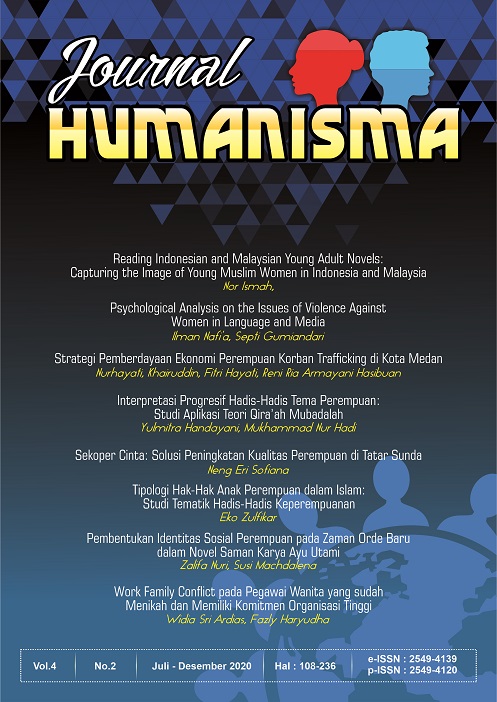
Reading Indonesian and Malaysian Young Adult Novels: Capturing the Image of Young Muslim Women in Indonesia and Malaysia
DOI:
https://doi.org/10.30983/humanisme.v4i2.3498Keywords:
Young adult novels, Indonesia, Malaysia, Image of young Muslim women, Gender analysis,Abstract
References
Anis, Khilma. Jadilah Purnamaku Ning. Yogyakarta: Matapena, 2008.
Belenky, Mary Field, Blythe McVicker Clinchy, Nancy Rule Goldberger, and Jill Mattuck Tarule. Women’s Ways of Knowing: The Development of Self, Voice, and Mind. New York: Basic Books, 1986.
Jutta, Berninghausen and Birgit Kerstan. Forging New Paths: Feminist Social Methodology and Rural Women in Java. London, Zed, 1992.
Blackburn, Susan, Bianca J. Smith, and Siti Syamsiyatun. Indonesian Islam in a New Era: How Women Negotiate Their Muslim Identities. Monash Papers on Southeast Asia. Clayton, Victoria, Australia: Monash University Press, 2008.
Bourdieu, Pierre. “Field of Power, Literary Field, and Habitus.†In The Cultural Studies Reader Third Edition, ed. Simon During, 88–98. New York: Routledge, 2007.
Cheng, Kho Gaik. Reclaiming Adat: Contemporary Malaysian Film and Literature. Toronto: UBC Press, 2006.
Dewayani, Sofie. Rumah Cinta Kelana.Bandung: Mizan, 2004.
Dhofier, Zamakhsyari. Tradisi Pesantren Studi Tentang Pandangan Hidup Kyai. Jakarta: LP3ES, 1982.
Haron, Nisah. Mencari Locus Standi. Kuala Lumpur: Utusan, 2004.
Hasanah, Ferli. "Representasi Femme Fatale Dalam Novel Cantik Itu Luka Karya Eka Kurniawan". In Poetika, Vol 5, No 1, 2017.
Hayati, Yenni. Dunia Perempuan dalam Karya Sastra Perempuan Indonesia(Kajian Feminisme). In Humanis, Vol. XI No.1 Th. 2012
Ismah, Nor. “Destabilising Male Domination: Building Community-Based Authority among Indonesian Female Ulamaâ€, Asian Studies Review, 40:4, 2016, p.491-509
Smith-Hefner, Nancy J. "Javanese Women and the Veil in Post-SoehartoIndonesia". The Journal of Asian Studies Vol. 66, No. 2 (May) 2007: 389–420
Hashim, Siti Zaleha M. Biarkan Kupu-Kupu Itu Terbang. Selangor, Malaysia: “K†Publications Sdn. Bhd., 2004.
Latrobe, Kathy Howard, and Judy Drury. Critical Approaches to Young Adult Literature. New York: Neal-Schuman, 2009.
Mahayana, Maman. “The Oppressed Women: Discussion on the Development of Indonesian Women Novel and Its Comparison with the Malaysian and Indian Novels.†Paper presented onASEAN and India: Searching for New Approach arranged by Global Association of Indo—ASEAN Studies in Hankuk University of Foreign Studies, Seoul, South Korea, November 2—4, 2007.
Meyer, Michael. The Bedford Introduction to Literature. Boston: Bedford Books of St. Martin’s Press, 1990.
Roberts, Rosemary, and Helen Creese. “Gender, Text, Performance and Agency in Asian Cultural Contexts.†Intersections: Gender and Sexuality in Asia and the Pacific 16, March (2008).
Swandayani, D., & Wilujeng, N. C. S. (2010). Konstruksi Nilai-Nilai Perempuan Metropolis Indonesia Dalam Majalah Femina. Jurnal Pendidikan Dan Kebudayaan, 16(5), 589-599
Tasai, M. Amran. “Teenlit, Masalah Baru Pernovelan Indonesia.†Republika, March 12, 2006.
Weintraub, Andrew. “The Study of Islam and Popular Culture in Indonesia and Malaysia.†In Islam and Popular Culture in Indonesia and Malaysia, edited by Andrew Weintraub, 1-17. New York: Routledge, 2011.
Downloads
Published
How to Cite
Issue
Section
Citation Check
License
Copyright (c) 2020 Nor Ismah

This work is licensed under a Creative Commons Attribution-ShareAlike 4.0 International License.
Authors who publish with this journal agree to the following terms:
- Authors retain copyright and grant the journal right of first publication with the work simultaneously licensed under a Creative Commons Attribution-ShareAlike 4.0. that allows others to share the work with an acknowledgment of the work's authorship and initial publication in this journal.
- Authors are able to enter into separate, additional contractual arrangements for the non-exclusive distribution of the journal's published version of the work (e.g., post it to an institutional repository or publish it in a book), with an acknowledgment of its initial publication in this journal.
- Authors are permitted and encouraged to post their work online (e.g., in institutional repositories or on their website) prior to and during the submission process, as it can lead to productive exchanges, as well as earlier and greater citation of published work (See The Effect of Open Access).