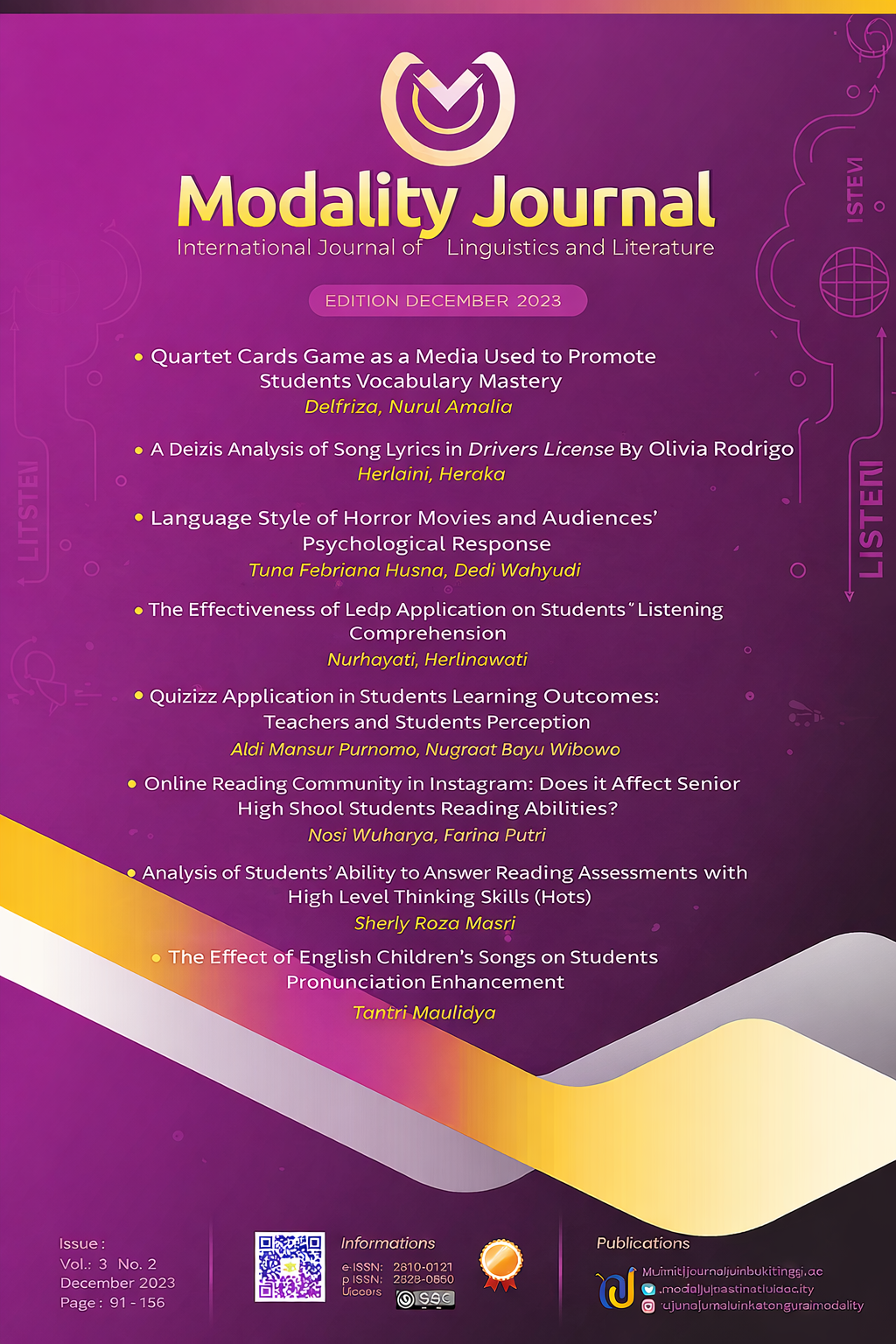
The Effectiveness of Ledp Application on Students Listening Comprehension
DOI:
https://doi.org/10.30983/mj.v3i2.6874Keywords:
LEDP application, listening comprehension, application as teaching mediaAbstract
References
Abdulrahman, T. et.al. (2018). The impact of podcasts on EFL students’ listening comprehension, IJOLE: International Journal of Language Education, 2(2), 23-33.
Audina, I.P., et.al. (2022). YouTube video for listening skills during covid-19 pandemic: EFL students’ views. Jurnal Penelitian dan Pengembangan Sains dan Humaniora, 6(3), 327-334. DOI: https://doi.org/10.23887/jppsh.v6i3.55809.
Creswell, J. (2016). Research in education: design, conduct and evaluation of quantitative and qualitative research. Athens: SAGE Publication.
Bano, F. (2017). Towards understanding listening comprehension in EFL classroom: the case of the Saudi learners. English Language Teaching, 10(6), 21-27.
Emilia, V. et.al. (2023). Dailymotion application as teaching media to increase students’ listening skills. TEFL Overseas Journal, 11(1), 92-102.
Frey, B.B. (2018). The SAGE encyclopedia of educational research, measurement, and evaluation. SAGE Publication, Inc.
Gerald, B. (2018). A brief review of independent, dependent and one sample t-test. International Journal of Applied Mathematics and Theoretical Physics, 4(2), 40. DOI: https://doi.org/10.11648/j.ijamtp.20180402.13.
Gilakjani, A.P. & Sabouri, N.B., (2016). The significance of listening comprehension in English language teaching. Theory and Practice in Language Studies, 6(8), 1670-1677. DOI: http://dx.doi.org/10.17507/tpls.0608.22.
Gilakjani, A.P, & Ahmadi, M. R. (2011). A study of factors affecting EFL learners’ English listening comprehension and the strategies for improvement. Journal of Language Teaching and Research, 2(5), 977-988.
Hamouda, A. (2013). An investigation of listening comprehension problems encountered by Saudi students in the EL listening classroom. International Journal of Academic Research in Progressive Education and Development. 2(2), 113-155.
Kim, H.S. (2015). Using authentic videos to improve EFL students’ listening comprehension. International Journal of Contents, 11(4), 15-24.
Kurita, T. (2012). Issues in second language listening comprehension and the Pedagogical Implications. Accents Asia, 5(1), 30-44.
MacháÄková, E. (2009). Teaching listening. bachelor thesis, pedagogical faculty department of English language and literature. Masaryk University Brno.
Morley, H. J., & Lawrence, M. S. (1971). The use of films in teaching English as a second language. Language Learning, 22(1), 101-3.
Ningtias, F.P., et.al. (2021). British Council podcast apps to improve students’ listening comprehension. Wiralodra English Journal (WEJ), 5(2), 28-38.
Nurussyifa, N. & Izzah, L. (2022). Application of Listening English Practice in understanding listening for junior high school students. SCRIPTA, 9(2), 158-171.
Purwanto, H.N. (2022). The effect of DuoLingo and SPADA to teach listening to students with different achievement levels. EEJ: English Education Journal, 12(1), 87-95.
Rost, M. (1994). Introducing listening. London: Penguin books.
Qomariyah, S.S., et.al. (2021). The effect of YouTibe video on students’ listening comprehension performance. Jo-ELT: Journal of English Language Teaching, 8(1), 67-73.
Silvi, N.I. & Nurjati, N. (2023). The effect of using spotify application on EFL listening achievement of senior high school student. SCRIPTA, 10(1), 166-174.
Sondy, T.D., & Mandasari, B. (2021). Teaching English through YouTube video to improve students’ listening comprehension for tenth grade students of SMK Negeri 8 Bandar Lampung. Journal of English Language Teaching and Learning, 4(1), 34-39,
Vahdat, S, & Eidiour, M. (2016). Adopting CALL to improve listening comprehension of Iranian junior high school students. Theory and Practice in Language Studies, 6(8), 1609-1617. DOI: http://dx.doi.org/10.17507/tpls.0608.13.
Vega, O. (2016). Factors to consider when teaching listening comprehension in the EFL/SL classroom. MEXTESOL Journal, 40(4), 1-6.
Yuyun, I. & Simamora, F,Y, (2021) The use of YouTube to support EFL student’s listening skills. ELLTER-J, 2(2), 1-12.
Downloads
Additional Files
Published
How to Cite
Issue
Section
Citation Check
License
Copyright (c) 2023 Elsa Monica, Lidiyatul Izzah

This work is licensed under a Creative Commons Attribution-ShareAlike 4.0 International License.
Authors who publish with this journal agree to the following terms:
- Authors retain copyright and grant the journal right of first publication with the work simultaneously licensed under a Creative Commons Attribution License that allows others to share the work with an acknowledgment of the work's authorship and initial publication in this journal.
- Authors are able to enter into separate, additional contractual arrangements for the non-exclusive distribution of the journal's published version of the work (e.g., post it to an institutional repository or publish it in a book), with an acknowledgment of its initial publication in this journal.
- Authors are permitted and encouraged to post their work online (e.g., in institutional repositories or on their website) prior to and during the submission process, as it can lead to productive exchanges, as well as earlier and greater citation of published work (See The Effect of Open Access).