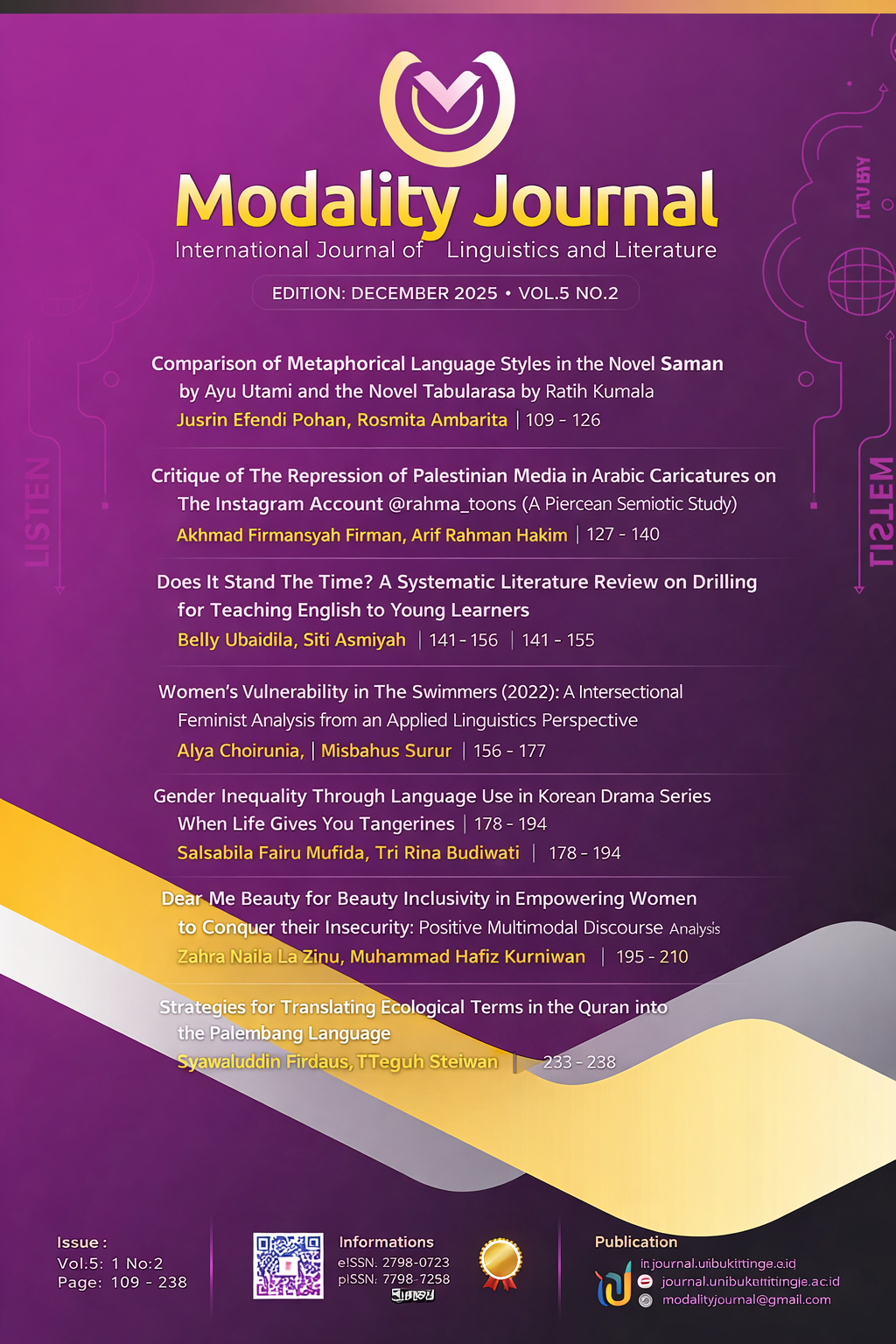
Dear Me Beauty for Beauty Inclusivity in Empowering Women to Conquer their Insecurity: Positive Multimodal Discourse Analysis
DOI:
https://doi.org/10.30983/modalityjournal.v5i2.10176Keywords:
Beauty and Diversity, Cosmetic Advertisements, Positive Multimodal Discourse AnalysisAbstract
References
Alek, A. R. R. D. N. H., & Jalil, N. (2020). Multimodal analysis of wardah lipstick advertisement. Elite Journal, 7(2), 149–159. https://doi.org/10.24252/elite.v7i2a4
Alifah, Nur, and A. R. H. (2024). A multimodal discourse analysis of Wardah Cosmetics advertisement. Jurnal Impresi Indonesia, 3(3), 260–266. https://doi.org/10.58344
Aqilah, N. S., & Trihandayani, D. (2023). The Toxicity of Beauty Standards: Body Image Perception Among Women Acne Fighters. Bulletin of Counseling and Psychotherapy, 6(1). https://doi.org/doi.org/10.51214/00202406819000
Baroroh, H. E., Anam, H. F., & Kharisma, M. (2025). Colonial Legacies and Gender Representation on Social Media’s Muslim Fashion Brands in Indonesia. Sawwa: Jurnal Studi Gender, 20(1–30). https://doi.org/10.21580/sa.v20i1.25854
Childs, K. M. (2022). “The Shade of It All”: How Black Women Use Instagram and YouTube to Contest Colorism in the Beauty Industry. SAGE Journals, 1–15. https://doi.org/10.1177
Devira, M., & Westin, E. (2021). A Genre and Appraisal Analysis of Critical Review Texts in Academic Writing From a Systemic Functional Linguistic Perspective. Journal of Research in Applied Linguistics, 12(22–36). https://doi.org/10.22055/RALS.2021.17007
Ditchfield, Hannah, & Meredith, J. (2018). Collecting qualitative data from Facebook: Approaches and methods. In Uwe Flick (Ed.), The SAGE handbook of qualitative data collection (pp. 496–510).
El-Falaky, M. S. (2023). Recovering from cultural blindness: multimodal Positive Discourse Analysis of metaphors in hand-drawn sketches about Islam. Language and Semiotic Studies, 9(3), 333–358. https://doi.org/10.1515/lass-2023-0005
Foster, J., & Pettinicchio, D. (2025). “This is real beauty”: pushing the boundaries of aesthetic citizenship onlin. Critical Studies in Media Communication, 42(1), 15–33. https://doi.org/10.1080/15295036.2025.2463409
Gloria, I., & Limanta, L. S. (2023). Beauty Standard Construction and its Influence on Consumerism in Indonesia’s Next Top Model. Kata Kita: Journal of Language, Literature, and Teaching, 11(1), 104–113. https://doi.org/10.9744/katakita.10.3.104-113
Guan, C. (2022). Multimodal positive discourse analysis of national image publicity video. Language and Semiotic Studies, 8(3), 66–85. https://doi.org/10.1515/lass-2022-2001
Hafifah, S., & Sinar, T. S. (2021). A Visual Grammar Design Analysis of Channel’s Spring-Summer 2021 Campaign Teaser Pictures in the Pandemic Era. Proceedings of the Ninth International Conference on Language and Arts (ICLA 2020). Atlantis Press, 32–37. https://doi.org/10.2991/assehr.k.210325.006
Hartono, D. A., Prima, S. A. B., & Dewobroto, W. S. (2022). A multimodal critical discourse analysis of garnier green beauty advertisement. IJEAL (International Journal of English and Applied Linguistics), 2(2), 301–312. https://doi.org/10.47709/ijeal.v2i2.1654
Hidayat, D. N., Kusuma, D., Alek, Defianty, M., & Purwahida, R. (2020). Beauty Advertisement Products in Forming the Reality of Society: A Critical Discourse Analysis. Voice of English Language Education Society, 4(2), 191–198. https://doi.org/10.29408/veles. v4i2.2393
Joon, N., & Hooda, M. (2022). Inclusivity in social media advertising: way ahead for brands. ShodhKosh: Journal of Visual and Performing Arts, 3(2), 355–361. https://doi.org/10.29121
Khoirunnisaa, S., & Harti, L. M. S. (2023). A Multimodal Discourse Analysis of Indonesian Beauty Product Advertisement Featuring Korean Celebrity on Instagram Post. LANGUAGE HORIZON: Journal of Language Studies, 11(1). https://doi.org/10.26740/lh.v11n1.p14-23
Kiranantika, R. H. L. A., Ariani, A. D., & Emy, S. (2023). Aesthetic Clinic and Beauty Myths in Indonesia: Discourse Analysis of Beauty Representation in Instagram Accounts. The Journal of Society and Media, 7(2), 514–545. https://doi.org/10.26740
Kress, G., & Leeuwen, T. Van. (2021). Reading Images; The Grammar of Visual Design (Third Edit). Routledge.
Lakamau, F., & Husein, R. (2025). Students’ perspectives on ‘magrib’ as a skin color metaphor in indonesian culture: a linguistic study. Jurnal Pendidikan Indonesia, 6(4). https://doi.org/10.4324/9780203872284-23
Marsakawati, N. P. E. (2022). ESP STUDENTS’ USE OF APPRAISAL LANGUAGE IN TOURISM BLOGS. IJEE (Indonesian Journal of English Education), 9(2), 289–310. https://doi.org/doi:10.15408/ijee.v9i2.24574
Nurrachmah, S. (2025). Gen Z’s Self-Expression and Digital Identity Strategies on Social Media X: A Quantitative Study of Communication Styles and Audience Engagement. Jurnal Multidisiplin Indonesia, 4(7). https://doi.org/10.58344/jmi.v4i7.2411
Putri, G. S., & Pratiwi, M. R. (2023). Instagram as A Digital Media to Build Self-Acceptance. Scriptura, 13(2), 129–141. https://doi.org/10.9744/scriptura.13.2.129-141
Santa Maya Pramusita. (2021). Korean wave’s influences on Indonesian beauty standard depicted in skincare advertisements: A critical discourse analysis. LingTera, 8(1), 20–29. https://doi.org/10.21831
Saraharah, Z. D., & Ningtyas, S. (2023). Change of Beauty Standards in Indonesian Society Through Beauty Product That Improve Lately. Sabda: Jurnal Kajian Kebudayaan, 18(1), 54–67. https://doi.org/10.14710/sabda.18.1.54-67
Tanca, J. T. (2025). Resistance Against Beauty Standards Stereotypes and Representation of Women’s Beauty Through BLP Beauty Advertisement. PERSPEKTIF, 13(1), 123–134. https://doi.org/10.31289
White, J. R. M. and P. R. R. (2005). The Language of Evaluation: appraisal in English (first). PALGRAVE MACMILLAN.
Wihadi, M., & Sujatna, E. T. S. (2024). Attitudes on Halal Beauty Products: An Appraisal Analysis. International Journal of Computer in Humanities, 1, 1–12. https://doi.org/10.34010/injuchum.v1i.5490
Yuman, L. (2023). A Critical Discourse Analysis of the Language Used in Dove’s Advertisements. Academic Journal of Humanities & Social Sciences, 6(10), 55–60.
Zhang, P. (2023). Visual Grammar in Multimodal Discourse: A Case Study of Nezha’s Poster Images. In 9th International Conference on Education, Language, Art and Inter-Cultural Communication (ICELAIC 2022), Athena Publishing, 4, 59–65. https://doi.org/10.55060/s.atssh.230322.010
Downloads
Published
How to Cite
Issue
Section
Citation Check
License
Copyright (c) 2025 Ms. La Zinu, Muhammad Hafiz Kurniawan

This work is licensed under a Creative Commons Attribution-ShareAlike 4.0 International License.
Authors who publish with this journal agree to the following terms:
- Authors retain copyright and grant the journal right of first publication with the work simultaneously licensed under a Creative Commons Attribution License that allows others to share the work with an acknowledgment of the work's authorship and initial publication in this journal.
- Authors are able to enter into separate, additional contractual arrangements for the non-exclusive distribution of the journal's published version of the work (e.g., post it to an institutional repository or publish it in a book), with an acknowledgment of its initial publication in this journal.
- Authors are permitted and encouraged to post their work online (e.g., in institutional repositories or on their website) prior to and during the submission process, as it can lead to productive exchanges, as well as earlier and greater citation of published work (See The Effect of Open Access).