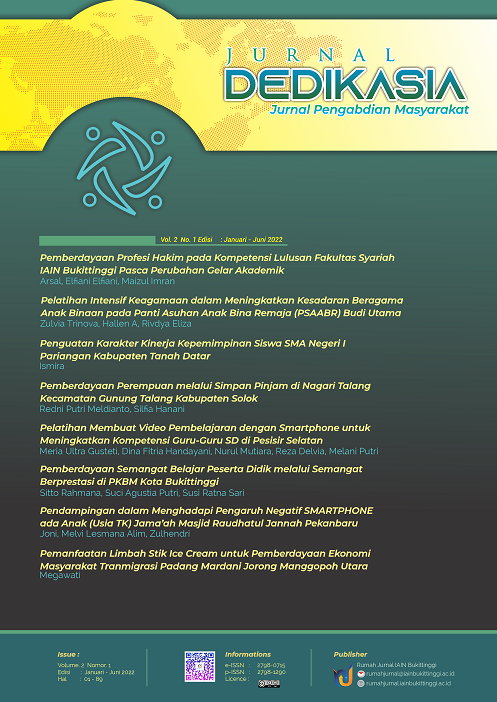
Pemanfaatan Limbah Stik Ice Cream untuk Pemberdayaan Ekonomi Masyarakat Tranmigrasi Padang Mardani Jorong Manggopoh Utara
DOI:
https://doi.org/10.30983/dedikasia.v2i1.5631Keywords:
Pemnafaaatan, Limbah Stiks E Krim, PemberdayaanAbstract
References
Drs. Abu Huraerah, M. S. (2008). PENGORGANISASIAN dan PENGEMBANGAN MASYARAKAT: Model dan Strategi Pembangunan Berbasis Kerakyatan. Humaniora. https://books.google.co.id/books?id=nHO0DwAAQBAJ
Kartasasmita, G. (1997). Pemberdayaan masyarakat: Konsep pembangunan yang berakar pada masyarakat. Yogyakarta: UGM, Sp 607, 1–25.
Prijono, O. S., & Pranarka, A. M. W. (1996). Pemberdayaan konsep, kebijakan dan implementasi / penyunting, Onny S. Prijono dan A.M.W. Pranarka. Centre for Strategicand International Studies (CSIS).
Roesmidi, & Risyanti, R. (2008). Pemberdayaan Masyarakat. Alqaprint.
Suharto, E. (1997). Pembangunan, Kebijakan Sosial dan Pekerjaan Sosial: Spektrum Pemikiran. Lembaga Studi Pembangunan STKS (LSP-STKS).
Usman, S. (2012). Pembangunan Dan Pemberdayaan Masyarakat. Pustaka Pelajar Offes.
Wasistiono, S. (1998). Pemberdayaan Aparatur Daerah. Abdi Praja.
Downloads
Additional Files
Published
How to Cite
Issue
Section
Citation Check
License
Copyright (c) 2022 Megawati Megawati

This work is licensed under a Creative Commons Attribution-ShareAlike 4.0 International License.
Authors who publish with this journal agree to the following terms:
- Authors retain copyright and grant the journal right of first publication with the work simultaneously licensed under a Creative Commons Attribution License that allows others to share the work with an acknowledgment of the work's authorship and initial publication in this journal.
- Authors are able to enter into separate, additional contractual arrangements for the non-exclusive distribution of the journal's published version of the work (e.g., post it to an institutional repository or publish it in a book), with an acknowledgment of its initial publication in this journal.
- Authors are permitted and encouraged to post their work online (e.g., in institutional repositories or on their website) prior to and during the submission process, as it can lead to productive exchanges, as well as earlier and greater citation of published work (See The Effect of Open Access).