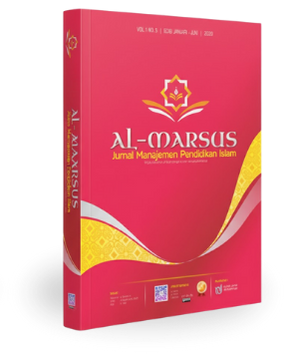
The Contribution of Teacher Well-Being and School Culture to the Performance of Teachers at Islamic Boarding Schools in Canduang Subdistrict, Agam Regency, West Sumatra
DOI:
https://doi.org/10.30983/al-marsus.v4i1.11247Keywords:
Teacher Well-being, School Culture, Teacher PerformanceAbstract
References
REFERENCES
Ahmad, F., Muhsin, A., Allabibah, Z., Darul, P., & Jombang, U. (2022). c. 6 (1), 11–37. https://journal.unipdu.ac.id/index.php/jpi/article/view/3022
Choliq, M., Alyasmin, D., Alvisan, Q., Yasmin, A. Z., & Amelia, S. (2025). Teachers as Waratsatul Anbiya: A Literature Review on the Status, Functions, and Roles of Teachers in Islam. Edukatif: Journal of Educational Sciences, 7 (4), 969–980. https://doi.org/https://doi.org/10.31004/edukatif.v7i4.8472
Dermawan, A. (2019). The Influence of Principals’ Leadership Styles and School Culture on Teacher Performance (A Study of Vocational High Schools in the Tourism Cluster in Tangerang City). Jurnal Mandiri, 3 (2), 244–256. https://doi.org/https://doi.org/10.33753/mandiri.v3i2.85
Eko Supria & Wedra Aprison. (2023). Implementation of a Character Education Model Based on Religious Values at SDIT Al Azhar Darul Jannah in Bukittinggi. Scientific Journal of Cultural and Religious Education, 1 (1), 93–101. https://doi.org/10.59024/jipa.v1i1.425
Fitriyah, L. (2025). The Influence of Teachers’ Well-Being and Work Motivation on the Performance of Public Junior High School Teachers in Tamalanrea District, Makassar. Journal of Education, Social Sciences, and Humanities, 4 (4), 6392–6405. https://doi.org/https://doi.org/10.56799/peshum.v4i4.10305
Ghuddah, A. F. A. (2022). Muhammad the Teacher: Emulating the Prophet’s 40 Educational Methods. PT Rene Turos Indonesia.
Hasanah, S. N., & Zainuddin, A. (2024). The Effect ofJournal of Teachers’ Scientific Works, 9 (2), 902–908. https://doi.org/https://doi.org/10.51169/ideguru.v9i2.992
Iqbal, M., & Arif, M. (2024). The Influence of Visionary Leadership by Boarding School Administrators and Work Climate on Teacher Performance at Islamic, East-
Iswantir, M. (2012). The Integrity of Professional Educators in Carrying Out Their Duties and Responsibilities: An Islamic Education Perspective. Annual International Conference on Islamic Studies XII, 12 (1), 3036–3057. https://pdf.core.ac.uk/corefilesystem/pdf/800/34212438.pdf?se=2026-09-30T02%3A48%3A35Z&sp=r&sv=2026-06-06&sr=b&rscd=inline%3B filename%3D%2234212438.pdf%22&rsct=application/pdf&sig=ZNMwTcsQb12fmVtiInxsjOgtKhX0ZbM5SIeuKsMEaBA%3D
Jannah, M., Yuhana, Y., & Hilaiyah, T. (2025). The Role of the Principal as a Leader in Developing School Culture. 10 (1), 209–217. https://doi.org/: https://doi.org/10.51169/ideguru.v10i1.1397
Jasmita, R., Paizah, Devari, A., Jamin, A., & Mitra, O. (2026). The Integration of the Values of Trustworthiness and Professionalism in Modern Educational Management. IHSAN: Journal of Islamic Education, Volume 4 N, 203–217. https://doi.org/10.61104/ihsan.v4i3.5974
Kulla, S. K. (2017). Teacher Competencies and Their Impact on Vocational High School Teachers’ Performance in West Sumba Regency. Journal of Educational Management Dynamics, 1 (2), 79–90. https://doi.org/https://doi.org/10.26740/jdmp.v1n2.p79-90
Kusumaningrum, D. E., Gunawan, I., Sumarsono, R. B., & Latifah, R. (2023). Exploring How Change Leadership Influences Instructional Leadership Effects on School Culture and Teachers’ Teaching Performance in Pesantren Education Settings in Indonesia: A Moderated-Mediation Analysis. 18 (2), 100–111. https://doi.org/http://dx.doi.org/10.7160/eriesj.2025.180204
Maryamah, E. (2016). Development of . 2(02), 86–96.
Mustopa, A. M. Y. S., & Iswantir, I. (2023). Development of Management in Islamic Educational Institutions in the Era of Disruption. Journal of Islamic Studies and Education, 15 (1). https://doi.org/https://doi.org/10.47435/al-qalam.v15i1.1565
Nasution, S. (2019). Pesantren: Characteristics and Institutional Elements. Tazkiya Journal of Islamic Education, VIII(2), 126–127. https://doi.org/http://dx.doi.org/10.30829/taz.v8i2.575
Nizary, M. A., & Hamami, T. (2020). School Culture. 13, 161–172. https://doi.org/https://doi.org/10.32505/at.v13i2.1630
Purwoko, S. (2018). The Influence of Principal Leadership, Teacher Commitment, Teacher Work Discipline, and School Culture on Vocational High School Teacher Performance. Journal of Management Accountability Education, 6 (2), 149–162. https://doi.org/https://doi.org/10.21831/amp.v6i2.8467
Raghdah, N., Mayasari, L. I., & Takdir, M. (2025). An Islam-Based Model of Teacher Professionalism: A Systematic Literature Review. https://journal.unj.ac.id/unj/index.php/semnas-ps/article/view/63723, 3(1), 458–466.
Srilaksmi, N. K. T., & Indrayasa, K. B. (2020). Educational Innovation in Improving Educational Quality Strategies. Center for Quality Assurance, 1(1), 28–35.
Subair, A. (2024). The Relationship Between Performance and the Well-Being of High School Teachers in Makassar. Journal of Multidisciplinary Academic Sciences, 1 (5), 140–148. https://doi.org/https://doi.org/10.61722/jmia.v1i5.2627
Sugiyono. (2013). Quantitative, Qualitative, and R&D Research Methods. ALFABETA.
Tewal, B., Adolfina, Merinda, Pandowo, & Tawas, N. H. (2017). Organizational Behavior (I). CV Patra Media Grafindo.
Wahdati, A. K. (2018). The Influence of School Culture, Well-Being, and Job Satisfaction on Elementary School Teachers’ Performance. http://lib.unnes.ac.id/40317/1/Upload Anisa Kusuma.pdf
Wahyuni, S., Hartinah, S., Prihatin, Y., Tegal, U. P., Kerja, B., & Guru, K. (2024). The Influence of Leadership, Motivation, Workload, Competence, and Religiosity on Elementary School Teachers’ Performance. Journal of Education Research, 5 (2), 4060–4072. https://doi.org/https://doi.org/10.37985/jer.v5i3.1544
Widodo, W. (2024). Developing Teacher Contextual Performance through School Organizational Culture and Cultural Intelligence. 08 (01), 59–72. https://doi.org/DOI: 10.33650/al-tanzim.v8i1.5811
Yuliyanti, D., Sudjanto, B., & ... (2021). Incentives, Motivation, and Performance of Teachers in North Jakarta. Jurnal Iqra’ …, 6 (1), 247–269. https://journal.iaimnumetrolampung.ac.id/index.php/ji/article/view/1211
Zainuri, R. D., & Masruroh, S. (2023). The Role of Teachers in Shaping Student Character at SMK Taruna Karya 2 Karawang. 6 (02), 1–23. https://doi.org/10.30868/im.v4i02.3004
Downloads
Published
How to Cite
Issue
Section
Citation Check
License
Copyright (c) 2026 Nadyya Zahratul Jannah, Zulfani Sesmiarni, hamdi Abdul Karim, Hesi Eka Putri

This work is licensed under a Creative Commons Attribution-ShareAlike 4.0 International License.